Results by title
2 books match the query 'Frederickson, H. George'

New Public Administration
H. George Frederickson
University of Alabama Press, 1980
A foundational exploration of social equity, public service, and the transformation of modern government.
In New Public Administration, H. George Frederickson presents a landmark examination of one of the most influential movements in modern public administration. Challenging traditional bureaucratic models, Frederickson explores how public institutions can become more responsive, equitable, and accountable to the citizens they serve. Emphasizing social equity, ethical governance, and the relationship between public organizations and society, this classic work continues to shape contemporary discussions of public service, government reform, and administrative leadership. This book will appeal to students and scholars of public administration, political science, public policy, government management, and practitioners seeking a deeper understanding of effective and equitable public service.
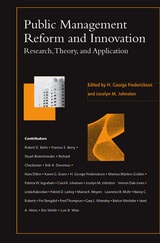
Public Management Reform and Innovation
Research, Theory, and ApplicationH. George Frederickson
University of Alabama Press, 1999
A foundational examination of how research, theory, and innovation shape effective public management and democratic governance.
The subject of reform in the public sector is not new; indeed, its latest rubric, reinventing government, has become good politics. Still, as the contributors ask in this volume, is good politics necessarily good government?
Given the growing desire to reinvent government, there are hard questions to be asked: Is the private sector market model suitable and effective when applied to reforming public and governmental organizations? What are the major political forces affecting reform efforts in public management? How is public management reform accomplished in a constitutional democratic government? How do the values of responsiveness, professionalism, and managerial excellence shape current public management reforms? In this volume, editors H. George Frederickson and Jocelyn M. Johnston bring together scholars with a shared interest in empirical research to confront head-on the toughest questions public managers face in their efforts to meet the demands of reform and innovation.
Throughout the book, the authors consider the bureaucratic resistance that results when downsizing and reinvention are undertaken simultaneously, the dilemma public managers face when elected executives set a reform agenda that runs counter to the law, and the mistaken belief that improved management can remedy flawed policy.