Results by title
4 books match the query 'Fredman, Stephen'
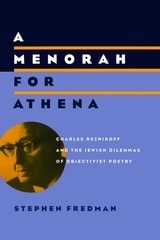
A Menorah for Athena
Charles Reznikoff and the Jewish Dilemmas of Objectivist PoetryStephen Fredman
University of Chicago Press, 2001
Stephen Fredman illuminates the relationship of Jewish intellectuals to modernity through a close look at Reznikoff's life and writing. He shows that when we regard the Objectivists as modern Jewish poets, we can see more clearly their distinctiveness as modernists and the reasons for their profound impact upon later poets, such as Allen Ginsberg and Charles Bernstein. Fredman also argues that to understand Reznikoff's work more completely, we must see it in the context of early, nonsectarian attempts to make the study of Jewish culture a force in the construction of a more pluralistic society. According to Fredman, then, the indelible images in Reznikoff's poetry open a window onto the vexed but ultimately successful entry of Jewish immigrants and their children into the mainstream of American intellectual life.
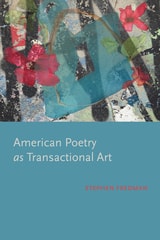
American Poetry as Transactional Art
Stephen Fredman
University of Alabama Press, 2020
Explores the ways American poetry engages with visual art, music, fiction, spirituality, and performance art
Many people think of poetry as a hermetic art, as though poets wrote only about themselves or as if the subject of poetry were finally only poetry—its forms and traditions. Indeed much of what constitutes poetry in the lyric tradition depends on a stringently controlled point of view and aims for a timeless, intransitive utterance. Stephen Fredman’s study proposes a different perspective.
American Poetry as Transactional Art explores a salient quality of much avant-garde American poetry that has so far lacked sustained treatment: namely, its role as a transactional art. Specifically Fredman describes this role as the ways it consistently engages in conversation, talk, correspondence, going beyond the scope of its own subjects and forms—its existential interactions with the outside world. Poetry operating in this vein draws together images, ideas, practices, rituals, and verbal techniques from around the globe, and across time—not to equate them, but to establish dialogue, to invite as many guests as possible to the World Party, which Robert Duncan has called the “symposium of the whole.”
Fredman invites new readers into contemporary poetry by providing lucid and nuanced analyses of specific poems and specific interchanges between poets and their surroundings. He explores such topics as poetry’s transactions with spiritual traditions and practices over the course of the twentieth century; the impact of World War II on the poetry of Charles Olson and George Oppen; exchanges between poetry and other art forms including sculpture, performance art, and ambient music; the battle between poetry and prose in the early work of Paul Auster and in Lyn Hejinian’s My Life. The epilogue looks briefly at another crucial transactional occasion: teaching American poetry in the classroom in a way that demonstrates that it is at the center of the arts and at the heart of American culture.
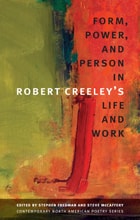
Form, Power, and Person in Robert Creeley’s Life and Work
Stephen Fredman
University of Iowa Press, 2010
By any measure—international reputation, influence upon fellow writers and later generations, number of books published, scholarly and critical attention—Robert Creeley (1926–2005) is a literary giant, an outstanding, irreplaceable poet. For many decades readers have remarked upon the almost harrowing emotional nakedness of Creeley’s writing. In the years since his death, it may be that the disappearance of the writer allows that nakedness to be observed more readily and without embarrassment.
Written by the foremost critics of his poetry, Form, Power, and Person in Robert Creeley’s Life and Work is the first book to treat Creeley’s career as a whole. Masterfully edited by Stephen Fredman and Steve McCaffery, the essays in this collection have been gathered into three parts. Those in “Form” consider a variety of characteristic formal qualities that differentiate Creeley from his contemporaries. In “Power,” writers reflect on the pressure exerted by emotions, gender issues, and politics in Creeley’s life and work. In “Person,” Creeley’s unique artistic and psychological project of constructing a person—reflected in his correspondence, teaching, interviews, collaborations, and meditations on the concept of experience—is excavated. While engaging these three major topics, the authors remain, as Creeley does, intent upon the ways such issues appear in language, for Creeley’s nakedness is most conspicuously displayed in his intimate relationship with words.
Contributors
Charles Altieri
Rachel Blau DuPlessis
Stephen Fredman
Benjamin Friedlander
Alan Golding
Michael Davidson
Steve McCaffery
Peter Middleton
Marjorie Perloff
Peter Quartermain
Libbie Rifkin
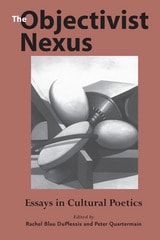
The Objectivist Nexus
Essays in Cultural PoeticsPeter Quartermain
University of Alabama Press, 1999
Outstanding poets and critics present cultural readings of the Objectivist poets, a group whose works have been largely unexamined.
"Objectivist" writers, conjoined through a variety of personal, ideological, and literary-historical links, have, from the late 1920s to the present, attracted emulation and suspicion. Representing a nonsymbolist, postimagist poetics and characterized by a historical, realist, antimythological worldview, Objectivists have retained their outsider status. Despite such status, however, the formal, intellectual, ideological, and ethical concerns of the Objectivist nexus have increasingly influenced poetry and poetics in the United States.
Thus, argue editors Rachel Blau DuPlessis and Peter Quartermain, the time has come for an anthology that unites essential works on Objectivist practices and presents Objectivist writing as an enlargement of the possibilities of poetry rather than as a determinable and definable literary movement. The authors' collective aim is to bring attention to this group of poets and to exemplify and specify cultural readings for poetic texts--readings alert to the material world, politics, society, and history, and readings concerned with the production, dissemination, and reception of poetic texts.
The contributors consider Basil Bunting, Lorine Niedecker, George Oppen, Carl Rakosi, Charles Reznikoff, and Louis Zukofsky within both their historical milieu and our own. The essays insist on poetry as a mode of thought; analyze and evaluate Objectivist politics; focus on the ethical, spiritual, and religious issues raised by certain Objectivist affiliations with Judaism; and explore the dissemination of poetic texts and the vagaries of Objectivist reception. Running throughout the book are two related threads: Objectivist writing as generally a practice aware of its own historical and social contingency and Objectivist writing as a site of complexity, contestation, interrogation, and disagreement.