Results by title
2 books match the query 'Free Press'
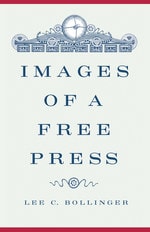
Images of a Free Press
Lee C. Bollinger
University of Chicago Press, 1991
Rich in historical detail, Images of a Free Press is an elegant, powerful guide to the evolution of our modern conception of freedom of the press, which finds expression in laws that protect print journalism and regulate broadcast media. Bollinger argues that this distinction remains meaningful but he advocates a more sophisticated approach to issues of privacy, access, and technology. Providing concrete guidelines for improving media laws, Images of a Free Press is a vital First Amendment primer for lawyers, media professionals, and critics, and all concerned citizens.
"Images of a Free Press is the natural sequel to Lee Bollinger's first book, The Tolerant Society, and is destined to become a standard in first amendment scholarship."—Rodney A. Smolla, Constitutional Commentary
"Revisiting themes he first explored some fifteen years ago, Bollinger now adds further to our understanding of the complex relationship among the First Amendment, the Supreme Court, the public, the press and the democratic process. This is a work of insight, sensitivity, and power. Bollinger has a profound knowledge of and a deep affection for his subject, and it shows."—Geoffrey R. Stone, Michigan Law Review
"This thoughtful, understated book remains a call to come join the town meeting and hammer out some new rules of order. Scholars and citizens alike could do well to read Bollinger's book and accept his challenge."—Yale Law Review
"For a number of years, Lee Bollinger has argued that the First Amendment has been applied differently to the print media than it has been to the broadcast media. In his new book, Images of a Free Press, Bollinger provides a concise, persuasive account of why this is so—and why it ought to be so."—Columbia Law Review
[more]
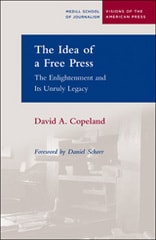
The Idea of a Free Press
The Enlightenment and Its Unruly LegacyDavid Copeland
Northwestern University Press, 2006
With the introduction of the printing press in England in 1476, a struggle over its control--and its potential for interrupting power--was joined. The written word, once the domain of the upper levels of society that controlled politics, economics, and religion, could be seen passing into the hands of anyone throughout the social strata who wished to voice opinions on any topic of interest or importance. How the advent of printing led to the idea of a free press is the story told by David Copeland in this book, which traces a confrontation that began with issues of religion and gradually expanded into the realm of political freedom.
The rise of a free press was, in many ways, a legacy of the Reformation and Enlightenment. Copeland describes a discourse centered on questions of religion--a discussion that the government, with all its religious authority, could not suppress because of the belief that the ability to reason for oneself was God-given. In this account we see how the debate moved from religion to the purely political sphere, and how, through the increased use of the printing press, it was opened to a multiplicity of voices and opinions. Spanning nearly four centuries in Britain and America, Copeland's book reveals how the tension between government control and the right to debate public affairs openly ultimately led to the idea of a free press; in doing so, it documents an intellectual development of unparalleled relevance and importance to the history of journalism.
The rise of a free press was, in many ways, a legacy of the Reformation and Enlightenment. Copeland describes a discourse centered on questions of religion--a discussion that the government, with all its religious authority, could not suppress because of the belief that the ability to reason for oneself was God-given. In this account we see how the debate moved from religion to the purely political sphere, and how, through the increased use of the printing press, it was opened to a multiplicity of voices and opinions. Spanning nearly four centuries in Britain and America, Copeland's book reveals how the tension between government control and the right to debate public affairs openly ultimately led to the idea of a free press; in doing so, it documents an intellectual development of unparalleled relevance and importance to the history of journalism.
[more]