Results by title
5 books match the query 'Free Society'

Free Society and Moral Crisis
Robert Cooley Angell
University of Michigan Press, 1958

Jewish Continuity in America
Creative Survival in a Free SocietyAbraham J. Karp
University of Alabama Press, 1998
Presents an overview of a life's work by a preeminent scholar and brings new insight to the challenge of American Jewish continuity
Jews have historically lived within a paradox of faith and fear: faith that they are an eternal people and fear that their generation may be the last. In the United States, the Jewish community has faced to a heightened degree the enduring question of identity and assimilation: How does the Jewish community in this free, open, pluralistic society discover or create factors-both ideological and existential-that make group survival beneficial to the larger society and rewarding to the individual Jew?
Abraham J. Karp's Jewish Continuity in America focuses on the three major sources of American Judaism's continuing vitality: the synagogue, the rabbinate, and Jewish religious pluralism. Particularly illuminating is Karp's examination of the coexistence and unity-in-diversity of American religious Jewry's three divisions-Orthodox, Reform, and Conservative-and of how this Jewish religious pluralism fits into the larger picture of American religious pluralism.
Informing the larger enterprise through sharp and full delineation of discrete endeavors, the essays collected in Jewish Continuity in America-some already acknowledged as classics, some appearing here for the first time-describe creative individual and communal responses to the challenge of Jewish survival. As the title suggests, this book argues that continuity in a free and open society demands a high order of creativity, a creativity that, to be viable, must be anchored in institutions wholly pledged to continuity.
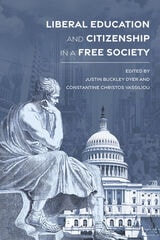
Liberal Education and Citizenship in a Free Society
Justin Buckley Dyer
University of Missouri Press, 2023
With Liberal Education and Citizenship in a Free Society, a collection of 19 original essays, editors Justin Dyer and Constantine Vassiliou present the work of a diverse group of scholars to assess the value of a liberal arts education in the face of market, technological, cultural, and political forces shaping higher learning today.
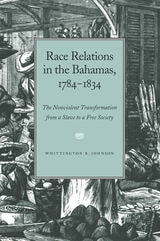
Race Relations in the Bahamas, 1784-1834
The Nonviolent Transformation from a Slave to a Free SocietyWhittington Johnson
University of Arkansas Press, 2000
This deeply researched, clearly written book is a history of black society and its relations with whites in the Bahamas from the close of the American Revolution to emancipation. Whittington B. Johnson examines the communities developed by free, bonded, and mixed-race blacks on the islands as British colonists and American loyalists unsuccessfully tried to establish a plantation economy. The author explores how relations between the races developed civilly in this region, contrasting it with the harsher and more violent experiences of other Caribbean islands and the American South.
Interpreting church documents and Colonial Office papers in a new light, Johnson presents a more favorable conclusion than previously advanced about the conditions endured by victims of the African Diaspora and by Creoles in the Bahama Islands. He makes use of an impressive and important body of archival and secondary research. Race Relations in the Bahamas will be a book of great interest to southern historians, historians of slave societies and black communities, scholars of race relations, and general readers.

The Social Programs of Sweden
A Search for Security in a Free SocietyAlbert H. RosenthalForeword by Marquis Childs
University of Minnesota Press, 1967
The Social Programs of Sweden was first published in 1967. Minnesota Archive Editions uses digital technology to make long-unavailable books once again accessible, and are published unaltered from the original University of Minnesota Press editions.
In his forward to this book, Marquis Childs, author of the classic work Sweden: The Middle Way,comments: "There has been a great deal of emotional writing about the effort of the labor government in Stockholm to regulate capitalism and provide a decent standard of living for every citizen. Much of this emotional writing has come from those who for one reason or another have sought to discredit the Swedish experiment ... The net result of much of this highly colored writing has been to ignore the real contribution that Sweden has made in a half dozen fields and particularly in the fields of social security and health. But now comes an author ideally equipped to appraise this contribution by reason of his background. This is the great virtue of this book. It is a careful and thorough examination of Sweden's achievement by a specialist familiar with our own social security, public health and welfare systems ... No subsequent appraisal of what Sweden has done can be made henceforth without this basic work."
The author traces the development of the Swedish programs and provides detailed descriptions of the social security, health insurance, public health, and welfare programs, with case examples. He evaluates and compares the programs with their American counterparts, and, in conclusion, considers the effects of the Swedish system on personal freedom. The work is based on extensive research done in Sweden.