Results by title
2 books match the query 'Freedom Is'
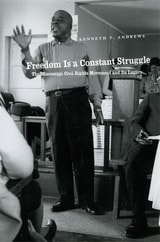
Freedom Is a Constant Struggle
The Mississippi Civil Rights Movement and Its LegacyKenneth T. Andrews
University of Chicago Press, 2004
No part of the United States was more resistant to the civil rights movement and its pursuit of racial equality than Mississippi. Freedom Is a Constant Struggle explores the civil rights movement in that state to consider its emergence before the 1965 Voting Rights Act and its impact long after. Did the civil rights movement have a lasting impact, and, if so, how did it bring about change? Kenneth T. Andrews is the first scholar to examine not only the history of the movement but its social and political legacy as well. His study demonstrates how during the 1970s and '80s, local movements worked to shape electoral politics, increase access to better public schools, and secure the administration of social welfare to needy African Americans.
Freedom Is a Constant Struggle is also the first book of its kind to detail the activities of white supremacists in Mississippi, revealing how white repression and intimidation sparked black activism and simultaneously undermined the movement's ability to achieve far-reaching goals. Andrews shows that the federal government's role was important but reactive as federal actors responded to the sustained struggles between local movements and their opponents. He tracks the mobilization of black activists by the NAACP, the creation of Freedom Summer, efforts to galvanize black voters, the momentous desegregation of public schools and the rise of all-white private academies, and struggles over the economic development of black communities. From this complex history, Andrews shows how the civil rights movement built innovative organizations and campaigns that empowered local leadership and had a lasting legacy in Mississippi and beyond.
Based on an original and creative research design that combines extensive archival research, interviews with activists, and quantitative historical data, Freedom Is a Constant Struggle provides many new insights into the civil rights struggle, and it presents a much broader theory to explain whether and how movements have enduring impacts on politics and society. What results is a work that will be invaluable to students of social movements, democratic politics, and the struggle for racial freedom in the U.S.
[more]
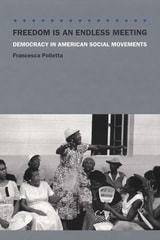
Freedom Is an Endless Meeting
Democracy in American Social MovementsFrancesca Polletta
University of Chicago Press, 2002
Freedom Is an Endless Meeting offers vivid portraits of American experiments in participatory democracy throughout the twentieth century. Drawing on meticulous research and more than one hundred interviews with activists, Francesca Polletta challenges the conventional wisdom that participatory democracy is worthy in purpose but unworkable in practice. Instead, she shows that social movements have often used bottom-up decision making as a powerful tool for political change.
Polletta traces the history of democracy in early labor struggles and pre-World War II pacifism, in the civil rights, new left, and women's liberation movements of the sixties and seventies, and in today's faith-based organizing and anti-corporate globalization campaigns. In the process, she uncovers neglected sources of democratic inspiration—Depression-era labor educators and Mississippi voting registration workers, among them—as well as practical strategies of social protest. But Freedom Is an Endless Meeting also highlights the obstacles that arise when activists model their democracies after familiar nonpolitical relationships such as friendship, tutelage, and religious fellowship. Doing so has brought into their deliberations the trust, respect, and caring typical of those relationships. But it has also fostered values that run counter to democracy, such as exclusivity and an aversion to rules, and these have been the fault lines around which participatory democracies have often splintered. Indeed, Polletta attributes the fragility of the form less to its basic inefficiency or inequity than to the gaps between activists' democratic commitments and the cultural models on which they have depended to enact those commitments. The challenge, she concludes, is to forge new kinds of democratic relationships, ones that balance trust with accountability, respect with openness to disagreement, and caring with inclusiveness.
For anyone concerned about the prospects for democracy in America, Freedom Is an Endless Meeting will offer abundant historical, theoretical, and practical insights.
"This is an excellent study of activist politics in the United States over the past century. . . . Assiduously researched, impressively informed by a great number of thoughtful interviews with key members of American social movements, and deeply engaged with its subject matter, the book is likely to become a key text in the study of grass-roots democracy in America."—Kate Fullbrook, Times Literary Supplement
"Polletta's portrayal challenges the common assumption that morality and strategy are incompatible, that those who aim at winning must compromise principle while those who insist on morality are destined to be ineffective. . . . Rather than dwell on trying to explain the decline of 60s movements, Polletta shows how participatory democracy has become the guiding framework for many of today's activists."—Richard Flacks, Los Angeles Times Book Review
"In Freedom Is an Endless Meeting, Francesca Polletta has produced a remarkable work of historical sociology. . . . She provides the fullest theoretical work of historical sociology. . . . She provides the fullest theoretical picture of participatory democracy, rich with nuance, ambiguity, and irony, that this reviewer has yet seen. . . . This wise book should be studied closely by both academics and by social change activists."—Stewart Burns, Journal of American History
[more]