Results by title
5 books match the query 'Fremont culture'
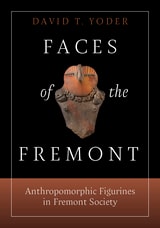
Faces of the Fremont
Anthropomorphic Figurines in Fremont SocietyDavid T. Yoder
University of Utah Press, 2025
The Fremont culture is famous for its anthropomorphic figurines—small clay figures occasionally dressed in clothing and decorated with jewelry—but surprisingly, archaeologists know very little about these important artifacts and their place in Fremont society. In Faces of the Fremont, the largest study of the subject ever undertaken, David T. Yoder takes a straightforward approach to cultural commentary through artifactual analysis as he interprets over 800 figurines and anthropomorphic objects.
Unlike previous research on the subject, this volume explores neglected topics within Fremont studies, including sex and gender, clothing and body decoration, hairstyles, and childhood. Complete with in-depth analysis and interpretation of the significance of the figurines to the Fremont people, as well as hundreds of beautiful color photographs, Faces of the Fremont provides a nuanced understanding of figurine manufacture, formalizes a classification system for figurine traits, and documents new and interesting geographic and temporal patterns.
The Ancient Culture of the Fremont River in Utah
Report on the Explorations under the Claflin-Emerson Fund, 1928-1929Noel Morss
University of Utah Press, 2009
One such survey was conducted by author Noel Morss during the summer of 1928, resulting in an unexpected revelation: the Fremont (Dirty Devil) River drainage area being surveyed proved to be host to a prehistoric culture different from all other established Southwestern cultures. Excavations completed the following field season confirmed Morss’s findings. This distinct culture was defined by unique unpainted black or gray pottery, sole use of a primitive moccasin type, elaborate clay figurines, and abundant distinctive pictographs. Though too definite and well developed to be confined to a single drainage, Morss concluded that the Fremont were nonetheless a periphery culture and not an integral part of the mainstream of Southwestern development.
Originally published in 1931 and now featuring a new foreword by Duncan Metcalfe, The Ancient Culture of the Fremont River in Utah has become a classic in Southwestern archaeology, furthering a conversation about the early peoples of southern Utah that continues even today.
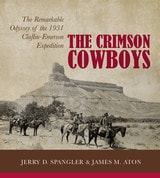
The Crimson Cowboys
The Remarkable Odyssey of the 1931 Claflin-Emerson ExpeditionJerry D. Spangler and James M. Aton
University of Utah Press, 2018
In 1931 a group from Harvard University’s Peabody Museum accomplished something that had never been attempted in the history of American archaeology: a six-week, four-hundred-mile horseback survey of Fremont prehistoric sites through some of the West’s most rugged terrain. The expedition was successful, but a report on the findings was never completed. What should have been one of the great archaeological stories in American history was relegated to boxes and files in the basement of the Peabody Museum at Harvard.
Now, based on over a thousand pages of documents (field journals, correspondence, and receipts) and over four hundred photographs, this book recounts the remarkable day-to-day adventures of this crew of one professor, five students, and three Utah guides who braved heat, fatigue, and the dangerous canyon wilderness to reveal vestiges of the Fremont culture in the Tavaputs Plateau and Uinta Basin areas. To better tell this story, authors Spangler and Aton undertook extensive fieldwork to confirm the sites; their recent photographs and those of the original expedition are shared on these pages. This engaging narrative situates the 1931 survey and its discoveries within the history of American archaeology.
Click here for a podcast with the APEX hour and Jim Aton about The Crimson Cowboys.
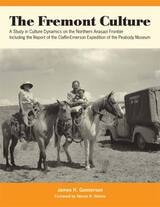
The Fremont Culture
A Study in Culture Dynamics on the Northern Anasazi Frontier, including the Report of the Claflin-Emerson Expedition of the Peabody MuseumJames H Gunnerson
University of Utah Press, 2009
Early expedition surveys and excavations conducted by Noel Morss would lead to a definition of the Fremont culture; later research would augment existing data on the Fremont by adding entirely new traits, disclosing new variations in architecture and basketry, and providing new information on the distribution of previously known traits.
In The Fremont Culture: A Study in Culture Dynamics on the Northern Anasazi Frontier, archaeologist James H. Gunnerson provides the results of his 1950s survey and excavation in the Utah area. He presents a functional synthesis of the Fremont culture and discusses the dynamics of its growth and decline.
Gunnerson’s report also uses the original field notes, maps, plans, photographs, sketches, and unpublished preliminary reports of the Claflin-Emerson expedition. Together, the reports of Morss and Gunnerson offer the most important and complete overview of the expedition available. They are fitting tributes to the men of that expedition, scientists who recognized the importance of an ancient people who once wrested a meager living from the rugged canyon country of the Green and Colorado Rivers.
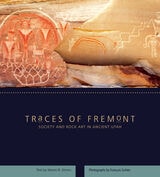
Traces of Fremont
Society and Rock Art in Ancient UtahSteven R. Simms, Photography by François Gohier
University of Utah Press, 2010
Fremont is a culture (ca. 300–1300 A.D.) first defined by archaeologist Noel Morss in 1928 based on characteristics unique to the area. Initially thought to be a simple socio-political system, recent reassessments of the Fremont assume a more complex society. This volume places Fremont rock art studies in this contemporary context. Author Steven Simms offers an innovative model of Fremont society, politics, and worldview using the principles of analogy and current archaeological evidence. Simms takes readers on a trip back in time by describing what a typical Fremont hamlet or residential area might have looked like a thousand years ago, including the inhabitants' daily activities. François Gohier's captivating photographs of Fremont art and artifacts offer an engaging complement to Simms's text, aiding us in our understanding of the lives of these ancient people.
Winner of the Utah Book Award in Nonfiction.
Winner of the Society for American Archaeology Book Award for Public Audience.