Results by title
3 books match the query 'French Regime'

Kaskaskia Under the French Regime
Natalia Maree Belting. Foreword by Carl J. Ekberg
Southern Illinois University Press, 2003
“The Illinois Habitant,” writes Natalia Maree Belting, “was a gay soul; he seemed shockingly carefree to later, self-righteous puritans from the American colonies. He danced on Sunday after mass, was passionately attached to faro and half a dozen other card games, and played billiards at all hours. He gossiped long over a friendly pipe and congenial mug of brandy in the half-dusk of his porch or in the noisy tavern.”
First published in 1948, Kaskaskia under the French Regime is a social and economic history of French Kaskaskia from 1703 to 1765. Using a readable, journalistic style, Belting brings to life the prairie terrain, the Kaskaskia mission, early architecture, building methods and materials, the beginnings of government, domestic tools and utensils, commerce, and the social customs of the pioneer.
In 1703, Kaskaskia was little more than a mission station in Illinois territory inhabited by a few French traders, their Indian wives, and a priest. Later in the century, the settlement became a flourishing French village filled with rows of low one-story French-style houses lining the streets. But the unique native and French bonds began when the explorers Louis Joliet and Pierre Marquette discovered a peaceful tribe, the Kaskaskia, while journeying along the Illinois River.
This historic friendship grew into a unique colonial culture, the remnants which can be seen through numerous primary source documents. Belting draws on and translates from eighteenth century French the Kaskaskia Manuscripts, in which French notaries recorded parish marriage contracts, property transactions (including slave sales), and estate inventories. She also examines the papers of the Marquis de Vaudreuil, among them the most complete census ever conducted in French Illinois, which provides a household-by-household enumeration of the population. What results is a comprehensive depiction of the lives and livelihood of French settlers in colonial Illinois.
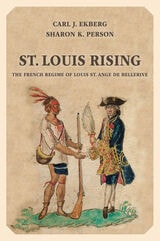
St. Louis Rising
The French Regime of Louis St. Ange de BelleriveCarl J. Ekberg and Sharon K. Person
University of Illinois Press, 2015
Drawing on new source materials, the authors delve into the complexities of politics, Indian affairs, slavery, and material culture that defined the city's founding period. Their alternative version of the oft-told tale uncovers the imperial realities--as personified by St. Ange--that truly governed in the Illinois Country of the time, and provide a trove of new information on everything from the fur trade to the arrival of the British and Spanish after the Seven Years' War.

The Commerce of Louisiana During the French Regime, 1699-1763
N. M. Miller Surrey, with an introduction by Gregory A. Waselkov
University of Alabama Press, 2006
By the time French colonists sought a portion of the New World’s riches, much of those resources had already been claimed by Spain and Portugal. Once settled in North America, however, they quickly turned their attentions to commerce, specifically to trade within the Louisiana region. For almost 65 years French explorers, soldiers, administrators, and accountants focused on establishing a string of forts and small villages at key points in the Mississippi and Illinois River valleys, eastward to the Mobile River drainage, and westward toward New Mexico. Despite a long and costly war at home, for a time it looked as though the French would be successful in controlling a vast swath of the middle of North America with routes stretching from Quebec City to New Orleans.
Under the guidance of leaders such as LaSalle, Joliet, Father Marquette, Frontenac, Hennepin, and Bienville, the French made a good start in the lucrative trading business and established working relationships with most of the Indians of the region. But by 1763, with war in Europe and a faltering economy at home, commerce in the New World eroded along with the ability of the French to control the region and to protect their investments from the encroachment of the Spanish and English.