Results by title
5 books match the query 'French-Canadians'
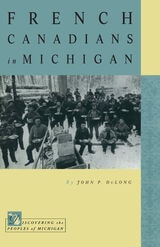
French Canadians in Michigan
John P. DuLong
Michigan State University Press, 2001
As the first European settlers in Michigan, the French Canadians left an indelible mark on the place names and early settlement patterns of the Great Lakes State. Because of its importance in the fur trade, many French Canadians migrated to Michigan, settling primarily along the Detroit- Illinois trade route, and throughout the fur trade avenues of the Straits of Mackinac. When the British conquered New France in 1763, most Europeans in Michigan were Francophones. John DuLong explores the history and influence of these early French Canadians, and traces, as well, the successive 19th- and 20th-century waves of industrial migration from Quebec, creating new communities outside the old fur trade routes of their ancestors.

La Nouvelle France
The Making of French Canada - A Cultural HistoryPeter N. Moogk
Michigan State University Press, 2000
On one level, Peter Moogk's latest book, La Nouvelle France: The Making of French Canada—A Cultural History, is a candid exploration of the troubled historical relationship that exists between the inhabitants of French- and English- speaking Canada. At the same time, it is a long- overdue study of the colonial social institutions, values, and experiences that shaped modern French Canada. Moogk draws on a rich body of evidence—literature; statistical studies; government, legal, and private documents in France, Britain, and North America— and traces the roots of the Anglo-French cultural struggle to the seventeenth century. In so doing, he discovered a New France vastly different from the one portrayed in popular mythology. French relations with Native Peoples, for instance, were strained. The colony of New France was really no single entity, but rather a chain of loosely aligned outposts stretching from Newfoundland in the east to the Illinois Country in the west.
Moogk also found that many early immigrants to New France were reluctant exiles from their homeland and that a high percentage returned to Europe. Those who stayed, the Acadians and Canadians, were politically conservative and retained Old Régime values: feudal social hierarchies remained strong; one's individualism tended to be familial, not personal; Roman Catholicism molded attitudes and was as important as language in defining Acadian and Canadian identities. It was, Moogk concludes, the pre-French Revolution Bourbon monarchy and its institutions that shaped modern French Canada, in particular the Province of Quebec, and set its people apart from the rest of the nation.

Loyal but French
The Negotiation of Identity by French-Canadian Descendants in the United StatesMark Paul Richard
Michigan State University Press, 2008
Richard’s work challenges prevailing notions of "assimilation." As he shows, “acculturation” better describes the roundabout process by which some ethnic groups join their host society. He argues that, for more than a century, the French- Canadians in Lewiston, Maine, pursued the twin objectives of ethnic preservation and acculturation. These were not separate goals but rather intertwined processes. Underscored with statistics compiled by the author, Loyal but French portrays the French-Canadian history of Lewiston, from the 1880s through the 1990s, in this light.
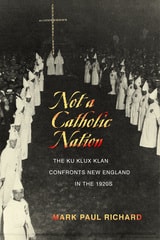
Not a Catholic Nation
The Ku Klux Klan Confronts New England in the 1920sMark Paul Richard
University of Massachusetts Press, 2015
Drawing on a wide range of previously untapped sources—French-language newspapers in the New England–Canadian borderlands; KKK documents scattered in local, university, and Catholic repositories; and previously undiscovered copies of the Maine Klansmen—Richard demonstrates that the Klan was far more active in the Northeast than previously thought. He also challenges the increasingly prevalent view that the Ku Klux Klan became a mass movement during this period largely because it functioned as a social, fraternal, or civic organization for many Protestants. While Richard concedes that some Protestants in New England may have joined the KKK for those reasons, he shows that the politics of ethnicity and labor played a more significant role in the Klan's growth in the region.
The most comprehensive analysis of the Ku Klux Klan's antagonism toward Catholics in the 1920s, this book is also distinctive in its consideration of the history of the Canada–U.S. borderlands, particularly the role of Canadian immigrants as both proponents and victims of the Klan movement in the United States.

The French-Canadian Heritage in New England
Gerard J. Brault
University Press of New England, 1986