Results by title
2 books match the query 'Frentz, Thomas S.'
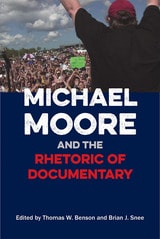
Michael Moore and the Rhetoric of Documentary
Edited by Thomas W. Benson and Brian J. Snee
Southern Illinois University Press, 2015
Not afraid to tackle provocative topics in American culture, from gun violence and labor policies to terrorism and health care, Michael Moore has earned both applause and invective in his career as a documentarian. In such polarizing films as Bowling for Columbine, Fahrenheit 9/11, and Sicko, Moore has established a unique voice of radical nostalgia for progressivism, and in doing so has become one of the most recognized documentary filmmakers of all time.
In the first in-depth study of Moore’s feature-length documentary films, editors Thomas W. Benson and Brian J. Snee have gathered leading rhetoric scholars to examine the production, rhetorical appeals, and audience reception of these films. Contributors critique the films primarily as modes of public argument and political art. Each essay is devoted to one of Moore’s films and traces in detail how each film invites specific audience responses.
Michael Moore and the Rhetoric of Documentary reveals not only the art, the argument, and the emotional appeals of Moore’s documentaries but also how these films have revolutionized the genre of documentary filmmaking.
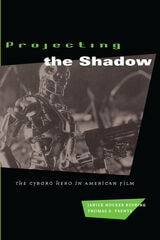
Projecting the Shadow
The Cyborg Hero in American FilmJanice Hocker Rushing and Thomas S. Frentz
University of Chicago Press, 1995
Through in-depth examinations of six representative films—Jaws, The Deer Hunter, The Manchurian Candidate, Blade Runner, The Terminator, and Terminator 2—Rushing and Frentz track the narrative's thread from the hunter to his technological nemesis, demonstrating how each film represents an unfolding hunter myth.
For each movie, Rushing and Frentz show how uninitiated male hunters slowly lose control over their weapons. In Jaws, a 'soft' man, dominated by technology, can re-acquire the heroic hunter qualities he needs by teaming up with a 'savage' man and a 'technological' man. In doing so, he can still conquer the prey. The Manchurian Candidate charts how technology can turn a human into a weapon; Blade Runner perfects the artificial human with its manufactured replicants who are "more than human"; and The Terminator introduces a female hunter who leads humanity in its struggle against technology.