Results by title
2 books match the query 'Freshwater ecology'

Freshwater Marshes
Ecology and Wildlife ManagementMilton W. Weller
University of Minnesota Press, 1994
Freshwater Marshes was first published in 1994. Minnesota Archive Editions uses digital technology to make long-unavailable books once again accessible, and are published unaltered from the original University of Minnesota Press editions.
Prairie potholes, wetland edges of lakes and rivers, and other freshwater marshes play a vital role in maintaining a clean and plentiful water supply for wildlife and human use. These wetland areas provide habitat for spawning fish, feed waterfowl, purify and retain water, and control erosion. In this updated third edition, Milton W. Weller describes the components of the freshwater marsh: its annual and seasonal dynamics as affected by rainfall cycles and the plant and animal population's response to such changes. Weller discusses how such wetland areas are managed for wildlife populations and diversity, and how such processes can be used in wetland conservation and restoration. He considers the impact society has on wetlands and offers conservation goals for freshwater wetland complexes.
Weller broadens the third edition to include an analysis of how prairie wetlands compare in water dynamics with swamps, tidal marshes, and other wetlands. He also expands the discussion of wetland classification, evaluation, mitigation, and restoration, and introduces a new glossary of current wetland terminology.Freshwater Marshes is Volume 1 of Wildlife Habitats.
Milton W. Weller is professor emeritus and former Kleberg Chair in Wildlife Ecology, at Texas A&M University.
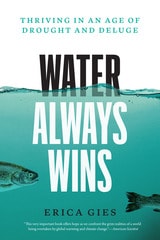
Water Always Wins
Thriving in an Age of Drought and DelugeErica Gies
University of Chicago Press, 2022
Nearly every human endeavor on the planet was conceived and constructed with a relatively stable climate in mind. But as new climate disasters remind us every day, our world is not stable—and it is changing in ways that expose the deep dysfunction of our relationship with water. Increasingly severe and frequent floods and droughts inevitably spur calls for higher levees, bigger drains, and longer aqueducts. But as we grapple with extreme weather, a hard truth is emerging: our development, including concrete infrastructure designed to control water, is actually exacerbating our problems. Because sooner or later, water always wins.
In this quietly radical book, science journalist Erica Gies introduces us to innovators in what she calls the Slow Water movement who start by asking a revolutionary question: What does water want? Using close observation, historical research, and cutting-edge science, these experts in hydrology, restoration ecology, engineering, and urban planning are already transforming our relationship with water.
Modern civilizations tend to speed water away, erasing its slow phases on the land. Gies reminds us that water’s true nature is to flex with the rhythms of the earth: the slow phases absorb floods, store water for droughts, and feed natural systems. Figuring out what water wants—and accommodating its desires within our human landscapes—is now a crucial survival strategy. By putting these new approaches to the test, innovators in the Slow Water movement are reshaping the future.