Results by title
7 books match the query 'Fried, Michael'
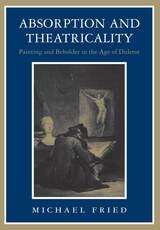
Absorption and Theatricality
Painting and Beholder in the Age of DiderotMichael Fried
University of Chicago Press, 1988
"A reinterpretation supported by immense learning and by a series of brilliantly perceptive readings of paintings and criticism alike. . . . An exhilarating book."—John Barrell, London Review of Books
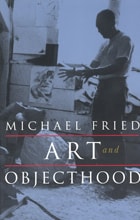
Art and Objecthood
Essays and ReviewsMichael Fried
University of Chicago Press, 1998
Ranging from brief reviews to extended essays, and including major critiques of Jackson Pollock, Morris Louis, Kenneth Noland, Jules Olitski, Frank Stella, and Anthony Caro, these writings establish a set of basic terms for understanding key issues in high modernism: the viability of Clement Greenberg’s account of the infralogic of modernism, the status of figuration after Pollock, the centrality of the problem of shape, the nature of pictorial and sculptural abstraction, and the relationship between work and beholder. In a number of essays Fried contrasts the modernist enterprise with minimalist or literalist art, and, taking a position that remains provocative to this day, he argues that minimalism is essentially a genre of theater, hence artistically self-defeating.
For this volume Fried has also provided an extensive introductory essay in which he discusses how he became an art critic, clarifies his intentions in his art criticism, and draws crucial distinctions between his art criticism and the art history he went on to write. The result is a book that is simply indispensable for anyone concerned with modernist painting and sculpture and the task of art criticism in our time.
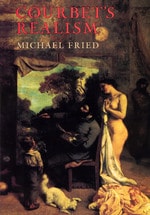
Courbet's Realism
Michael Fried
University of Chicago Press, 1990
Courbet's Realism is clearly a major contribution to the highly active field of Courbet studies. . . . But to contribute here and now is necessarily also to contribute to central debates about art history itself, and so the book is also—I hesitate to say 'more importantly,' because of the way object and method are woven together in it—a major contribution to current attempts to rethink the foundations and objects of art history. . . . It will not be an easy book to come to terms with; for all its engagement with contemporary literary theory and related developments, it is not an application of anything, and its deeply thought-through arguments will not fall easily in line with the emerging shapes of the various 'new art histories' that tap many of the same theoretical resources. At this moment, there may be nothing more valuable than such a work."—Stephen Melville, Art History

Gustave Caillebotte and the Fashioning of Identity in Impressionist Paris
Edited by Norma Broude
Rutgers University Press, 2002
The essays that comprise this volume exemplify the best aspects of recent Caillebotte scholarship. They employ a variety of perspectives to examine the ways in which his art sheds light on the formation of individual and class identities in Paris during the early years of the Third Republic—an era of transition marked by the burgeoning of capitalism and the instabilities of newly shifting gender roles in the modern world.
Addressing a wide range of major paintings by Caillebotte, the contributors reveal the compound ways in which the artist encoded his images and the multiple interpretations to which these images are susceptible. Juxtaposed so as to complement and challenge one another, these essays build a provocative whole as they probe issues of spectatorship and authorial intention. The contributors—all internationally known scholars and art professionals—create an important theoretical framework for the discussion of Caillebotte’s work.
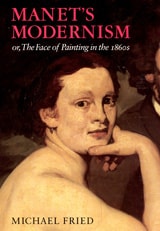
Manet's Modernism
or, The Face of Painting in the 1860sMichael Fried
University of Chicago Press, 1996
"Beautifully produced. . . . [Fried's] thought is always stimulating, if not provocative. This is an important book, which all students of modernism, in the broadest sense, will find rewarding."—Virginia Quarterly Review
"An astonishing piece of scholarship that will cause readers to rethink their understanding of Manet's influence, ambition, and achievement."—Gary Michael, Bloomsbury Review
"An audaciously brilliant book, long awaited and as essential reading for philosophers as for art historians."—Wayne Andersen, Common Knowledge
"Art history of the highest originality and distinction."—Arthur C. Danto, New York Times Book Review
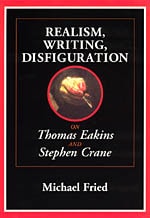
Realism, Writing, Disfiguration
On Thomas Eakins and Stephen CraneMichael Fried
University of Chicago Press, 1987
"An extraordinary achievement of scholarship and critical analysis. It is a book distinguished not only for its brilliance but for its courage, its grace and wit, its readiness to test its arguments in tough-minded ways, and its capacity to meet the challenge superbly. . . . This is a landmark in American cultural and intellectual studies."—Sacvan Bercovitch, Harvard University

The Next Bend in the Road
Michael Fried
University of Chicago Press, 2004