Results by title
2 books match the query 'Friedan, Betty'
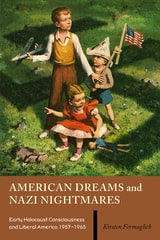
American Dreams and Nazi Nightmares
Early Holocaust Consciousness and Liberal America, 1957-1965Kirsten Fermaglich
University Press of New England, 2007
To a great extent, Holocaust consciousness in the contemporary United States has become intertwined with American Jewish identity and with support for right-wing Israeli politics -- but this was not always the case. In this illuminating study, Kirsten Fermaglich demonstrates that in the late 1950s and early 1960s, many American Jewish writers and academics viewed the Nazi extermination of European Jewry as a subject of universal interest, with important lessons to be learned for the liberal reform of American politics. Fermaglich analyzes the lives and writings of Stanley M. Elkins, Betty Friedan, Stanley Milgram, and Robert Jay Lifton, four social scientific thinkers whose work was shaped by a liberal perspective. For them, the Holocaust served as a critical frame of reference for a particular issue: Elkins on slavery's legacy, Friedan on the oppressions of domesticity, Milgram on the willingness to obey, and Lifton on war's survivors. In each case, these thinkers were deeply influenced by their Jewish backgrounds, whether by early encounters with antisemitism or by the profound sense that only fate and an ocean had spared them death in Hitler's Europe. Thus, each chose imagery from the concentration camps, albeit utterly devoid of a particular Jewish association, to illuminate themes that advanced liberal politics, including civil rights, the nuclear test ban, feminism, and Vietnam veterans' rights. Rather than being offended by these authors' comparisons between American institutions and Nazi concentration camps, American audiences of all ethnic and religious backgrounds during the late 1950s and early 1960s generally cheered these authors' Nazi imagery and adopted it as part of their own political ideology. Fermaglich demonstrates that liberalism in the United States in the 1960s was more substantially shaped by the Holocaust than we have previously recognized.
[more]
Mom
The Transformation of Motherhood in Modern AmericaRebecca Jo Plant
University of Chicago Press, 2010
In the early twentieth century, Americans often waxed lyrical about “Mother Love,” signaling a conception of motherhood as an all-encompassing identity, rooted in self-sacrifice and infused with social and political meaning. By the 1940s, the idealization of motherhood had waned, and the nation’s mothers found themselves blamed for a host of societal and psychological ills. In Mom, Rebecca Jo Plant traces this important shift by exploring the evolution of maternalist politics, changing perceptions of the mother-child bond, and the rise of new approaches to childbirth pain and suffering.
Plant argues that the assault on sentimental motherhood came from numerous quarters. Male critics who railed against female moral authority, psychological experts who hoped to expand their influence, and women who strove to be more than wives and mothers—all for their own distinct reasons—sought to discredit the longstanding maternal ideal. By showing how motherhood ultimately came to be redefined as a more private and partial component of female identity, Plant illuminates a major reorientation in American civic, social, and familial life that still reverberates today.
[more]