Results by title
13 books match the query 'Friedman, Milton'
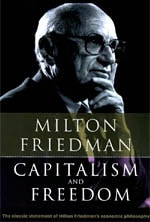
Capitalism and Freedom
Milton Friedman
University of Chicago Press, 1963
"Milton Friedman is one of the nation's outstanding economists, distinguished for remarkable analytical powers and technical virtuosity. He is unfailingly enlightening, independent, courageous, penetrating, and above all, stimulating."-Henry Hazlitt, Newsweek
"It is a rare professor who greatly alters the thinking of his professional colleagues. It's an even rarer one who helps transform the world. Friedman has done both."-Stephen Chapman, Chicago Tribune
Capitalism and Freedom
Milton Friedman
University of Chicago Press, 2020
One of Times Literary Supplement’s 100 Most Influential Books Since the War
One of National Review’s 100 Best Nonfiction Books of the Century
One of the Intercollegiate Studies Institute’s 50 Best Books of the 20th Century
How can we benefit from the promise of government while avoiding the threat it poses to individual freedom? In this classic book, Milton Friedman provides the definitive statement of an immensely influential economic philosophy—one in which competitive capitalism serves as both a device for achieving economic freedom and a necessary condition for political freedom.
First published in 1962, Friedman’s Capitalism and Freedom is one of the most significant works of economic theory ever written. Enduring in its eminence and esteem, it has sold nearly a million copies in English, has been translated into eighteen languages, and continues to inform economic thinking and policymaking around the world. This new edition includes prefaces written by Friedman for both the 1982 and 2002 reissues of the book, as well as a new foreword by Binyamin Appelbaum, lead economics writer for the New York Times editorial board.
Capitalism and Freedom
Fortieth Anniversary EditionMilton Friedman
University of Chicago Press, 2002
How can we benefit from the promise of government while avoiding the threat it poses to individual freedom? In this classic book, Milton Friedman provides the definitive statement of his immensely influential economic philosophy—one in which competitive capitalism serves as both a device for achieving economic freedom and a necessary condition for political freedom. The result is an accessible text that has sold well over half a million copies in English, has been translated into eighteen languages, and shows every sign of becoming more and more influential as time goes on.
Essays in Positive Economics
Milton Friedman
University of Chicago Press, 1966
"His critical blast blows like a north wind against the more pretentious erections of modern economics. It is however a healthy and invigorating blast, without malice and with a sincere regard for scientific objectivity."—K.E. Boulding, Political Science Quarterly
"Certainly one of the most engrossing volumes that has appeared recently in economic theory."—William J. Baumol, Review of Economics and Statistics
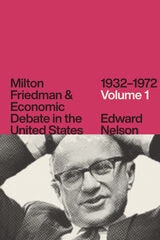
Milton Friedman and Economic Debate in the United States, 1932–1972, Volume 1
Edward Nelson
University of Chicago Press, 2020
This two-volume account provides a foundational introduction to Friedman’s role in several major economic debates that took place in the United States between 1932 and 1972. The first volume, which takes the story through 1960, covers the period in which Friedman began and developed his research on monetary policy. It traces Friedman’s thinking from his professional beginnings in the 1930s as a combative young microeconomist, to his wartime years on the staff of the US Treasury, and his emergence in the postwar period as a leading proponent of monetary policy. The second volume covers the years between 1960 and 1972— years that saw the publication of Friedman and Anna Schwartz’s Monetary History of the United States. The book also covers Friedman’s involvement in a number of debates in the 1960s and 1970s, on topics such as unemployment, inflation, consumer protection, and the environment.
As a fellow monetary economist, Nelson writes from a unique vantage point, drawing on both his own expertise in monetary analysis and his deep familiarity with Friedman’s writings. Using extensive documentation, the book weaves together Friedman’s research contributions and his engagement in public debate, providing an unparalleled analysis of Friedman’s views on the economic developments of his day.
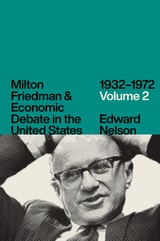
Milton Friedman and Economic Debate in the United States, 1932–1972, Volume 2
Edward Nelson
University of Chicago Press, 2020
This two-volume account provides a foundational introduction to Friedman’s role in several major economic debates that took place in the United States between 1932 and 1972. The first volume, which takes the story through 1960, covers the period in which Friedman began and developed his research on monetary policy. It traces Friedman’s thinking from his professional beginnings in the 1930s as a combative young microeconomist, to his wartime years on the staff of the US Treasury, and his emergence in the postwar period as a leading proponent of monetary policy. The second volume covers the years between 1960 and 1972— years that saw the publication of Friedman and Anna Schwartz’s Monetary History of the United States. The book also covers Friedman’s involvement in a number of debates in the 1960s and 1970s, on topics such as unemployment, inflation, consumer protection, and the environment.
As a fellow monetary economist, Nelson writes from a unique vantage point, drawing on both his own expertise in monetary analysis and his deep familiarity with Friedman’s writings. Using extensive documentation, the book weaves together Friedman’s research contributions and his engagement in public debate, providing an unparalleled analysis of Friedman’s views on the economic developments of his day.
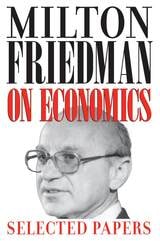
Milton Friedman on Economics
Selected PapersMilton Friedman
University of Chicago Press, 2007
Milton Friedman on Economics: Selected Papers collects a variety of Friedman’s papers on topics in economics that were originally published in the Journal of Political Economy. Opening with Friedman’s 1977 Nobel Lecture, the volume spans nearly the whole of his career, incorporating papers from as early as 1948 and as late as 1990. An excellent introduction to Friedman’s economic thought, Milton Friedman will be essential for anyone tracing the course of twentieth-century economics and politics.

Milton Friedman's Monetary Framework
A Debate with His CriticsEdited by Robert J. Gordon, with essays by Milton Friedman, Karl Brunner and All
University of Chicago Press, 1975
Because his statement was important and controversial both as a commentary on the history of economic thought and as a theoretical contribution in its own right, the Journal of Political Economy in 1972 presented critical reviews from noted monetary theorists, including Karl Brunner and Allan H. Meltzer, James Tobin, Paul Davidson, and Don Patinkin. Their studies, which are printed in the present volume, focus on substantive issues, covering a variety of topics. All of their major points are discussed in Friedman's reply, which clarifies and expands upon his original themes and introduces interesting new material. Thus the synthesis of his two articles, the critical comments, and his response, together with an introduction by Robert J. Gordon, are combined in one volume for the convenience of scholars and students.
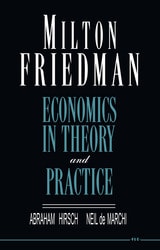
Milton Friedman
Economics in Theory and PracticeAbraham Hirsch and Neil de Marchi
University of Michigan Press, 1991
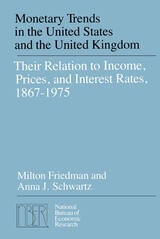
Monetary Trends in the United States and the United Kingdom
Their Relations to Income, Prices, and Interest RatesMilton Friedman and Anna J. Schwartz
University of Chicago Press, 1982
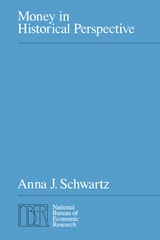
Money in Historical Perspective
Anna J. Schwartz
University of Chicago Press, 1987
In the papers in part I, dating from 1947 to the present, Dr. Schwartz examines money and banking in the United States and the United Kingdom from a historical perspective. Her investigation of the historical evidence linking economic instability to erratic monetary behavior—this behavior itself a product of discretionary monetary policy—has led her to argue for the importance of stable money, and her writings on these issues over the last two decades form part II. The volume concludes with four recent articles on international monetary arrangements, including Dr. Schwartz's well-known work on the gold standard.
This volume of classic essays by Anna Schwartz will be a useful addition to the libraries of scholars and students for its exemplary historical research and commentary on monetary systems.
Two Lucky People
MemoirsMilton Friedman and Rose D. Friedman
University of Chicago Press, 1998
"The Friedmans come across as the last Enlightenment thinkers in a post-modern world. . . . This is a book that restores your faith in reasoned discourse. . . . There really are people who believe in scholarly exchange as a way to discover truth."—David Brooks, New York Times Book Review
"The Friedmans are a feisty couple, who clearly delight in their lives and each other. And shining through their reticence, and their conservatism, is a decency that even liberals will recognize."—Milton and Judith Viorst, Washington Post Book World
"This engaging book recounts the life and contributions of one of America's most influential writers and economists in the second half of the twentieth century. And her husband's no slouch either. . . . An indispensable guide through the evolution of economic thought."—Stephen Moore, National Review
"A thought-provoking book and one rich in history, the personal history of the Friedmans . . . and the cultural and political history of our country."—Steve Huntley, Chicago Sun-Times Books
"[Two Lucky People] is almost like a letter from a couple of old friends—a couple of old friends who had a long, compelling intellectual journey, came to know some of the great world leaders of this century, and had 60 years of happy, supportive marriage."—N. Gregory Mankiw, Fortune
"A rich autobiographical and historical panorama."—William P. Kucewicz, Wall Street Journal
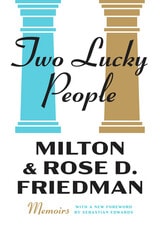
Two Lucky People
MemoirsMilton Friedman and Rose D. Friedman
University of Chicago Press, 2026
The story of Rose and Milton Friedman’s incredible lives and influential work told in their own words, now with a new foreword by Sebastian Edwards.
In Two Lucky People, Rose and Milton Friedman provide a memorable and lively account of their lives, the people they knew, and the work they shared. Their involvement with world leaders and many of this century's most important public policy issues moves their memoir beyond the merely personal and makes fascinating reading for anyone interested in the history of twentieth-century ideas.
This new edition of the Friedmans’ jointly authored memoir includes a foreword by economist Sebastian Edwards, the Henry Ford II Professor of International Economics at the University of California, Los Angeles.