Results by title
7 books match the query 'Frontier thesis'
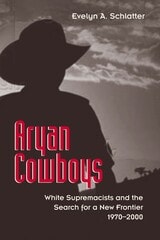
Aryan Cowboys
White Supremacists and the Search for a New Frontier, 1970–2000By Evelyn A. Schlatter
University of Texas Press, 2006
During the last third of the twentieth century, white supremacists moved, both literally and in the collective imagination, from midnight rides through Mississippi to broadband-wired cabins in Montana. But while rural Montana may be on the geographical fringe of the country, white supremacist groups were not pushed there, and they are far from "fringe elements" of society, as many Americans would like to believe. Evelyn Schlatter's startling analysis describes how many of the new white supremacist groups in the West have co-opted the region's mythology and environment based on longstanding beliefs about American character and Manifest Destiny to shape an organic, home-grown movement.
Dissatisfied with the urbanized, culturally progressive coasts, disenfranchised by affirmative action and immigration, white supremacists have found new hope in the old ideal of the West as a land of opportunity waiting to be settled by self-reliant traditional families. Some even envision the region as a potential white homeland. Groups such as Aryan Nations, The Order, and Posse Comitatus use controversial issues such as affirmative action, anti-Semitism, immigration, and religion to create sympathy for their extremist views among mainstream whites—while offering a "solution" in the popular conception of the West as a place of freedom, opportunity, and escape from modern society. Aryan Cowboys exposes the exclusionist message of this "American" ideal, while documenting its dangerous appeal.
Contested Ground
Comparative Frontiers on the Northern and Southern Edges of the Spanish EmpireEdited by Donna J. Guy and Thomas E. Sheridan
University of Arizona Press, 1998

Dos X
Disability and Racial Dysphoria in Latinx and Filipinx CultureSony Coráñez Bolton
University of Texas Press, 2025
An examination of the interconnectedness of brown-racialized people across multiple identities, told through case studies of television, literature, and writing.
As a Filipinx immigrant to the United States, Sony Coráñez Bolton has frequently been mistaken as Mexican. Dos X theorizes such misrecognition. What does it mean to exist in this liminal state, which Coráñez Bolton dubs the “racial uncanny”? What generative possibilities emerge from the presumed interchangeability of Latinx and Filipinx bodies—and from the in-betweenness of brownness as such?
Dos X tracks misrecognition through cultural products like the TV series Undone, Brian Ascalon Roley’s American Son, and the nonfiction work of Jose Antonio Vargas. Misrecognition, Coráñez Bolton argues, produces moments of uncanniness in which subjects experience dysphoric attachments to identities that aren’t supposed to be theirs. In the context of racial capitalism, racial dysphoria is a disability because it undermines certainty about what one’s body is and therefore what role one is meant to play as a laborer. But racial dysphoria can also be revealing. Coráñez Bolton identifies vast potential in this supposed disability, which compels its “sufferers” to confront their shared position within the social, political, and economic organization of capital’s empire, opening new avenues for liberatory solidarity.
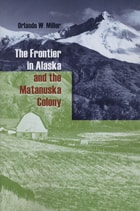
Frontier in Alaska and the Matanuska Colony
Orlando W. Miller
University of Alaska Press, 2008
During the Great Depression, Franklin D. Roosevelt gave more than two hundred families from some of the poorest areas in Minnesota, Wisconsin, and Michigan the opportunity to start their farms anew in the undeveloped land of Matanuska in Alaska. These transplanted midwesterners soon found themselves in a startling new climate and landscape that presented many unexpected challenges. Available for the first time in paperback, The Frontier in Alaska and the Matanuska Colony examines several case studies of these original families, dispelling many frontier myths and describing the reality of pioneering in Alaska. Despite the many impediments, Orlando W. Miller argues, much of the current agricultural success in Matanuska can be directly credited to the innovative farmers who settled there in the 1930s.

Historians Against History
The Frontier Thesis and the National Covenant in American Historical Writing Since 1830David W. Noble
University of Minnesota Press, 1967
Historians Against History was first published in 1967. Minnesota Archive Editions uses digital technology to make long-unavailable books once again accessible, and are published unaltered from the original University of Minnesota Press editions.
Professor Noble examines the basic philosophy and writing of six American historians, George Bancroft, Frederick Jackson, Charles A. Beard, Carl Becker, Vernon Louis Parrington, and Daniel J. Boorstin, and finds in them a common tradition which he calls anti-historical. He argues that this viewpoint is founded in the frontier interpretation of American history, that American historians have served as the chief political theorists and theologians of this country since 1830, and that their writings can be interpreted as Jeremiads designed to preserve a national covenant with nature.
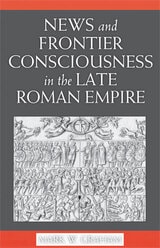
News and Frontier Consciousness in the Late Roman Empire
Mark W. Graham
University of Michigan Press, 2006
Approaching Roman frontiers with the aid of media studies as well as anthropological and sociological methodologies, Mark W. Graham chronicles and documents this significant transition in ancient thought, which coincided with, but was not necessarily dependent on, the Christianization of the Roman world.
Mark W. Graham is Assistant Professor of History at Grove City College.
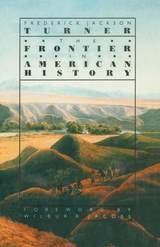
The Frontier in American History
Frederick Jackson Turner
University of Arizona Press, 1986