Results by title
3 books match the query 'Fukushima Nuclear Disaster, Japan, 2011'
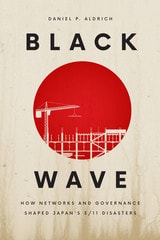
Black Wave
How Networks and Governance Shaped Japan’s 3/11 DisastersDaniel P. Aldrich
University of Chicago Press, 2019
Despite the devastation caused by the magnitude 9.0 earthquake and 60-foot tsunami that struck Japan in 2011, some 96% of those living and working in the most disaster-stricken region of Tōhoku made it through. Smaller earthquakes and tsunamis have killed far more people in nearby China and India. What accounts for the exceptionally high survival rate? And why is it that some towns and cities in the Tōhoku region have built back more quickly than others?
Black Wave illuminates two critical factors that had a direct influence on why survival rates varied so much across the Tōhoku region following the 3/11 disasters and why the rebuilding process has also not moved in lockstep across the region. Individuals and communities with stronger networks and better governance, Daniel P. Aldrich shows, had higher survival rates and accelerated recoveries. Less-connected communities with fewer such ties faced harder recovery processes and lower survival rates. Beyond the individual and neighborhood levels of survival and recovery, the rebuilding process has varied greatly, as some towns and cities have sought to work independently on rebuilding plans, ignoring recommendations from the national government and moving quickly to institute their own visions, while others have followed the guidelines offered by Tokyo-based bureaucrats for economic development and rebuilding.
Black Wave illuminates two critical factors that had a direct influence on why survival rates varied so much across the Tōhoku region following the 3/11 disasters and why the rebuilding process has also not moved in lockstep across the region. Individuals and communities with stronger networks and better governance, Daniel P. Aldrich shows, had higher survival rates and accelerated recoveries. Less-connected communities with fewer such ties faced harder recovery processes and lower survival rates. Beyond the individual and neighborhood levels of survival and recovery, the rebuilding process has varied greatly, as some towns and cities have sought to work independently on rebuilding plans, ignoring recommendations from the national government and moving quickly to institute their own visions, while others have followed the guidelines offered by Tokyo-based bureaucrats for economic development and rebuilding.
[more]
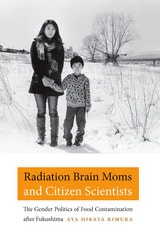
Radiation Brain Moms and Citizen Scientists
The Gender Politics of Food Contamination after FukushimaAya Hirata Kimura
Duke University Press, 2016
Following the Fukushima Daiichi Nuclear Power Plant disaster in 2011 many concerned citizens—particularly mothers—were unconvinced by the Japanese government’s assurances that the country’s food supply was safe. They took matters into their own hands, collecting their own scientific data that revealed radiation-contaminated food. In Radiation Brain Moms and Citizen Scientists Aya Hirata Kimura shows how, instead of being praised for their concern about their communities’ health and safety, they faced stiff social sanctions, which dismissed their results by attributing them to the work of irrational and rumor-spreading women who lacked scientific knowledge. These citizen scientists were unsuccessful at gaining political traction, as they were constrained by neoliberal and traditional gender ideologies that dictated how private citizens—especially women—should act. By highlighting the challenges these citizen scientists faced, Kimura provides insights into the complicated relationship between science, foodways, gender, and politics in post-Fukushima Japan and beyond.
[more]
Radiation and Revolution
Sabu Kohso
Duke University Press, 2020
In Radiation and Revolution political theorist and anticapitalist activist Sabu Kohso uses the 2011 Fukushima nuclear disaster to illuminate the relationship between nuclear power, capitalism, and the nation-state. Combining an activist's commitment to changing the world with a theorist's determination to grasp the world in its complexity, Kohso outlines how the disaster is not just a pivotal event in postwar Japan; it represents the epitome of the capitalist-state mode of development that continues to devastate the planet's environment. Throughout, he captures the lived experiences of the disaster's victims, shows how the Japanese government's insistence on nuclear power embodies the constitution of its regime under the influence of US global strategy, and considers the future of a radioactive planet driven by nuclearized capitalism. As Kohso demonstrates, nuclear power is not a mere source of energy—it has become the organizing principle of the global order and the most effective way to simultaneously accumulate profit and govern the populace. For those who aspire to a world free from domination by capitalist nation-states, Kohso argues, the abolition of nuclear energy and weaponry is imperative.
[more]