Results by title
5 books match the query 'Fula (African people)'

African Entrepreneurship
Muslim Fula Merchants in Sierra LeoneAlusine Jalloh
Ohio University Press, 1999
Departing from the prevailing scholarship, Jalloh characterizes the Fula businesses as independent, rather than appendages of Western expatriate commerce. In addition to establishing successful businesses, Fula merchants established Islamic educational institutions for propogating the Muslim faith and promoting Islamic scholarship.
This study also examines the evolution of Fula chieftaincy from the colonial era to the postcolonial period and documents the importance of mercantile wealth and networks in the election of Fula chiefs in Freetown. African Entrepreneurship makes an important contribution to the understudied role of African business in Sierra Leone.

Amkoullel, the Fula Boy
Amadou Hampâté Bâ
Duke University Press, 2021
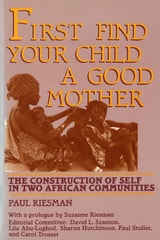
First Find Your Child a Good Mother
The Construction of Self in Two African CommunitiesRiesman, Paul
Rutgers University Press, 1992
Through a systematic comparison of the life circumstances, child-rearing practices, and personalities of the FulBe and their former slaves, the RiimaayBe, this book develops an alternative theory of the way personality is formed in the Fulani society of West Africa. Riesman discusses the different characters, economies, and life plans of adult men and women of both groups, focusing on their ideas about the value of relatives. He further presents detailed observations of child-rearing practices, and concludes that the FulBe and RiimaayBe do not differ in these practices. Contrasting Fulani and Western notions of parenting, he suggests that child-rearing practices are themselves irrelevant to the formation of adult personality, but that a people's ideas about the meaning of life, social relations, and the development of character are very important. Finally, Riesman outlines a sociocultural theory of personality and its formation, and uses this theory to make sense of the differences between FulBe and RiimaayBe.
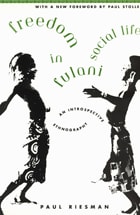
Freedom in Fulani Social Life
An Introspective EthnographyPaul Riesman
University of Chicago Press, 1977
"Freedom in Fulani Social Life richly documents how the ethnographer's own personal and cultural background is implicated in the research process. . . . For this reason, [Riesman's] book will be of paramount interest to all ethnographers."—Philip L. Kilbride, Reviews in Anthropology
"A remarkably well-written and insightful account of Fulani life. . . . In addition to using the conventional approaches of participating in and observing the daily activities of the Jelgobe . . . Riesman enriches his account by examining his personal feelings about particular incidents."—Library Journal
"An interesting and provocative study."—Choice
At the time of his death in 1988, Paul Riesman was an anthropologist who taught at Carleton College.
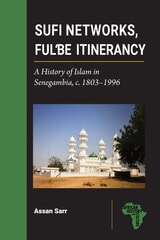
Sufi Networks, Fulbe Itinerancy
A History of Islam in Senegambia, c. 1803–1996Assan Sarr
Michigan State University Press, 2026
This book traces the development and expansion of a network of itinerant Fulbe clerics in southern Senegambia who forged solidarity under the banner of Islam. Beginning with a marabout named Cherno Muhammadu Jallow (c. 1803–1883)—who expanded the Umarian branch of the Tijaniyya sect into remote parts of the region—Assan Sarr demonstrates that some Fulbe groups were not drawn into Islam until the late nineteenth and early twentieth centuries. He argues that by creating a series of villages that served as educational centers during a tumultuous period, the itinerant scholars who are at the heart of this book not only spread Islam throughout the land of the Firdu, Saloum, and parts of the Gambia region but also played a pivotal role in establishing a widely shared Muslim identity among the Fulbe people.