Results by title
8 books match the query 'Fuller, Margaret'
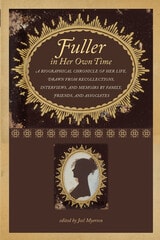
Fuller in Her Own Time
A Biographical Chronicle of Her Life, Drawn from Recollections, Interviews, and Memoirs by Family, Friends, and AssociatesJoel Myerson
University of Iowa Press, 2008
The forty-one remembrances from Nathaniel Hawthorne, Oliver Wendell Holmes, Ralph Waldo Emerson, Thomas Carlyle, Harriet Martineau, Henry James, and twenty-four others chart Fuller’s expanding influence from schooldays in Boston, meetings at the Transcendental Club, teaching in Providence and Boston, work on the New York Tribune, publications and conversations, travels in the British Isles, and life and love in Italy before her tragic early death. Joel Myerson’s perceptive introduction assesses the pre- and postmortem building of Fuller’s reputation as well as her relationship to the prominent Transcendentalists, reformers, literati, and other personalities of her time, and his headnotes to each selection present valuable connecting contexts.
The woman who admitted that “at nineteen she was the most intolerable girl that ever took a seat in a drawing-room,” whose Woman in the Nineteenth Century is considered the first major book-length feminist call to action in America, never conformed to nineteenth-century expectations of self-effacing womanhood. The fascinating contradictions revealed by these narratives create a lively, lifelike biography of Fuller’s “rare gifts and solid acquirements . . . and unfailing intellectual sympathy.”

Margaret Fuller and Her Circles
Brigitte Bailey
University of New Hampshire Press, 2013
Margaret Fuller
Transatlantic Crossings in a Revolutionary AgeEdited by Charles Capper and Cristina Giorcelli
University of Wisconsin Press, 2007
This volume is a collaboration of international scholars who, from varied fields and approaches, assess Fuller’s genius and character. Treating the last several years of Margaret Fuller’s short life, these essays offer a truly international discussion of Fuller’s unique cultural, political, and personal achievements. From the origins and articulations of Fuller’s cosmopolitanism to her examination of “the woman question,” and from her fascination with the European “other” to her candid perception of imperial America from abroad, they ponder what such an extraordinary woman meant to America, and also to Italy and Europe, during her lifetime and continuing to the present.
Moral Enterprise
Literature and Education in Antebellum AmericaDerek Pacheco
The Ohio State University Press, 2013
Our Lady Of Victorian Feminism
The Madonna in the Work of Anna Jameson, Margaret Fuller, and George EliotKimberly VanEsveld Adams
Ohio University Press, 2000
Our Lady of Victorian Feminism is about three nineteenth-century women, Protestants by background and feminists by conviction, who are curiously and crucially linked by their extensive use of the Madonna in arguments designed to empower women.
In the field of Victorian studies, few scholars have looked beyond the customary identification of the Christian Madonna with the Victorian feminine ideal—the domestic Madonna or the Angel in the House. Kimberly VanEsveld Adams shows, however, that these three Victorian writers made extensive use of the Madonna in feminist arguments. They were able to see this figure in new ways, freely appropriating the images of independent, powerful, and wise Virgin Mothers.
In addition to contributions in the fields of literary criticism, art history, and religious studies, Our Lady of Victorian Feminism places a needed emphasis on the connections between the intellectuals and the activists of the nineteenth-century women's movement. It also draws attention to an often neglected strain of feminist thought, essentialist feminism, which proclaimed sexual equality as well as difference, enabling the three writers to make one of their most radical arguments, that women and men are made in the image of the Virgin Mother and the Son, the two faces of the divine.
Poe, Fuller, and the Mesmeric Arts
Transition States in the American RenaissanceBruce Mills
University of Missouri Press, 2005
Transcendent Woman
Margaret Fuller’s Art and AchievementDavid M. Robinson
University of Massachusetts Press, 2025
Journalist, editor, critic, translator, and women’s rights advocate, Margaret Fuller was America’s first major female intellectual. Throughout much of the late-19th and 20th centuries, however, critics and scholars largely saw her as a minor figure in the transcendentalist movement with which she is associated, and her work was considered secondary to that of male figures like Emerson and Hawthorne. While her biography—including her marriage to an Italian noble and her dramatic death in a shipwreck—was often the focus, her skill as a writer was generally overlooked, and her intellectual development largely ignored.
In the early 1980s, David M. Robinson was one of the first scholars to publish an article that focused on Fuller’s mind and art. Now Transcendent Woman completes and extends this early work. Outlining the development of her philosophy, which Robinson defines as a “purpose-oriented form of thinking, tailored to the commitment and assets of each individual,” he traces Fuller’s intellectual journey, first in relation to her family and the people around her in New England and later in her travels in the midwestern United States and, more importantly, through Europe and her residency in Italy. He focuses first and foremost on what Fuller was reading (Goethe was key), what she was thinking as revealed in her letters and journals, and what she was writing, including seminal works such as Summer on the Lakes and Woman in the Nineteenth Century as well as lesser-known essays, translations, and short stories. Drawing extensively on primary sources, Robinson charts Fuller’s development and achievement as an original thinker and fearless advocate of democracy.
Transfiguring America
Myth, Ideology, and Mourning in Margaret Fuller's WritingJeffrey Steele
University of Missouri Press, 2001
Transfiguring America is the product of more than ten years of research and numerous published articles on Margaret Fuller, arguably America's first feminist theorist and one of the most important woman writers in the nineteenth century. Focusing on Fuller's development of a powerful language that paired cultural critique with mythmaking, Steele shows why her writing had such a vital impact on the woman's rights movement and modern conceptions of gender.
This groundbreaking study pays special attention to the ways in which Fuller's feminist consciousness and social theory emerged out of her mourning for herself and others, her dialogue with Emersonian Transcendentalism, and her eclectic reading in occult and mythical sources. Transfiguring America is the first book to provide detailed analyses of all of Fuller's major texts, including her mystical Dial essays, correspondence with Emerson, Summer on the Lakes, 1844 poetry, Woman in the Nineteenth Century, and New York Tribune essays written both in New York and Europe.
Starting from her own profound sense of loss as a marginalized woman, Fuller eventually recognized the ways in which the foundational myths of American society, buttressed by conservative religious ideologies, replicated dysfunctional images of manhood and womanhood. With Woman in the Nineteenth Century, after exploring the roots of oppression in her essays and poetry, Fuller advanced the cause of woman's rights by conceptualizing a more fluid and equitable model of gender founded upon the mythical reconfiguration of human potential. But as her horizons expanded, Fuller demanded not only political equality for women, but also emotional, intellectual, and spiritual freedom for all victims of social oppression.
By the end of her career, Steele shows, Fuller had blended personal experience and cultural critique into the imaginative reconstruction of American society. Beginning with a fervent belief in personal reform, she ended her career with the apocalyptic conviction that the dominant myths both of selfhood and national identity must be transfigured. Out of the ashes of personal turmoil and political revolution, she looked for the phoenix of a revitalized society founded upon the ideal of political justice.