Results by title
12 books match the query 'Fungi'
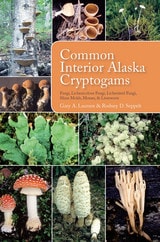
Common Interior Alaska Cryptogams
Fungi, Lichenicolous Fungi, Lichenized Fungi, Slime Molds, Mosses, and LiverwortsGary A. Laursen and Rodney D. Seppelt
University of Alaska Press, 2009
With Common Interior Alaska Cryptogams, Gary A. Laursen and Rodney Seppelt offer the first field guide to cryptogams of the Denali National Park and Preserve. Useful to both lay and professional investigators, this fully illustrated compendium covers mushroom fungi, lichenized fungi, lichenicolous fungi, slime molds, mosses, and liverworts. This field guide to commonly seen cryptogams will provide a basis for understanding their vast diversity of taxa, speciation, edibility, relative abundance, and utility, as well as the ecological roles played by these organisms.
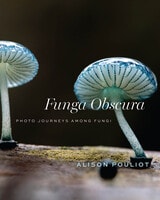
Funga Obscura
Photo Journeys Among FungiAlison Pouliot
University of Chicago Press, 2025
An unforgettable visual journey through the kingdom of fungi, both enigmatic and entrancing.
Recyclers, creators of soil, enablers of life, and food for many—fungi are as dynamic as they are diverse. And, throughout her career, Alison Pouliot has observed these organisms with a unique vision. As a scientist and photographer, she has led hundreds of forays through the forests of the Americas, Australia, and Europe. In this book, readers can travel along with her on these global explorations through stunning photographs and meditations on the landscape. She says her camera is where fungal lives come most clearly into focus. And like the camera obscura, this book, Funga Obscura, captures brief mycological moments and unforgettable fungus microcosms.
The word funga refers to the fungi of a region, and Pouliot’s photography spans continents. We see a parade of violet webcap mushrooms, spotted in the understory of a Pacific Northwest forest; brilliantly blue pixie’s parasols in Australia; an Italian alpine lichen, looking for all the world like a treasure map; and a showstopping whitelaced shank, ready to spread its spores in Switzerland. We learn that fungi live almost everywhere, from our lawns to forests and woodlands, from the ocean’s depths to deserts and alpine peaks. Yet, like a web of rootlike mycelium, Funga Obscura goes deeper to investigate how fungi shape landscapes and interact with other organisms, including humans. This journey spans eons, from long ago in evolutionary time, when fungi first emerged from the ocean onto land, to today, when we witness their work all around us. The scenes here challenge our ideas about what fungi are, what they do, and why they matter.
In Pouliot’s photographs, you might recognize a few old friends, but many mushrooms will be new acquaintances. Sometimes they make their presence immediately known; at other times, they just provide clues—and trails to follow.
Genera Of The Myxomycetes
George W. Martin
University of Iowa Press, 1983
Critically examining past master narratives in light of emerging alternatives, these essayists ask us to reevaluate the stories we tell, the narrative traditions within which they are situated, and the audiences they are designed to persuade. The first essays explore the gendered character of social history rhetoric by exposing alternative, feminist traditions of social scientific and social historical writing. The second section focuses on alternative narrative traditions of historical writing in non-European contexts, specifically India, Japan, and China. And the third group spotlights the rhetorical uses of synthesis in the writings of social historians.
The essays feature the range of narrative possibilities available to historians who have become self-critical about the pervasive use of unexamined master narratives; they show how limited that tradition can be compared with the diverse alternatives derived from, for example, gendered traditions of Latin American travel writers of the nineteenth century, Victorian women's historical writing, or the lively subaltern tradition in Indian social history. Together they argue not for the abandonment of historical materialism or the elimination of all master narratives but for the reinvigoration of social history through the use of new and more persuasive arguments based on alternative narratives.

Grain Storage
The Role of Fungi in Quality LossClyde M. Christensen and Henry H. Kaufmann
University of Minnesota Press, 1969
Grain Storage was first published in 1969. Minnesota Archive Editions uses digital technology to make long-unavailable books once again accessible, and are published unaltered from the original University of Minnesota Press editions.
The deterioration or spoilage of stored grain is a problem of serious dimension, both from the standpoint of the financial balance sheet of those engaged in commercial grain enterprises and as a formidable factor in the worldwide fight against hunger. In this useful book the authors present practical information, in non-technical language, about the causes and methods of preventing the deterioration of stored grains and seeds.
The emphasis is on the role of fungi but material also is included on problems with insects, mites, and rodents in connection with grain storage. The fungi are of prime importance since not until recently have they been recognized as a major cause of loss of quality in grains and seeds. Even today many of those who deal with grains, from warehouses to management personnel, fail to realize that fungi may play a decisive role in their operations.
The book will be of special interest and value to grain merchants and processors, grain elevator managers and operators, grain inspectors, agronomists and agricultural economists concerned with crop production, and many others in agricultural or food processing fields.
International Code of Nomenclature for algae, fungi, and plants (Madrid Code)
Editorial Committee of the Madrid Code
University of Chicago Press, 2025
The International Code of Nomenclature for algae, fungi, and plants, known as “the Code,” is the set of internationally agreed rules and recommendations that govern the naming of these organisms. Scientific naming has deep historical roots. Indeed, the system of naming organisms is one of the first truly global scientific standards. This essential reference originates in Alphonse de Candolle’s 1867 Lois de la nomenclature botanique. This 2025 edition of the Code, the Madrid Code, reflects the decisions made at the Twentieth International Botanical Congress, which met in Madrid, Spain, in July 2024. The congress debated 447 proposals to amend the Code and accepted important new rules, including a mechanism for voluntary registration of plant and algal names, clarifications for naming fossil taxa, the option to reject a new name if it is derogatory to a group of people, and the replacement of an epithet that was considered particularly offensive (revising to afra, afrorum, and afrum).
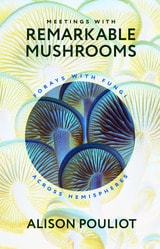
Meetings with Remarkable Mushrooms
Forays with Fungi across HemispheresAlison Pouliot
University of Chicago Press, 2023
A whirlwind journey through fungus frontiers that underscores how appreciating fungi is key to understanding our planet’s power and fragility.
What can we learn from the lives of fungi? Splitting time between the northern and southern hemispheres, ecologist Alison Pouliot ensures that she experiences two autumns per year in the pursuit of fungi—from Australia’s deserts to Iceland’s glaciers to America’s Cascade Mountains. In Meetings with Remarkable Mushrooms, we journey alongside Pouliot, magnifiers in hand, as she travels the world.
With Pouliot as our guide, we smell fire-loving truffles that transform their scent after burning to lure mammals who eat them and, ultimately, spread their spores. We spot the eerie glow of the ghost fungus, a deceptive entity that looks like an edible oyster mushroom but will soon heave back out—along with everything else in your stomach—if you take a bite. And we crawl alongside vegetable caterpillars, which are neither vegetable nor caterpillar but a fungus that devours insects from the inside out.
Featuring stunning color photographs of these mycological miracles, Meetings with Remarkable Mushrooms shows that understanding fungi is fundamental for harmonizing with the natural world.
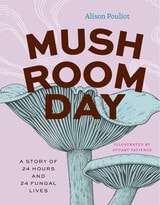
Mushroom Day
A Story of 24 Hours and 24 Fungal LivesAlison Pouliot
University of Chicago Press, 2025
On this mushroom-filled day, ecologist Alison Pouliot tours the world to introduce readers to a fascinating variety of fungi. Each chapter of Mushroom Day introduces a single fungus during a single hour, highlighting twenty-four different species.
In the dark of the night, the green glow of the ghost fungus guides us into the forest to learn about the mysteries of bioluminescence. At dawn, we awaken to find a fairy ring of mushrooms that has appeared overnight like something out of folklore. But we don’t have much time to linger, as we must reach the Italian forest before other porcino hunters forage the morning’s fattest and finest. In the heat of the afternoon, the ripe stench of the stinkhorn might send us out of the woods, while the enticing aroma of the aniseed funnel lures us back in. Late in the evening we spy a fungus known as the witches cauldron and wonder what it might tell us about the future. By the end of our mushroom day, we’ll have glimpsed the diversity of this unique kingdom, met fungus friends that feed and fascinate, and learned how humans can encourage their flourishing.
For each hour, celebrated artist Stuart Patience has depicted these scenes with evocative pen and ink illustrations. Working together to narrate and illustrate these unique moments in time, Pouliot and Patience have created an engaging read that is a perfect way to spend an hour or two—and a true gift for foragers, mycophiles, and anyone who wants to stop and appreciate fungi.
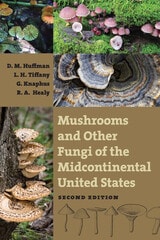
Mushrooms and Other Fungi of the Midcontinental United States
Donald M. Huffman
University of Iowa Press, 2008
This completely revised second edition provides all the information necessary to identify mushrooms in the ?eld in the midcontinental region of Iowa, Illinois, Nebraska, Missouri, Minnesota, South Dakota, and Wisconsin: the tallgrass prairies and the western parts of the eastern deciduous forests.
The first edition has been improved in significant ways. The authors have updated scientific names, added photos where there were none and replaced poor photos with better ones, improved the keys, added some species and deleted others, added a section on truffles, and annotated the bibliography. There were originally 224 species; now there are 248. Some of the new photos-125 in all-serve as a second photo for a species, where it is helpful to show details that cannot be viewed in a single photo.
The authors describe each species' cap, gills, stalk, annulus, and season when it is most likely to be seen as well as such characteristics as edibility and toxicity. In their detailed and lively introduction they discuss the economic and environmental aspects of fungi, basic mushroom biology, nomenclature, edibility and toxicity, and habitats and time of fruiting. Most important are the keys, which lead the dedicated reader to the major groups of fungi included in this guide. The section on mushrooms includes keys to their genera in addition to the species within each family discussed, and each of the subsequent sections has a key to the genera and species except where so few species are discussed that a key is not necessary. The volume also includes a glossary and two bibliographies, one with general and one with technical references.
Through their detailed technical descriptions and captivating color photos the authors convey their passionate fondness for these diverse and colorful organisms, whose mysterious appearances and disappearances have long made them objects of fascination.
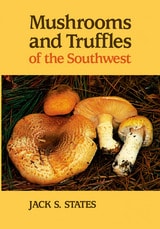
Mushrooms and Truffles of the Southwest
Jack S. States
University of Arizona Press, 1990
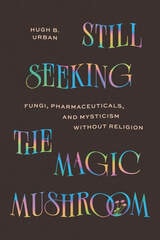
Still Seeking the Magic Mushroom
Fungi, Pharmaceuticals, and Mysticism Without ReligionHugh B. Urban
University of Chicago Press, 2026
A sweeping cultural history of our yearning for psychedelics to free us from both modern life and traditional religion.
In 1957, Life Magazine published an article called “Seeking the Magic Mushroom” about a Mexican healing ritual centered on an obscure psychedelic: Psilocybe mushrooms. Readers raced to experiment with the drug for their own spiritual, therapeutic, and recreational purposes until a psychedelic wave swept the nation. Today, though psilocybin has been transformed from a sacred fungus into a pharmaceutical product, many people still turn to the enigmatic mushroom to encounter profound spiritual experiences without the baggage of traditional religion.
In Still Seeking the Magic Mushroom, Hugh B. Urban examines the alluring promise of mysticism without religion. With psychedelics, one need not fast, flagellate, or even worship a god to encounter the transcendent; a carefully timed ingestion of psilocybin will suffice. But, Urban argues, stripping the trip from its religion came at a cost: the erasure of Indigenous culture and the eventual commercialization and scientification of the psychedelic underground. Urban shows that psychedelic mushrooms, far from the fringe or countercultural margins, have been central players in shaping American attitudes toward religion and science over the last century. He argues that our love affair with the intoxicating fungus reveals a deep frustration with a disenchanted world, desire for meaning beyond religion, yearning for nature amid ecological crisis, faith in science to save us, and the relentless power of capitalism to turn everything into commodities.
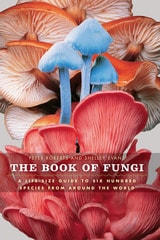
The Book of Fungi
A Life-Size Guide to Six Hundred Species from around the WorldPeter Roberts and Shelley Evans
University of Chicago Press, 2011
Colorful, mysterious, and often fantastically shaped, fungi have been a source of wonder and fascination since the earliest hunter-gatherers first foraged for them. Today there are few, if any, places on Earth where fungi have not found themselves a home. And these highly specialized organisms are an indispensable part of the great chain of life. They not only partner in symbiotic relationships with over ninety percent of the world’s trees and flowering plant species, they also recycle and create humus, the fertile soil from which such flora receive their nutrition. Some fungi are parasites or saprotrophs; many are poisonous and, yes, hallucinogenic; others possess life-enhancing properties that can be tapped for pharmaceutical products; while a delicious few are prized by epicureans and gourmands worldwide.
In this lavishly illustrated volume, six hundred fungi from around the globe get their full due. Each species here is reproduced at its actual size, in full color, and is accompanied by a scientific explanation of its distribution, habitat, association, abundance, growth form, spore color, and edibility. Location maps give at-a-glance indications of each species’ known global distribution, and specially commissioned engravings show different fruitbody forms and provide the vital statistics of height and diameter. With information on the characteristics, distinguishing features, and occasionally bizarre habits of these fungi, readers will find in this book the common and the conspicuous, the unfamiliar and the odd. There is a fungal predator, for instance, that hunts its prey with lassos, and several that set traps, including one that entices sows by releasing the pheromones of a wild boar.
Mushrooms, morels, puffballs, toadstools, truffles, chanterelles—fungi from habitats spanning the poles and the tropics, from the highest mountains to our own backyards—are all on display in this definitive work.
The Molds and Man
An Introduction to the FungiClyde M. Christensen
University of Minnesota Press, 1965
The Molds and Man was first published in 1965. Minnesota Archive Editions uses digital technology to make long-unavailable books once again accessible, and are published unaltered from the original University of Minnesota Press editions.
This highly readable volume on a little-known but important subject has been widely used as a text and reference book by the student as well as the interested layman.