Results by title
10 books match the query 'Furniture'
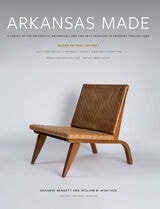
Arkansas Made, Volume 1
A Survey of the Decorative, Mechanical, and Fine Arts Produced in Arkansas through 1950Swannee Bennett
University of Arkansas Press, 2020
Arkansas Made is the culmination of Historic Arkansas Museum’s exhaustive investigations into the history of the state’s material culture. Decades of meticulous research have resulted in this exciting two-volume survey of cabinetmakers, silversmiths, potters, fine artists, quilters, and other artisans working in communities all over the state.
The work of the artisans documented here has been the driving force of Historic Arkansas Museum’s mission to collect and preserve Arkansas’s creative legacy and rich artistic traditions. Artisans from across Arkansas’s rich cultural landscape come to life among the colorful quilts, playful temperance jugs, and inventive effigies included in Volume I. Readers will delight not only in the striking full-color images but also in the stories that weave them together across time and region to create a lively picture of art and artisanship in a state too little celebrated for its creative output.
Quilts and Textiles • Ceramics • Silver •Weaponry • Furniture • Vernacular Architecture • Native American Art

French Rococo Ébénisterie in the J. Paul Getty Museum
Gillian Wilson
J. Paul Getty Trust, The, 2021
The first comprehensive catalogue of the Getty Museum’s significant collection of French Rococo ébénisterie furniture.
This catalogue focuses on French ébénisterie furniture in the Rococo style dating from 1735 to 1760. These splendid objects directly reflect the tastes of the Museum’s founder, J. Paul Getty, who started collecting in this area in 1938 and continued until his death in 1976.
The Museum’s collection is particularly rich in examples created by the most talented cabinet masters then active in Paris, including Bernard van Risenburgh II (after 1696–ca. 1766), Jacques Dubois (1694–1763), and Jean-François Oeben (1721–1763). Working for members of the French royal family and aristocracy, these craftsmen excelled at producing veneered and marquetried pieces of furniture (tables, cabinets, and chests of drawers) fashionable for their lavish surfaces, refined gilt-bronze mounts, and elaborate design. These objects were renowned throughout Europe at a time when Paris was considered the capital of good taste.
The entry on each work comprises both a curatorial section, with description and commentary, and a conservation report, with construction diagrams. An introduction by Anne-Lise Desmas traces the collection’s acquisition history, and two technical essays by Arlen Heginbotham present methodologies and findings on the analysis of gilt-bronze mounts and lacquer.
The free online edition of this open-access publication is available at www.getty.edu/publications/rococo/ and includes zoomable, high-resolution photography. Also available are free PDF, EPUB, and Kindle/MOBI downloads of the book, and JPG downloads of the main catalogue images.

Furnishing Fascism
Modernist Design and Politics in ItalyIgnacio G. Galán
University of Minnesota Press, 2025
The role of modernist interior design in the construction of Italian nationalism
Along with the rise of Mussolini’s fascist regime, the interwar years in Italy also saw the widespread development of its modernist interior design and furnishing practices. While the regime’s politics were overtly manifest in monumental government architecture, Furnishing Fascism examines the subtler yet effective role of household goods and decor in the cultivation of Italy’s exclusionary sense of national identity.
Presenting a fresh look at the work of various architects and designers, including iconic figures such as Gio Ponti and Carlo Enrico Rava, Ignacio G. Galán explores how seemingly neutral products of everyday life contributed to the propagation of fascist ideology. Through extensive promotion in popular magazines and department stores, on the film sets of Cinecittà Studios, and throughout the country’s colonial territories, Italy’s modernist design practices were part of a larger political project that aimed to produce a totalizing image of cultural hegemony.
Interweaving design theory, architectural history, and media scholarship, Furnishing Fascism reexamines the period’s so-called minor arts to reveal the political entanglement of modernism in early twentieth-century Italy and offers valuable insight into the complications of cultural production under the auspices of authoritarian power.
Retail e-book files for this title are screen-reader friendly with images accompanied by short alt text and/or extended descriptions.

Great American Treasures
Women Preserving History Since 1891Carol Cadou
The Artist Book Foundation, 2025
Great American Treasures is a comprehensive survey of America's historic sites and buildings, their furnishings, and their gardens.
America’s historic sites, homes, and public buildings are a living record of the diverse ethnicities that, over four centuries, helped to build a growing nation. Since 1891, the National Society of the Colonial Dames of America (NSCDA) has actively promoted our national heritage through historic preservation, restoration, and the interpretation of historic sites across the United States. In conjunction with NSCDA, in 2025 The Artist Book Foundation (TABF) published Great American Treasures, a comprehensive survey of the architecture, furnishings, and gardens that epitomize the nation’s diverse material culture over more than 400 years.
The publication features the NSCDA’s collection of historic places, which span the sixteenth to the twentieth centuries, and highlights the residences of those who established themselves in America during this time. It features an array of buildings that speak to the diversity of traditions, people, and architecture in a growing nation—from English Georgian houses on the eastern seaboard to a French Colonial dwelling in Missouri and mission houses in Hawai’i. This survey illuminates the stories and material traditions of the wide range of individuals who contributed to the founding of the United States and to the development of America as a dynamic multicultural nation.
Many of the sites tell the stories of familiar historic figures like George and Martha Washington, John Adams, James and Dolley Madison, John Quincy Adams, Benjamin Franklin, and George Mason. Other sites offer the narratives of figures who contributed to America’s artistic heritage, such as John James Audubon and John Smibert, or those who helped to shape the country’s mercantile system, like Frederick Van Cortlandt and James Logan. Some places were designed by well-known architects such as Robert Mills or McKim, Mead & White, while most were the work of unknown or little-known architects, builders, joiners, and slave laborers. The classic architecture of these sites, their exquisite furnishings and lush gardens, and even the headstones in historic cemeteries all provide a window into the rich diversity of men, women, and children—free, indentured, and enslaved—who came together to build America.

Speaking of Furniture
Conversations with 14 American MastersWarren Eames Johnson
The Artist Book Foundation, 2013
Speaking of Furniture: Conversations with 14 American Masters is a fresh, stimulating, and in-depth examination of the modus operandi of 14 accomplished—and diverse—furniture makers. An engaging history of studio furniture, this colorful, informative study includes engaging conversations with James Krenov, Wendell Castle, Jere Osgood, Judy Kensley McKie, David Ebner, Richard Scott Newman, Hank Gilpin, Alphonse Mattia, John Dunnigan, Wendy Maruyama, James Schriber, Timothy S. Philbrick, Michael Hurwitz, and Thomas Hucker. The insightful interviews illuminate how these creative and gifted craftspeople arrived professionally and what their craft means to them individually.
In his enlightening foreword, Edward S. Cook, Jr. maps out the background of the studio furniture movement. Author and furniture maker Roger Holmes offers an insider's perspective on the art and craft of producing exquisite contemporary furniture in his conversational introduction and maintains, "Art or craft, this is very personal work." This elegant presentation skillfully sheds light on the thought processes and techniques of a celebrated and exceptional gathering of studio furniture makers who are as unique as they are stellar. As sculptor and furniture designer Wendell Castle remarks, "What I admired was that... fine art and craft were the same thing."
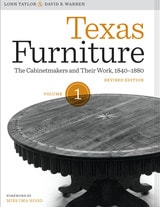
Texas Furniture, Volume One
The Cabinetmakers and Their Work, 1840-1880, Revised editionBy Lonn Taylor and David B. Warren
University of Texas Press, 2012
The art of furniture making flourished in Texas during the mid-nineteenth century. To document this rich heritage of locally made furniture, Miss Ima Hogg, the well-known philanthropist and collector of American decorative arts, enlisted Lonn Taylor and David B. Warren to research early Texas Furniture and its makers. They spent more than a decade working with museums and private collectors throughout the state to examine and photograph representative examples. They also combed census records, newspapers, and archives for information about cabinetmakers. These efforts resulted in the 1975 publication of Texas Furniture, which quickly became the authoritative reference on this subject.
Now updated with an expanded Index of Texas Cabinetmakers that includes information that has come to light since the original publication and corrects errors, Texas Furniture presents a catalog of more than two hundred pieces of furniture, each superbly photographed and accompanied by detailed descriptions of the piece’s maker, date, materials, measurements, history, and owner, as well as an analysis by the authors. The book also includes chapters on the material culture of nineteenth-century Texas and on the tools and techniques of nineteenth-century Texas cabinetmakers, with a special emphasis on the German immigrant cabinetmakers of the Hill Country and Central Texas. The index of Texas cabinetmakers contains biographical information on approximately nine hundred men who made furniture in Texas, and appendices list information on the state’s largest cabinet shops taken from the United States census records.
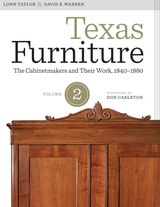
Texas Furniture, Volume Two
The Cabinetmakers and Their Work, 1840–1880By Lonn Taylor and David B. Warren
University of Texas Press, 2012
The art of furniture making flourished in Texas during the mid-nineteenth century. To document this rich heritage of locally made furniture, Miss Ima Hogg, the well-known philanthropist and collector of American decorative arts, enlisted Lonn Taylor and David B. Warren to research early Texas furniture and its makers. After more than a decade of investigation, they published Texas Furniture in 1975, and it quickly became the authoritative reference on this subject. An updated edition, Texas Furniture, Volume One, was issued in the spring of 2012.
Texas Furniture, Volume Two presents over 150 additional pieces of furniture that were not included in Volume One, each superbly photographed in color and accompanied by detailed descriptions of the piece’s maker, date, materials, measurements, history, and owner, as well as an analysis by the authors. Taylor and Warren have also written a new introduction for this volume, in which they amplify the story of early Texas furniture. In particular, they compare and contrast the two important traditions of cabinetmaking in Texas, Anglo-American and German, and identify previously unknown artisans. The authors also discuss nineteenth-century Texans’ desire for refinement and gentility in furniture, non-commercial furniture making, and marquetry work. And they pay tribute to the twentieth-century collectors who first recognized the value of locally made Texas furniture and worked to preserve it. A checklist of Texas cabinetmakers, which contains biographical information on approximately nine hundred men who made furniture in Texas, completes the volume.
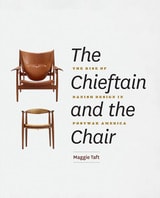
The Chieftain and the Chair
The Rise of Danish Design in Postwar AmericaMaggie Taft
University of Chicago Press, 2023
Today, Danish Modern design is synonymous with clean, midcentury cool. During the 1950s and ‘60s, it flourished as the furniture choice for Americans who hoped to signal they were current and chic. But how did this happen? How did Danish Modern become the design movement of the times? In The Chieftain and the Chair, Maggie Taft tells the tale of our love affair with Danish Modern design. Structured as a biography of two iconic chairs—Finn Juhl’s Chieftain Chair and Hans Wegner’s Round Chair, both designed and first fabricated in 1949—this book follows the chairs from conception and fabrication through marketing, distribution, and use.
Drawing on research in public and private archives, Taft considers how political, economic, and cultural forces in interwar Denmark laid the foundations for the postwar furniture industry, and she tracks the deliberate maneuvering on the part of Danish creatives and manufacturers to cater to an American market. Taft also reveals how American tastemakers and industrialists were eager to harness Danish design to serve American interests and how furniture manufacturers around the world were quick to capitalize on the fad by flooding the market with copies.
Sleek and minimalist, Danish Modern has experienced a resurgence of popularity in the last few decades and remains a sought-after design. This accessible and engaging history offers a unique look at its enduring rise among tastemakers.
Wendell Castle Remastered
Wendell Castle
The Artist Book Foundation, 2015
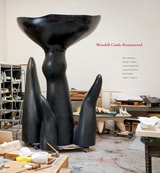
Wendell Castle (1932–2018), master furniture maker, designer, sculptor, and educator, was in the sixth decade of his extraordinary creativity when an emblematic exhibition of his signature works was mounted by the Museum of Art and Design in 2016. It blended the artist's seminal works with his latest collection, produced with digital technology. In part a self-reflection, this eponymous, full-color companion book examines some of Castle's historically representative works as well as significant contemporary furniture pieces, continuing his highly respected and acclaimed sculptural/functional dialogue. Castle, ever the innovator, was remarkable for his openness to new technologies; he not only embraced an initially complex practice but has "remastered" it. His vast oeuvre represents a prodigious lifework that began in 1958 and aligns with the development of the American art furniture movement.
The solo exhibition was a somewhat self-reflective examination of his early ground-breaking works that tested the boundaries of traditional furniture making by presenting his later innovations using new digital technologies such as 3D scanning and modeling, and computer-controlled milling—a digital "remastering" of his immense oeuvre. Unique perspectives on the master's work are presented by informative essays by authors well-versed on Castle's celebrated career.
Wendell Castle
A Catalogue Raisonné, 1958–2012Wendell Castle
The Artist Book Foundation, 2014
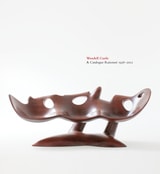
Sculptor and furniture designer Wendell Castle (1932–2018) carved a distinct path in furniture making over nearly six decades of a distinguished career, and this long-awaited recording of his oeuvre, Wendell Castle: A Catalogue Raisonné, 1958–2012, beautifully presents the extraordinary scope of his artistry and craftsmanship. The voluminous accounting of his works, beginning with Castle's earliest, mid-century works through to his unabashed experiments with unconventional materials (gel-coated fiberglass and metallic automobile paint) and his latest signature wood laminations, is comprehensive and detailed. Three essays of varying perpectives introduce the catalogue raisonné followed by an extensive accounting of his enormous oeuvre, his exhibitions, numerous awards, and the collections of his works, as well as a substantive bibliography.
With his organic and whimsical approach to his various mediums, Castle seamlessly merged sculpture and design into one discipline, obscuring the distinction between the two. He invented the technique of carving stacked laminations of wood, and his later explorations into the qualities of fiberglass as a sculptural medium are unparalleled.