Results by title
13 books match the query 'Galilei, Galileo'
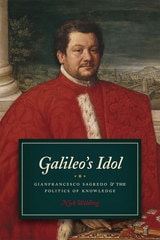
Galileo's Idol
Gianfrancesco Sagredo and the Politics of KnowledgeNick Wilding
University of Chicago Press, 2014
Nick Wilding uses as wide a variety of sources as possible—paintings, ornamental woodcuts, epistolary hoaxes, intercepted letters, murder case files, and others—to challenge the picture of early modern science as pious, serious, and ecumenical. Through his analysis of the figure of Sagredo, Wilding offers a fresh perspective on Galileo as well as new questions and techniques for the study of science. The result is a book that turns our attention from actors as individuals to shifting collective subjects, often operating under false identities; from a world made of sturdy print to one of frail instruments and mistranscribed manuscripts; from a complacent Europe to an emerging system of complex geopolitics and globalizing information systems; and from an epistemology based on the stolid problem of eternal truths to one generated through and in the service of playful, politically engaged, and cunning schemes.
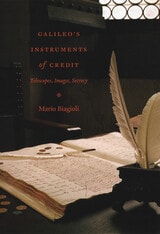
Galileo's Instruments of Credit
Telescopes, Images, SecrecyMario Biagioli
University of Chicago Press, 2006
Galileo's Instruments of Credit proposes radical new interpretations of several key episodes of Galileo's career, including his early telescopic discoveries of 1610, the dispute over sunspots, and the conflict with the Holy Office over the relationship between Copernicanism and Scripture. Galileo's tactics during this time shifted as rapidly as his circumstances, argues Mario Biagioli, and the pace of these changes forced him to respond swiftly to the opportunities and risks posed by unforeseen inventions, further discoveries, and the interventions of his opponents.
Focusing on the aspects of Galileo's scientific life that extend beyond the framework of court culture and patronage, Biagioli offers a revisionist account of the different systems of exchanges, communication, and credibility at work in various phases of Galileo's career. Galileo's Instruments of Credit will find grateful readers among scholars of science studies, historical epistemology, visual studies, Galilean science, and late Renaissance astronomy.
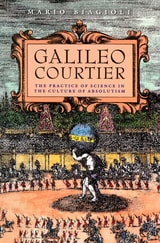
Galileo, Courtier
The Practice of Science in the Culture of AbsolutismMario Biagioli
University of Chicago Press, 1993
Galileo, Courtier is a fascinating cultural and social history of science highlighting the workings of power, patronage, and credibility in the development of science.
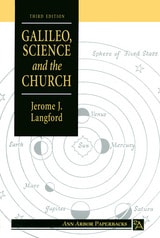
Galileo, Science and the Church
Jerome J. Langford
University of Michigan Press, 1992
Jerome J. Langford's Galileo, Science, and the Church is widely recognized as a classic, balanced account of Galileo Galilei’s legendary 1633 confrontation with the Roman Catholic Inquisition. Moving past the overly polarized arguments of traditional polemicists and apologists, Langford contextualizes the "Galileo Affair" within its proper 17th-century historical, theological, and philosophical milieu. The book meticulously explores how the clash was less a fundamental war between science and faith, and more a complex dispute over scriptural interpretation, ecclesiastical authority, and the academic rigidities of Aristotelian philosophy. Through objective research, Langford demonstrates that this momentous historical drama still serves as a timeless case study on the enduring friction between institutional authority and the freedom of individual thought and expression.
Intelligibility of Nature
A William A. Wallace ReaderWilliam A. Wallace
Catholic University of America Press, 2022
New Science, New World
Denise Albanese
Duke University Press, 1996
Albanese reads the inaugurators of the scientific revolution against the canonical authors of early modern literature, discussing Galileo’s Dialogue on the Two Chief World Systems and Bacon’s New Atlantis as well as Milton’s Paradise Lost and Shakespeare’s The Tempest. She examines how the newness or “novelty” of investigating nature is expressed through representations of the New World, including the native, the feminine, the body, and the heavens. “New” is therefore shown to be a double sign, referring both to the excitement associated with a knowledge oriented away from past practices, and to the oppression and domination typical of the colonialist enterprise. Exploring the connections between the New World and the New Science, and the simultaneously emerging patterns of thought and forms of writing characteristic of modernity, Albanese insists that science is at its inception a form of power-knowledge, and that the modern and postmodern division of “Two Cultures,” the literary and the scientific, has its antecedents in the early modern world.
New Science, New World makes an important contribution to feminist, new historicist, and cultural materialist debates about the extent to which the culture of seventeenth-century England is proto-modern. It will offer scholars and students from a wide range of fields a new critical model for historical practice.
Novelties in the Heavens
Rhetoric and Science in the Copernican ControversyJean Dietz Moss
University of Chicago Press, 1993
Moss describes the nature of dialectical and rhetorical discourse in the period of the Copernican debate to shed new light on the argumentative strategies used by the participants. Against the background of Ptolemy's Almagest, she analyzes the gradual increase of rhetoric beginning with Copernicus's De Revolutionibus and Galileo's Siderius nuncius, through Galileo's debates with the Jesuits Scheiner and Grassi, to the most persuasive work of all, Galileo's Dialogue. The arguments of the Dominicans Bruno and Campanella, the testimony of Johannes Kepler, and the pleas of Scriptural exegetes and the speculations of John Wilkins furnish a counterpoint to the writings of Galileo, the centerpiece of this study.
The author places the controversy within its historical frame, creating a coherent narrative movement. She illuminates the reactions of key ecclesiastical and academic figures figures and the general public to the issues.
Blending history and rhetorical analysis, this first study to look at rhetoric as defined by sixteenth- and seventeenth-century participants is an original contribution to our understanding of the use of persuasion as an instrument of scientific debate.
On Sunspots
Galileo Galilei and Christoph Scheiner
University of Chicago Press, 2010
Galileo’s telescopic discoveries, and especially his observation of sunspots, caused great debate in an age when the heavens were thought to be perfect and unchanging. Christoph Scheiner, a Jesuit mathematician, argued that sunspots were planets or moons crossing in front of the Sun. Galileo, on the other hand, countered that the spots were on or near the surface of the Sun itself, and he supported his position with a series of meticulous observations and mathematical demonstrations that eventually convinced even his rival.
On Sunspots collects the correspondence that constituted the public debate, including the first English translation of Scheiner’s two tracts as well as Galileo’s three letters, which have previously appeared only in abridged form. In addition, Albert Van Helden and Eileen Reeves have supplemented the correspondence with lengthy introductions, extensive notes, and a bibliography. The result will become the standard work on the subject, essential for students and historians of astronomy, the telescope, and early modern Catholicism.

Reading Galileo's Letters
Experiments in Friendship, Knowledge, and CommunityEdited by Paula Findlen and Hannah Marcus
University of Chicago Press, 2027
Essays by many of the foremost experts on Galileo offer an interdisciplinary approach to the legendary scientist’s correspondence.
The Tuscan mathematician, physicist, and astronomer Galileo Galilei (1564–1642) is one of history’s most iconic and controversial figures. Letters form the backbone of what one early Galileo scholar called the “private Galileo,” and his correspondence is indeed a record of his family and friendships; his intellectual evolution; his professional interactions with other scientific figures; and his relations with patrons, brokers, and publishers. Last, but hardly least, his letters are a unique cultural artifact of Galileo the writer and master of vernacular prose.
Galileo’s correspondence crossed Europe in public mail pouches, through diplomatic messengers, and was written in code. Today, there are 3,272 surviving letters to or from Galileo and his many friends, family members, disciples, and rivals across Europe. This volume examines these letters as an essential aspect of Galileo’s personal and scientific career. They are what the editors call his “experiments in friendship,” which enabled, abetted, and often served as early drafts of the theories in his published works. This collaborative volume brings together different approaches, case studies, and forms of expertise—historical and literary, intellectual and material, archival and digital. It is a must-read for all Galileo enthusiasts and anyone interested in how to make the most of a rich record of correspondence.
Sidereus Nuncius, or The Sidereal Messenger
Galileo Galilei
University of Chicago Press, 1989
"[Sidereus nunclus] has never before been made available in its entirety in a continuous form, with full notes and comment. The introduction, translation and notes by Van Helden are a splendid example of the best scholarship and fullest accessibility. . . . we can now truly get to grips with the phenomenon of Galileo and what his life and work should mean to us today."—Robert Temple, Nature
Sidereus Nuncius, or The Sidereal Messenger
Galileo Galilei
University of Chicago Press, 2015
Albert Van Helden’s beautifully rendered and eminently readable translation is based on the Venice 1610 edition’s original Latin text. An introduction, conclusion, and copious notes place the book in its historical and intellectual context, and a new preface, written by Van Helden, highlights recent discoveries in the field, including the detection of a forged copy of Sidereus Nuncius, and new understandings about the political complexities of Galileo’s work.
Telescopes, Tides, and Tactics
A Galilean Dialogue about The Starry Messenger and Systems of the WorldStillman Drake
University of Chicago Press, 1983
Drake has revised his earlier abridged translation of the Starry Messenger, and for the first time the entire work is presented here in modern English. No other edition or translation of this famous work has analyzed Galileo's recorded observations in detail, compared them with modern calculations, or explained the later use he made of them. In the accompanying fictional dialogue, Salviati, Sagredo, and Sarpi reread the Starry Messenger in 1613 and discuss events and issues raised in the three years since its publication. Much of the dialogue is based on archival materials not previously cited in English. Drake has unearthed a wealth of information that will interest the lay reader as well as the historian and the scientist—descriptions of the various and occasionally bizarre critics of Galileo, a reconstruction of Galileo's promised book on the system of the world, his tables of observations and calculations of satellite motions, and evidence for an early tide theory. It was this theory explaining tides by motions of the earth, rather than the influence of Platonic metaphysics, Drake argues that played a major role in Galileo's acceptance of Copernican astronomy.
Telescopes, Tides, and Tactics is a thorough portrait of Galileo as a working astronomer. Offering much more than a commentary on the Starry Messenger, Drake has written a novel and absorbing contribution to the history of physics and astronomy and the study of the Scientific Revolution.
To Save the Phenomena
An Essay on the Idea of Physical Theory from Plato to GalileoPierre Duhem
University of Chicago Press, 1969
Duhem's 1908 essay questions the relation between physical theory and metaphysics and, more specifically, between astronomy and physics–an issue still of importance today. He critiques the answers given by Greek thought, Arabic science, medieval Christian scholasticism, and, finally, the astronomers of the Renaissance.