Results by title
3 books match the query 'Gaps'
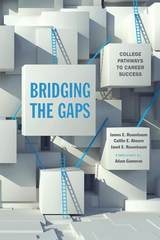
Bridging the Gaps
College Pathways to Career SuccessJames E. Rosenbaum
Russell Sage Foundation, 2017
The authors find that sub-baccalaureate credentials—associate degrees and college certificates—can improve employment outcomes. Young adults who complete these credentials have higher employment rates, earnings, autonomy, career opportunities, and job satisfaction than those who enroll but do not complete credentials. Sub-BA credentials can be completed at community college in less time than bachelor’s degrees, making them an affordable option for many low-income students.
Bridging the Gaps shows that when community colleges overemphasize bachelor’s degrees, they tend to funnel resources into remedial programs, and try to get low-performing students on track for a BA. Yet, remedial programs have inconsistent success rates and can create unrealistic expectations, leading struggling students to drop out before completing any degree. The authors show that colleges can devise procedures that reduce remedial placements and help students discover unseen abilities, attain valued credentials, get good jobs, and progress on degree ladders to higher credentials.
To turn college-for-all into a reality, community college students must be aware of their multiple credential and career options. Bridging the Gaps shows how colleges can create new pathways for non-traditional students to achieve success in their schooling and careers.
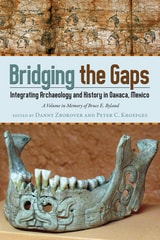
Bridging the Gaps
Integrating Archaeology and History in Oaxaca, Mexico; A Volume in Memory of Bruce E. BylandDanny Zborover
University Press of Colorado, 2015
Bridging the Gaps: Integrating Archaeology and History in Oaxaca, Mexico does just that: it bridges the gap between archaeology and history of the Precolumbian, Colonial, and Republican eras of the state of Oaxaca, Mexico, a cultural area encompassing several of the longest-enduring literate societies in the world.
Fourteen case studies from an interdisciplinary group of archaeologists, anthropologists, ethnohistorians, and art historians consciously compare and contrast changes and continuities in material culture before and after the Spanish conquest, in Prehispanic and Colonial documents, and in oral traditions rooted in the present but reflecting upon the deep past. Contributors consider both indigenous and European perspectives while exposing and addressing the difficulties that arise from the application of this conjunctive approach.
Inspired by the late Dr. Bruce E. Byland’s work in the Mixteca, which exemplified the union of archaeological and historical evidence and inspired new generations of scholars, Bridging the Gaps promotes the practice of integrative studies to explore the complex intersections between social organization and political alliances, religion and sacred landscape, ethnic identity and mobility, colonialism and resistance, and territoriality and economic resources.
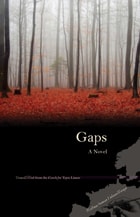
Gaps
A NovelBohumil Hrabal
Northwestern University Press, 2011
Gaps is a more overtly political novel than either In-House Weddings or Vita Nuova. The 1968 Soviet invasion of Czechoslovakia and the subsequent repression of artistic freedom figure prominently. Hrabal is placed on the "liquidated writers" list, and copies of his novel Poupata (Buds) are disposed of at the paper salvage where he once worked. Hrabal's decision to tell his autobiography in his wife Eliska's voice highlights their very close relationship and lovingly details her deep influence on his work. Every movement, sound, fragrance, and color is detailed, creating a collage of Bohumil and Eliska's life together, an unforgettable picture that reveals the author's innermost attitudes to life, love, and the pursuit of his own art.