Results by title
4 books match the query 'Garbage'
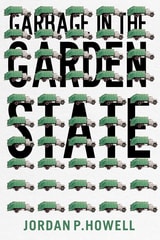
Garbage in the Garden State
Jordan P. Howell
Rutgers University Press, 2023
Garbage in the Garden State is the only book to examine the history of waste management in New Jersey. The state has played a pioneering role in the overall trajectory of waste management in the US. Howell's book is unique in the way that it places the contemporary challenges of waste management into their proper historical context – for instance, why does the system for recycling seem to work so poorly? Why do we have so many landfills in New Jersey, but also simultaneously not enough landfills or incinerators?
Howell acknowledges that New Jersey is sometimes imagined, particularly by non-New Jerseyans, as a giant garbage dump for New York and Philadelphia. But every place has had to struggle with the challenges of waste management. New Jersey's trash history is in fact more interesting and more important than most. New Jersey’s waste history includes intensive planning, deep-seated political conflict, organized crime, and literally every level of state and federal judiciary. It is a colorful history, to say the least, and one that includes a number of firsts with regard to recycling, comprehensive planning, and the challenging economics of trash.
Howell acknowledges that New Jersey is sometimes imagined, particularly by non-New Jerseyans, as a giant garbage dump for New York and Philadelphia. But every place has had to struggle with the challenges of waste management. New Jersey's trash history is in fact more interesting and more important than most. New Jersey’s waste history includes intensive planning, deep-seated political conflict, organized crime, and literally every level of state and federal judiciary. It is a colorful history, to say the least, and one that includes a number of firsts with regard to recycling, comprehensive planning, and the challenging economics of trash.
[more]
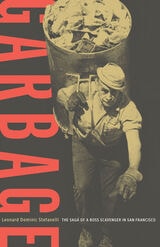
Garbage
The Saga of a Boss Scavenger in San FranciscoLeonard Dominic Stefanelli
University of Nevada Press, 2017
Garbage is a memoir of an exceptional trash collector from the streets and wharves of San Francisco. This is a rollicking first-person narrative that recounts an incredible life led and has amazing nuggets of wisdom scattered throughout its pages.
Stefanelli was trained to be a scavenger by his uncles in the 1940s and 50s at a time when rampant discrimination prevented Italian immigrants and their families from pursuing any other career. From there, he became a ‘boss scavenger’, married a garbage man’s daughter, and climbed the ranks of the Sunset Scavenger Company where he eventually took part in a corporate shakeup that made him the company’s president at only 31 years old. As one of the men at the helm of this booming industry, he became the chief advocate for increasingly innovative recycling and waste management practices in the Bay Area, and a foremost leader of environmentally-conscious business in the world.
Stefanelli’s lively memoir will enlighten readers to the waste management business, an industry that was once considered the lowest rung on the social ladder, but will also show his unparalleled capacity for transformation and vision.
[more]
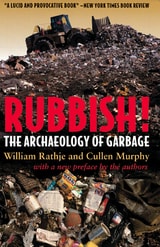
Rubbish!
The Archaeology of GarbageWilliam Rathje and Cullen Murphy
University of Arizona Press, 2001
It is from the discards of former civilizations that archaeologists have reconstructed most of what we know about the past, and it is through their examination of today’s garbage that William Rathje and Cullen Murphy inform us of our present. Rubbish! is their witty and erudite investigation into all aspects of the phenomenon of garbage. Rathje and Murphy show what the study of garbage tells us about a population’s demographics and buying habits. Along the way, they dispel the common myths about our “garbage crisis”—about fast-food packaging and disposable diapers, about biodegradable garbage and the acceleration of the average family’s garbage output. They also suggest methods for dealing with the garbage that we do have.
[more]
The Argument about Things in the 1980s
Goods and Garbage in an Age of NeoliberalismTim Jelfs
West Virginia University Press, 2018
In the late 1970s, a Jeff Koons art exhibit featured mounted vacuum cleaners lit by fluorescent tube lighting and identified by their product names: New Hoover Quik Broom, New Hoover Celebrity IV. Raymond Carver published short stories such as “Are These Actual Miles?” that cataloged the furniture, portable air conditioners, and children’s bicycles in a family home. Some years later the garbage barge Mobro 4000 turned into an international scandal as it spent months at sea, unable to dump its trash as it was refused by port after port.
Tim Jelfs’s The Argument about Things in the 1980s considers all this and more in a broad study of the literature and culture of the “long 1980s.” It contributes to of-the-moment scholarly debate about material culture, high finance, and ecological degradation, shedding new light on the complex relationship between neoliberalism and cultural life.
Tim Jelfs’s The Argument about Things in the 1980s considers all this and more in a broad study of the literature and culture of the “long 1980s.” It contributes to of-the-moment scholarly debate about material culture, high finance, and ecological degradation, shedding new light on the complex relationship between neoliberalism and cultural life.
[more]