Results by title
6 books match the query 'Garcilaso de la Vega'
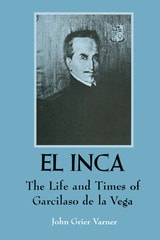
El Inca
The Life and Times of Garcilaso de la VegaBy John Grier Varner
University of Texas Press, 1968
Garcilaso de la Vega, the great chronicler of the Incas and the conquistadors, was born in Cuzco in 1539. At the age of twenty, he sailed to Spain to acquire an education, and he remained there until his death at Córdoba in 1616. As the natural son of a noble conquistador and an Indian woman of royal blood, he took immense pride in both his Spanish and Inca heritage, and, living as he did during a bewildering but stimulating epoch, he personally witnessed the last gasp of the dying Inca empire, the fratricidal conflicts that accompanied the Conquest, and the literary growth as well as the political decline of the Spain of Philip II and Philip III.
Garcilaso left for posterity one of the earliest accounts of the ancient Incas, a reliable though admittedly biased chronicle of Spanish conquests in Andean America and a glowing story of Hernando de Soto’s exploration of North America. Though he never lost pride in his Spanish heritage, continued rebuffs in caste-conscious Spain strengthened his pride in his Indian heritage and his sympathy for his mother’s people. Thus his histories, while ennobling Spaniards, also ennobled the Incas, and eventually were to have some influence in the struggle of South Americans for political independence from Spain. In both blood and character El Inca Garcilaso was a true mestizo. He is generally considered to have been the first native-born American to attain the honor of publication.
This was the life, and these were the times, that Varner has evoked so richly in his narrative. It rings and glitters with the sounds and colors of festivals, pageantry, and battle; it listens to the murmur of prayers, the defeated mutter of the Incas, the scratch of the scholar’s quill; it pictures both highlights and shadows. For the reader already acquainted with Garcilaso’s chronicles, this book will be a welcome complement; for those who are meeting El Inca here for the first time, it will be a rewarding and satisfying introduction.
Royal Commentaries of the Incas and General History of Peru, Part One
By Garcilaso de la Vega; translated by Harold V. Livermore
University of Texas Press, 1966
Garcilaso de la Vega, the first native of the New World to attain importance as a writer in the Old, was born in Cuzco in 1539, the illegitimate son of a Spanish cavalier and an Inca princess. Although he was educated as a gentleman of Spain and won an important place in Spanish letters, Garcilaso was fiercely proud of his Indian ancestry and wrote under the name EI Inca.
Royal Commentaries of the Incas is the account of the origin, growth, and destruction of the Inca empire, from its legendary birth until the death in 1572 of its last independent ruler. For the material in Part One of Royal Commentaries—the history of the Inca civilization prior to the arrival of the Spaniards—Garcilaso drew upon "what I often heard as a child from the lips of my mother and her brothers and uncles and other elders . . . [of] the origin of the Inca kings, their greatness, the grandeur of their empire, their deeds and conquests, their government in peace and war, and the laws they ordained so greatly to the advantage of their vassals."
The conventionalized and formal history of an oral tradition, Royal Commentaries describes the gradual imposition of order and civilization upon a primitive and barbaric world. To this Garcilaso adds facts about the geography and the flora and fauna of the land; the folk practices, religion, and superstitions; the agricultural and the architectural and engineering achievements of the people; and a variety of other information drawn from his rich store of traditional knowledge, personal observation, or speculative philosophy.
Important though it is as history, Garcilaso's classic is much more: it is also a work of art. Its gracious and graceful style, skillfully translated by Harold V. Livermore, succeeds in bringing to life for the reader a genuine work of literature.
Part One covers the history of the Incas up to the arrival of the Spanish.
Royal Commentaries of the Incas and General History of Peru, Part Two
By Garcilaso de la Vega; translated by Harold V. Livermore
University of Texas Press, 1966
Garcilaso de la Vega, the first native of the New World to attain importance as a writer in the Old, was born in Cuzco in 1539, the illegitimate son of a Spanish cavalier and an Inca princess. Although he was educated as a gentleman of Spain and won an important place in Spanish letters, Garcilaso was fiercely proud of his Indian ancestry and wrote under the name El Inca.
Royal Commentaries of the Incas is the account of the origin, growth, and destruction of the Inca empire, from its legendary birth until the death in 1572 of its last independent ruler. For the material in Part One of Royal Commentaries—the history of the Inca civilization prior to the arrival of the Spaniards—Garcilaso drew upon "what I often heard as a child from the lips of my mother and her brothers and uncles and other elders . . . [of] the origin of the Inca kings, their greatness, the grandeur of their empire, their deeds and conquests, their government in peace and war, and the laws they ordained so greatly to the advantage of their vassals."
The conventionalized and formal history of an oral tradition, Royal Commentaries describes the gradual imposition of order and civilization upon a primitive and barbaric world. To this Garcilaso adds facts about the geography and the flora and fauna of the land; the folk practices, religion, and superstitions; the agricultural and the architectural and engineering achievements of the people; and a variety of other information drawn from his rich store of traditional knowledge, personal observation, or speculative philosophy.
Important though it is as history, Garcilaso's classic is much more: it is also a work of art. Its gracious and graceful style, skillfully translated by Harold V. Livermore, succeeds in bringing to life for the reader a genuine work of literature.
Part Two covers the Spanish conquest of the Incas.
Royal Commentaries of the Incas and General History of Peru, Parts One and Two
Harold V. Garcilaso de la Vega
University of Texas Press, 2014
Garcilaso de la Vega, the first native of the New World to attain importance as a writer in the Old, was born in Cuzco in 1539, the illegitimate son of a Spanish cavalier and an Inca princess. Although he was educated as a gentleman of Spain and won an important place in Spanish letters, Garcilaso was fiercely proud of his Indian ancestry and wrote under the name El Inca.
Royal Commentaries of the Incas is the account of the origin, growth, and destruction of the Inca empire, from its legendary birth until the death in 1572 of its last independent ruler. For the material in Part One of Royal Commentaries—the history of the Inca civilization prior to the arrival of the Spaniards—Garcilaso drew upon "what I often heard as a child from the lips of my mother and her brothers and uncles and other elders . . . [of] the origin of the Inca kings, their greatness, the grandeur of their empire, their deeds and conquests, their government in peace and war, and the laws they ordained so greatly to the advantage of their vassals."
The conventionalized and formal history of an oral tradition, Royal Commentaries describes the gradual imposition of order and civilization upon a primitive and barbaric world. To this Garcilaso adds facts about the geography and the flora and fauna of the land; the folk practices, religion, and superstitions; the agricultural and the architectural and engineering achievements of the people; and a variety of other information drawn from his rich store of traditional knowledge, personal observation, or speculative philosophy.
Important though it is as history, Garcilaso's classic is much more: it is also a work of art. Its gracious and graceful style, skillfully translated by Harold V. Livermore, succeeds in bringing to life for the reader a genuine work of literature.
Selected Poems of Garcilaso de la Vega
A Bilingual EditionGarcilaso de la Vega
University of Chicago Press, 2009
Garcilaso de la Vega (ca. 1501–36), a Castilian nobleman and soldier at the court of Charles V, lived a short but glamorous life. As the first poet to make the Italian Renaissance lyric style at home in Spanish, he is credited with beginning the golden age of Spanish poetry. Known for his sonnets and pastorals, gracefully depicting beauty and love while soberly accepting their passing, he is shown here also as a calm student of love’s psychology and a critic of the savagery of war.
This bilingual volume is the first in nearly two hundred years to fully represent Garcilaso for an Anglophone readership. In facing-page translations that capture the music and skill of Garcilaso’s verse, John-Dent Young presents the sonnets, songs, elegies, and eclogues that came to influence generations of poets, including San Juan de la Cruz, Luis de Leon, Cervantes, and Góngora. The Selected Poems of Garcilaso de la Vega will help to explain to the English-speaking public this poet’s preeminence in the pantheon of Spanish letters.
The Florida of the Inca
By Garcilaso de la Vega
University of Texas Press, 1951
Perhaps the most amazing thing of all about Garcilaso de la Vega's epic account of the De Soto expedition is the fact that, although it is easily the first great classic of American history, it had never before received a complete or otherwise adequate English translation in the 346 years which have elapsed since its publication in Spanish. Now the Inca's thrilling narrative comes into its own in the English speaking world.
Hernando de Soto's expedition for the conquest of North America was the most ambitious ever to brave the perils of the New World. Garcilaso tells in remarkably rich detail of the conquistadors' wanderings over half a continent, of the unbelievable vicissitudes which beset them, of the Indians whom they sought to win for King and Church and by whose hands most of them died, of De Soto's death, and of the final pitiful failure of the expedition.