Results by title

4 books match the query 'Garland'
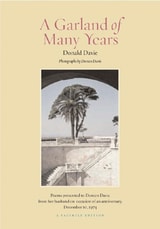
cover of A Garland of Many Years

A Garland of Many Years

Donald Davie

Vanderbilt University Press, 2005

The poems gathered here were composed by Donald Davie for his wife Doreen, to whom he was married and devoted for fifty years. The earliest of them were copied out by hand and presented to Doreen as a tribute on the occasion of her 54th birthday, and this "garland" was then added to over the years. Of the 43 poems, ten are published here for the first time, two others in new versions. They span the five decades of the couple's marriage, and because of this portray an enduring but complex relationship as it changes over time.

To some readers the poems will seem unusual as love poems because they do not idealize love and marriage. Their strength lies in their honesty and intimacy and in the openness to the pain and self-understanding that both ardor and conflict ("We, we throve on friction") can produce. This is a relationship in which each knows the other too well to be assuaged by a sentimental lyricism.

For this special edition, twelve of Doreen's photographs from their travels together have been included, so that her sensibility may be present, too, as an artist in her own right. Donald's handwritten poems are reproduced both in facsimile and in type.

[more]
cover of American Naturalism and the Jews: Garland, Norris, Dreiser, Wharton, and Cather

American Naturalism and the Jews

Garland, Norris, Dreiser, Wharton, and Cather

Donald Pizer

University of Illinois Press, 2007
American Naturalism and the Jews examines the unabashed anti-Semitism of five notable American naturalist novelists otherwise known for their progressive social values. Hamlin Garland, Frank Norris, and Theodore Dreiser all pushed for social improvements for the poor and oppressed, while Edith Wharton and Willa Cather both advanced the public status of women. But they all also expressed strong prejudices against the Jewish race and faith throughout their fiction, essays, letters, and other writings, producing a contradiction in American literary history that has stymied scholars and, until now, gone largely unexamined. In this breakthrough study, Donald Pizer confronts this disconcerting strain of anti-Semitism pervading American letters and culture, illustrating how easily prejudice can coexist with even the most progressive ideals. Pizer shows how these writers' racist impulses represented more than just personal biases, but resonated with larger social and ideological movements within American culture. Anti-Semitic sentiment motivated such various movements as the western farmers' populist revolt and the East Coast patricians' revulsion against immigration, both of which Pizer discusses here. This antagonism toward Jews and other non-Anglo-Saxon ethnicities intersected not only with these authors' social reform agendas but also with their literary method of representing the overpowering forces of heredity, social or natural environment, and savage instinct.
[more]
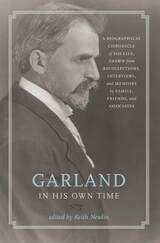
cover of Garland in His Own Time: A Biographical Chronicle of His Life, Drawn from Recollections, Interviews, and Memoirs by Family, Friends, and Associates

Garland in His Own Time

A Biographical Chronicle of His Life, Drawn from Recollections, Interviews, and Memoirs by Family, Friends, and Associates

Keith Newlin

University of Iowa Press, 2013
In his heyday, Hamlin Garland had a considerable reputation as a radical writer whose realistic stories and polemical essays agitating for a literature that accurately represented American life riled the nation’s press. Born in poverty and raised on a series of frontier farms, Garland fled the rural Midwest in 1881 at age twenty-one. When his stories combining the radical economic theories of Henry George with realistic depictions of farm life appeared as Main-Travelled Roads in 1891, reviewers praised his method but were disturbed by the bleak subject matter. Four years (and eight books) later, his frank depiction of sexuality in his novel of the New Woman, Rose of Dutcher’s Coolly (1895), made Garland even more controversial.


After realizing he couldn’t make a living from such realistic works, Garland turned first to biography, then to critically panned but commercially popular romances set in the mountain west, and eventually to autobiography. In 1917 he published A Son of the Middle Border, a remarkable autobiography in which he combined the story of his life to 1893 with the story of U.S. westward expansion, to considerable critical acclaim and large sales. Its 1921 sequel, A Daughter of the Middle Border, received the Pulitzer Prize for biography.


Although the author eventually wrote no fewer than eight autobiographies, he showed little awareness of the effect of his strong personality upon others. The sixty-six reminiscences in Garland in His Own Time offer an essential complement to his self-portrait by giving the perspectives of family, friends, fellow writers, and critics. The book offers the contemporary reader new reasons to return to this fascinating writer’s work. 
[more]
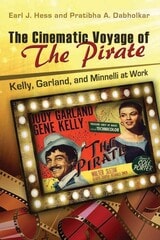
cover of The Cinematic Voyage of THE PIRATE: Kelly, Garland, and Minnelli at Work

The Cinematic Voyage of THE PIRATE

Kelly, Garland, and Minnelli at Work

Earl J. Hess and Pratibha A. Dabholkar

University of Missouri Press, 2014

During Metro-Goldwyn-Mayer’s glory days, the studio’s famous Arthur Freed Unit made an extraordinary string of dazzling musicals. One of its very best was The Pirate. Based on a successful 1942 Broadway production, the film was directed by Vincente Minnelli and starred Gene Kelly and Judy Garland. It showcased some of the brightest work of these three gifted moviemakers and entranced many critics and viewers with exotic set décor and costumes, brilliant Technicolor application, stunning dance routines, and a clever plot about an actor who pretends to be a famous pirate to win the love of a fanciful island girl.

The Cinematic Voyage of The Pirate: Kelly, Garland, and Minnelli at Work follows the model of Hess and Dabholkar’s previous study of Singin’ in the Rain. Drawing on exhaustive research in archives, memoirs, interviews, and newspaper coverage, it takes the reader from the original conception of the story in the mind of a German playwright named Ludwig Fulda, through S. N. Behrman’s Broadway production starring Alfred Lunt and Lynn Fontanne, to the arduous task of crafting a suitable screenplay at MGM. Behind-the-scenes issues such as Garland’s personal problems during the making of the film and the shaping of the film by Minnelli and Kelly are among the many subjects detailed here.
While the initial reception of The Pirate reinforced hopes for its success, many audiences did not understand the film’s tongue-in-cheek aspect, and some critical reviews were mixed. This shaded the perception of the film and its significance. As this careful study shows, The Pirate was a commercial and critical success despite some early misperceptions. The movie made a small profit for MGM, and the film grew in public appeal over time.

The Pirate has been studied by film historians, gender studies scholars, and film studies professionals since it was released in 1948. The Cinematic Voyage of The Pirate contributes to a growing literature asserting the importance of single-film production history and the significance of the film musical in the golden age of Hollywood.

[more]