Results by title
5 books match the query 'Gas industry'
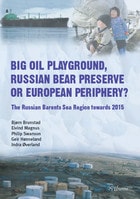
Big Oil Playground, Russian Bear Preserve or European Periphery?
The Russian Barents Sea Region towards 2015Bjørn Brunstad, Eivind Magnus, Philip Swanson, Geir Hønneland, and Indra Øverlan
Eburon Academic Publishers, 2005
In the far northwestern corner of Russia lies the Barents Sea: a rich region of natural resources that has yet to be fully exploited. Future actions taken in Barents will create major environmental, political, and economic ripples around the globe. Big Oil Playground, Russian Bear Preserve or European Periphery? explores three plausible and thought-provoking scenarios for the region's future over the next two decades.
The volume considers whether the international energy industry will transform Barents into a "big oil playground," if environmental protection rules will make it a "Russian bear preserve," or if integration into world trade will put it on the "European periphery." The result is a valuable resource for understanding the changing dynamics and challenges in modern public planning and a globalized economy.
The volume considers whether the international energy industry will transform Barents into a "big oil playground," if environmental protection rules will make it a "Russian bear preserve," or if integration into world trade will put it on the "European periphery." The result is a valuable resource for understanding the changing dynamics and challenges in modern public planning and a globalized economy.
[more]
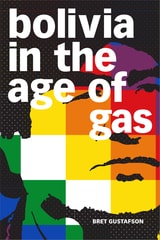
Bolivia in the Age of Gas
Bret Gustafson
Duke University Press, 2020
Evo Morales, Bolivia's first Indigenous president, won reelection three times on a leftist platform championing Indigenous rights, anti-imperialism, and Bolivian control over the country's natural gas reserves. In Bolivia in the Age of Gas, Bret Gustafson explores how the struggle over natural gas has reshaped Bolivia, along with the rise, and ultimate fall, of the country's first Indigenous-led government. Rethinking current events against the backdrop of a longer history of oil and gas politics and military intervention, Gustafson shows how natural gas wealth brought a measure of economic independence and redistribution, yet also reproduced political and economic relationships that contradicted popular and Indigenous aspirations for radical change. Though grounded in the unique complexities of Bolivia, the volume argues that fossil-fuel political economies worldwide are central to the reproduction of militarism and racial capitalism and suggests that progressive change demands moving beyond fossil-fuel dependence and the social and ecological ills that come with it.
[more]

REGULATED ENTERPRISE
NATURAL GAS PIPELINES AND NORTHEASTERN MCHRISTOPHER J. CASTANEDA
The Ohio State University Press, 1992
[more]
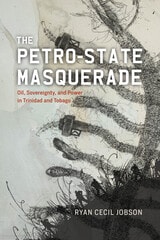
The Petro-state Masquerade
Oil, Sovereignty, and Power in Trinidad and TobagoRyan Cecil Jobson
University of Chicago Press, 2024
A historical and ethnographic study of the fraught relationship between fossil fuels and political power in Trinidad and Tobago.
Examining the past, present, and future of Trinidad and Tobago’s oil and gas industries, anthropologist Ryan Cecil Jobson traces how a model of governance fashioned during prior oil booms is imperiled by declining fossil fuel production and a loss of state control. Despite the twin-island nation’s increasingly volatile and vulnerable financial condition, however, government officials continue to promote it as a land of inexhaustible resources and potentially limitless profits.
The result is what Jobson calls a “masquerade of permanence” whereby Trinbagonian state actors represent the nation as an interminable reserve of hydrocarbons primed for multinational investment. In The Petro-state Masquerade, Jobson examines the gulf between this narrative crafted by the postcolonial state and the vexed realities of its dwindling petroleum-fueled aspirations. After more than a century of commercial oil production, Trinidad and Tobago instructs us to regard the petro-state as less a permanent form than a fragile relation between fossil fuels and sovereign authority. Foregrounding the concurrent masquerades of oil workers, activists, and Carnival revelers, Jobson argues that the promise of decolonization lies in the disarticulation of natural resources, capital, and political power by ordinary people in the Caribbean.
[more]
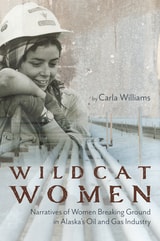
Wildcat Women
Narratives of Women Breaking Ground in Alaska's Oil and Gas IndustryCarla Williams
University of Alaska Press, 2018
Subzero temperatures, whiteout blizzards, and even the lack of restrooms didn’t deter them. Nor did sneers, harassment, and threats. Wildcat Women is the first book to document the life and labor of pioneering women in the oil fields of Alaska’s North Slope. It profiles fourteen women who worked in the fields, telling a little-known history of the Trans-Alaska Pipeline. These trailblazers conquered their fears to face hazardous working and living conditions, performing and excelling at “a man’s job in a man’s world.” They faced down challenges on and off the job: they drove buses over ice roads through snowstorms; wrestled with massive pipes; and operated dangerous valves that put their lives literally in their hands; they also fought union hall red tape, challenged discriminatory practices, and fought for equal pay—and sometimes won. The women talk about the roads that brought them to this unusual career, where they often gave up comfort and convenience and felt isolated and alienated. They also tell of the lifelong friendships and sense of family that bonded these unlikely wildcats. The physical and emotional hardship detailed in these stories exemplifies their courage, tenacity, resilience, and leadership, and shows how their fight for recognition and respect benefited woman workers everywhere.
[more]