Results by title
5 books match the query 'Gavaler, Chris'
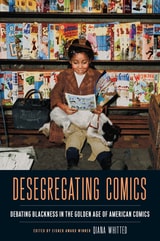
Desegregating Comics
Debating Blackness in the Golden Age of American ComicsQiana Whitted
Rutgers University Press, 2023
Winner of the Comics Studies Society Edited Book Prize
Shortlisted for the Best Academic / Scholarly Work Eisner Award
Honorable Mention for the Harry Shaw and Katrina Hazzard-Donald Award for Outstanding Work in African-American Popular Culture Studies from the Popular Culture Association
Some comics fans view the industry’s Golden Age (1930s-1950s) as a challenging time when it comes to representations of race, an era when the few Black characters appeared as brutal savages, devious witch doctors, or unintelligible minstrels. Yet the true portrait is more complex and reveals that even as caricatures predominated, some Golden Age comics creators offered more progressive and nuanced depictions of Black people.
Desegregating Comics assembles a team of leading scholars to explore how debates about the representation of Blackness shaped both the production and reception of Golden Age comics. Some essays showcase rare titles like Negro Romance and consider the formal innovations introduced by Black comics creators like Matt Baker and Alvin Hollingsworth, while others examine the treatment of race in the work of such canonical cartoonists as George Herriman and Will Eisner. The collection also investigates how Black fans read and loved comics, but implored publishers to stop including hurtful stereotypes. As this book shows, Golden Age comics artists, writers, editors, distributors, and readers engaged in heated negotiations over how Blackness should be portrayed, and the outcomes of those debates continue to shape popular culture today.
[more]

Mixed-Race Superheroes
Sika A. Dagbovie-Mullins
Rutgers University Press, 2021
American culture has long represented mixed-race identity in paradoxical terms. On the one hand, it has been associated with weakness, abnormality, impurity, transgression, shame, and various pathologies; however, it can also connote genetic superiority, exceptional beauty, and special potentiality. This ambivalence has found its way into superhero media, which runs the gamut from Ant-Man and the Wasp’s tragic mulatta villain Ghost to the cinematic depiction of Aquaman as a heroic “half-breed.”
The essays in this collection contend with the multitude of ways that racial mixedness has been presented in superhero comics, films, television, and literature. They explore how superhero media positions mixed-race characters within a genre that has historically privileged racial purity and propagated images of white supremacy. The book considers such iconic heroes as Superman, Spider-Man, and The Hulk, alongside such lesser-studied characters as Valkyrie, Dr. Fate, and Steven Universe. Examining both literal and symbolic representations of racial mixing, this study interrogates how we might challenge and rewrite stereotypical narratives about mixed-race identity, both in superhero media and beyond.
The essays in this collection contend with the multitude of ways that racial mixedness has been presented in superhero comics, films, television, and literature. They explore how superhero media positions mixed-race characters within a genre that has historically privileged racial purity and propagated images of white supremacy. The book considers such iconic heroes as Superman, Spider-Man, and The Hulk, alongside such lesser-studied characters as Valkyrie, Dr. Fate, and Steven Universe. Examining both literal and symbolic representations of racial mixing, this study interrogates how we might challenge and rewrite stereotypical narratives about mixed-race identity, both in superhero media and beyond.
[more]

On the Origin of Superheroes
From the Big Bang to Action Comics No. 1Chris Gavaler
University of Iowa Press, 2015
Most readers think that superheroes began with Superman’s appearance in Action Comics No. 1, but that Kryptonian rocket didn’t just drop out of the sky. By the time Superman’s creators were born, the superhero’s most defining elements—secret identities, aliases, disguises, signature symbols, traumatic origin stories, extraordinary powers, self-sacrificing altruism—were already well-rehearsed standards. Superheroes have a sprawling, action-packed history that predates the Man of Steel by decades and even centuries. On the Origin of Superheroes is a quirky, personal tour of the mythology, literature, philosophy, history, and grand swirl of ideas that have permeated western culture in the centuries leading up to the first appearance of superheroes (as we know them today) in 1938.
From the creation of the universe, through mythological heroes and gods, to folklore, ancient philosophy, revolutionary manifestos, discarded scientific theories, and gothic monsters, the sweep and scale of the superhero’s origin story is truly epic. We will travel from Jane Austen’s Bath to Edgar Rice Burroughs’s Mars to Owen Wister’s Wyoming, with some surprising stops along the way. We’ll meet mad scientists, Napoleonic dictators, costumed murderers, diabolical madmen, blackmailers, pirates, Wild West outlaws, eugenicists, the KKK, Victorian do-gooders, detectives, aliens, vampires, and pulp vigilantes (to name just a few). Chris Gavaler is your tour guide through this fascinating, sometimes dark, often funny, but always surprising prehistory of the most popular figure in pop culture today. In a way, superheroes have always been with us: they are a fossil record of our greatest aspirations and our worst fears and failings.
From the creation of the universe, through mythological heroes and gods, to folklore, ancient philosophy, revolutionary manifestos, discarded scientific theories, and gothic monsters, the sweep and scale of the superhero’s origin story is truly epic. We will travel from Jane Austen’s Bath to Edgar Rice Burroughs’s Mars to Owen Wister’s Wyoming, with some surprising stops along the way. We’ll meet mad scientists, Napoleonic dictators, costumed murderers, diabolical madmen, blackmailers, pirates, Wild West outlaws, eugenicists, the KKK, Victorian do-gooders, detectives, aliens, vampires, and pulp vigilantes (to name just a few). Chris Gavaler is your tour guide through this fascinating, sometimes dark, often funny, but always surprising prehistory of the most popular figure in pop culture today. In a way, superheroes have always been with us: they are a fossil record of our greatest aspirations and our worst fears and failings.
[more]

Superhero Thought Experiments
Comic Book PhilosophyChris Gavaler and Nathaniel Goldberg
University of Iowa Press, 2019
Examining the deep philosophical topics addressed in superhero comics, authors Gavaler and Goldberg read plot lines for the complex thought experiments they contain and analyze their implications as if the comic authors were philosophers. Reading superhero comic books through a philosophical lens reveals how they experiment with complex issues of morality, metaphysics, meaning, and medium. Given comics’ ubiquity and influence directly on (especially young) readers—and indirectly on consumers of superhero movies and video games—understanding these deeper meanings is in many ways essential to understanding contemporary popular culture. The result is an entertaining and enlightening look at superhero dilemmas.
[more]
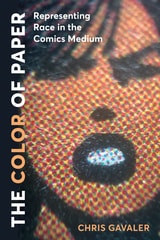
The Color of Paper
Representing Race in the Comics MediumChris Gavaler
The Ohio State University Press, 2026
How does a comics reader understand that a certain race is assigned to a character? In The Color of Paper, Chris Gavaler establishes a formal approach for analyzing racial representations in comics, demonstrating that the ink-on-paper materiality of comics reveals the illogic of metaphorical colors as racial categorizations. Analyzing images by a wide range of comics artists and colorists, including Emilee Denich, Jaime Hernandez, George Herriman, Jack Kirby, and Ben Passmore, Gavaler goes beyond pigment and gradient to explore the formal and material elements of page backgrounds and the negative space of gutters that literally frame race in comics. He surveys major and independent publishers to assess how industry trends and evolving coloring techniques affect racial representation. And, breaking from subjective and overgeneralized analytical norms, Gavaler grounds his analysis in quantitative research on viewers’ responses. The centuries-old relationships between drawn racial markers and assumptions about their meanings continue in a white-dominated culture that benefits from and therefore preserves illusions of their natural accuracy. Denaturalizing racial depictions through formal visual analysis potentially alters racial thinking in ways that extend beyond works on paper and into daily lives.
[more]