Results by title
4 books match the query 'Gay interpretations'
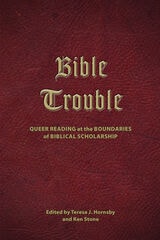
Bible Trouble
Queer Reading at the Boundaries of Biblical ScholarshipTeresa J. Hornsby
SBL Press, 2011
The essays in Bible Trouble all engage queer theories for purposes of biblical interpretation, a rare effort to date within biblical scholarship. The title phrase “Bible Trouble” plays on Judith Butler's Gender Trouble, gesturing toward a primary text for contemporary queer theory. The essays consider, among others, the Lazarus story, the Ethiopian eunuch, “gender trouble” in Judges 4 and 5, the Song of Songs, and an unorthodox coupling of the books of Samuel and the film Paris Is Burning. This volume “troubles” not only the boundaries between biblical scholarship and queer theory but also the boundaries between different frameworks currently used in the analysis of biblical literature, including sexuality, gender, race, class, history, and literature. The contributors are Ellen T. Armour, Michael Joseph Brown, Sean D. Burke, Heidi Epstein, Deryn Guest, Jione Havea, Teresa J. Hornsby, Lynn R. Huber, S. Tamar Kamionkowski, Joseph A. Marchal, Jeremy Punt, Erin Runions, Ken Stone, Gillian Townsley, Jay Twomey, and Manuel Villalobos.
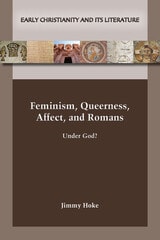
Feminism, Queerness, Affect, and Romans
Under God?Jimmy Hoke
SBL Press, 2021
"This is a book about submission and subversion, injustice and justice, heroes and villains."
In Feminism, Queerness, Affect, and Romans: Under God? Jimmy Hoke reads Romans with an innovative, intersectional approach that produces distinctive meanings for passages that probe how queer wo/men who first encountered Paul's letter could have engaged with it. Though Paul's letter to the Romans arguably contains the Bible’s strongest condemnation of queer wo/men (1:26–27), that is not the letter's full story. Hoke turns a feminist and queer gaze toward Paul’s conception of faith and ethics, making explicit how Paul's theology throughout Romans has been affectively motivated by imperial notions of gender, race, and sexuality. Moving beyond Paul's singular voice, Hoke engages with a feminist and queer praxis of assemblage to generate plausible ways wo/men of Rome interacted with this epistle. By engaging affect theory, Hoke brings to life not only ideas and words but the feelings and sensations that moved in-between some of the earliest Christ-followers, revealing how queer wo/men were there among them and what that means for queer wo/men today. Hoke includes a reader's guide with key terms used throughout the book, making this an excellent option for both students and scholars beginning to engage not only Paul's letters but also the complex worlds of feminist, queer, and affect theories.
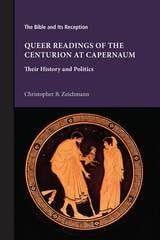
Queer Readings of the Centurion at Capernaum
Their History and PoliticsChristopher B. Zeichmann
SBL Press, 2022
The first-ever monograph on the history of queer biblical interpretation of a controversial biblical passage
Since the 1950s, homoerotic readings of the pericope in which Jesus heals a Roman centurion’s slave have been built upon three of the account’s features: the specific Greek word pais, which can refer to youth, slave, or the junior partner in a sexual relationship between two men; Luke’s characterization of the young man as “dear” (entimos) to the centurion; and commonplace homoeroticism in the Roman army. Rather than affirming or denying the historical reality of a sexual relationship between the centurion and the young man, Christopher B. Zeichmann instead traces the shifting patterns of queer readings of the text and the influences of the sexual, political, and theological discourses of late twentieth- and early twenty-first-century Europe, the United States, and Australia. Readers will see how distinct political contexts have led interpreters to find very different meanings about the sexual subtexts of this story.
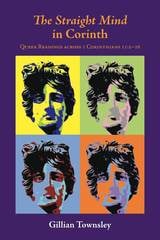
The Straight Mind in Corinth
Queer Readings across 1 Corinthians 11:2-16Gillian Townsley
SBL Press, 2017
A new reading that troubles and transgresses the normal with regard to biblical studies and our understandings of gender and sexuality
Despite its lack of both historical and exegetical clarity, 1 Corinthians 11:2-16 has often been fundamental to understandings of gender and sexuality in many Christian traditions. In particular, a hierarchical model of gender and a heterosexual model of sexuality tend to dominate and are presented as “natural” and “God-ordained.” With the materialist lesbian theory of Monique Wittig providing the theoretical basis for discussion, this book intersects various biblical, theological, and queer lines of inquiry across 1 Corinthians 11:2-16 in order to reveal and challenge these models of gender and sexuality that lie behind both the text itself and its various interpretations.
Features
- Reveals the complex relationship between effeminacy, masculinity and sexual relations in the first century Greco-Roman environment of the New Testament
- Explores the ideologies of sexuality that underlie much of the debate within evangelical circles
- Examines Karl Barth’s theology on the binary pairing of “man and woman” as asymmetrically related to each other and to God through the notion of the imago dei, revealing and challenging the ways in which this reflects androcentric and patriarchal ideologies