Results by title
8 books match the query 'Gay people in literature'
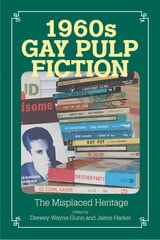
1960s Gay Pulp Fiction
The Misplaced HeritageDrewey Wayne Gunn
University of Massachusetts Press, 2013
As a result of a series of court cases, by the mid-1960s the U.S. post office could no longer interdict books that contained homosexuality. Gay writers were eager to take advantage of this new freedom, but the only houses poised to capitalize on the outpouring of manuscripts were “adult” paperback publishers who marketed their products with salacious covers. Gay critics, unlike their lesbian counterparts, have for the most part declined to take these works seriously, even though they cover an enormous range of genres: adventures, blue-collar and gray-flannel novels, coming-out stories, detective fiction, gothic novels, historical romances, military stories, political novels, prison fiction, romances, satires, sports stories, and spy thrillers—with far more short story collections than is generally realized. Twelve scholars have now banded together to begin a recovery of this largely forgotten explosion of gay writing that occurred in the 1960s.
Descriptions of these pulps have often been inadequate and misinforming, the result of misleading covers, unrepresentative sampling of texts, and a political blindness that refuses to grant worth to pre-Stonewall writing. This volume charts the broader implications of this state of affairs before examining some of the more significant pulp writers from the period. It brings together a diverse range of scholars, methodologies, and reading strategies. The evidence that these essays amass clearly demonstrates the significance of gay pulps for gay literary history, queer cultural studies, and book history.
Aberrations In Black
Toward a Queer of Color CritiqueRoderick A. Ferguson
University of Minnesota Press, 2003
A hard-hitting look at the regulation of sexual difference and its role in circumscribing African American culture
The sociology of race relations in America typically describes an intersection of poverty, race, and economic discrimination. But what is missing from the picture—sexual difference—can be as instructive as what is present. In this ambitious work, Roderick A. Ferguson reveals how the discourses of sexuality are used to articulate theories of racial difference in the field of sociology. He shows how canonical sociology—Gunnar Myrdal, Ernest Burgess, Robert Park, Daniel Patrick Moynihan, and William Julius Wilson—has measured African Americans’s unsuitability for a liberal capitalist order in terms of their adherence to the norms of a heterosexual and patriarchal nuclear family model. In short, to the extent that African Americans’s culture and behavior deviated from those norms, they would not achieve economic and racial equality.
Aberrations in Black tells the story of canonical sociology’s regulation of sexual difference as part of its general regulation of African American culture. Ferguson places this story within other stories—the narrative of capital’s emergence and development, the histories of Marxism and revolutionary nationalism, and the novels that depict the gendered and sexual idiosyncrasies of African American culture—works by Richard Wright, Ralph Ellison, James Baldwin, Audre Lorde, and Toni Morrison. In turn, this book tries to present another story—one in which people who presumably manifest the dysfunctions of capitalism are reconsidered as indictments of the norms of state, capital, and social science. Ferguson includes the first-ever discussion of a new archival discovery—a never-published chapter of Invisible Man that deals with a gay character in a way that complicates and illuminates Ellison’s project.
Unique in the way it situates critiques of race, gender, and sexuality within analyses of cultural, economic, and epistemological formations, Ferguson’s work introduces a new mode of discourse—which Ferguson calls queer of color analysis—that helps to lay bare the mutual distortions of racial, economic, and sexual portrayals within sociology.
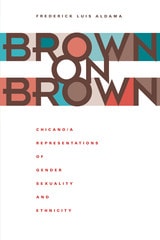
Brown on Brown
Chicano/a Representations of Gender, Sexuality, and EthnicityBy Frederick Luis Aldama
University of Texas Press, 2005
Common conceptions permeating U.S. ethnic queer theory tend to confuse aesthetics with real-world acts and politics. Often Chicano/a representations of gay and lesbian experiences in literature and film are analyzed simply as propaganda. The cognitive, emotional, and narrational ingredients (that is, the subject matter and the formal traits) of those representations are frequently reduced to a priori agendas that emphasize a politics of difference.
In this book, Frederick Luis Aldama follows an entirely different approach. He investigates the ways in which race and gay/lesbian sexuality intersect and operate in Chicano/a literature and film while taking into full account their imaginative nature and therefore the specific kind of work invested in them. Also, Aldama frames his analyses within today's larger (globalized) context of postcolonial literary and filmic canons that seek to normalize heterosexual identity and experience. Throughout the book, Aldama applies his innovative approach to throw new light on the work of authors Arturo Islas, Richard Rodriguez, John Rechy, Ana Castillo, and Sheila Ortiz Taylor, as well as that of film director Edward James Olmos. In doing so, Aldama aims to integrate and deepen Chicano literary and filmic studies within a comparative perspective. Aldama's unusual juxtapositions of narrative materials and cultural personae, and his premise that literature and film produce fictional examples of a social and historical reality concerned with ethnic and sexual issues largely unresolved, make this book relevant to a wide range of readers.
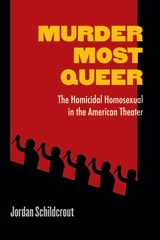
Murder Most Queer
The Homicidal Homosexual in the American TheaterJordan Schildcrout
University of Michigan Press, 2014
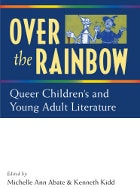
Over the Rainbow
Queer Children's and Young Adult LiteratureEdited by Michelle Ann Abate and Kenneth Kidd
University of Michigan Press, 2011
"Over the Rainbow is lively, engaging, and thoughtful. More to the point, the field of children's literature needs such a collection."
---Katherine Capshaw Smith, University of Connecticut
In spite of the growing critical interest concerning gender and sexual nonnormativity in and around narratives written for young readers, no book-length volume on the subject has yet appeared. Over the Rainbow: Queer Children's and Young Adult Literature is the first collection of essays dedicated to LGBTQ issues in children's literature. Bringing together significant essays and introducing new work, Over the Rainbow is intended to serve both as a scholarly reference and as a textbook for students of children's studies; gender/queer studies; and related disciplines such as English, history, sociology, and education. Editors Michelle Ann Abate and Kenneth Kidd showcase important essays on the subject of LGBTQ children's and young adult literature ---including Harriet the Spy, Rainbow Boys, Little Women, the Harry Potter series, and A Separate Peace---while providing a provisional history of both the literature and the scholarship and examining the field's origins, current status, and possible future orientations.
Over the Rainbow collects essays by Jes Battis, Robin Bernstein, Thomas Crisp, June Cummins, Elizabeth A. Ford, Sherrie A. Inness, Christine A. Jenkins, Vanessa Wayne Lee, Biddy Martin, Robert McRuer, Claudia Nelson, Jody Norton, Tison Pugh, Catherine Tosenberger, Eric L. Tribunella, Roberta Seelinger Trites, and Andrea Wood. These pieces will be of interest to scholars and students in the fields of children's literature, American Studies, LGBTQ and queer studies, cultural studies, and literary criticism.
Cover art: Original title page of The Wonderful Wizard of Oz, by Frank L. Baum, illustrated by W. W. Denslow. New York: George M. Hill, 1900.
Quare Joyce
Joseph Valente, Editor
University of Michigan Press, 2000
Queer Tidalectics
Linguistic and Sexual Fluidity in Contemporary Black Diasporic LiteratureEmilio Amideo
Northwestern University Press, 2021
Amideo engages and extends the work of Black queer studies, Oceanic studies, ecocriticism, phenomenology, and new materialism through the theorizations of Sara Ahmed, Omise’eke Natasha Tinsley, M. Jacqui Alexander, Édouard Glissant, José Esteban Muñoz, and Edward Kamau Brathwaite, among others. Ambitious in scope and captivating to read, Queer Tidalectics brings Caribbean writers like Glissant and Brathwaite into queer literary analysis—a major scholarly contribution.
Staging Desire
Queer Readings of American Theater HistoryKim Marra and Robert A. Schanke, Editors
University of Michigan Press, 2002
Essays cover the careers of major figures Clyde Fitch, Rachel Crothers, Mercedes de Acosta, Djuna Barnes, Cole Porter, Lorenz Hart, George Kelly, William Inge, James "Acorn" Oaks, Adam "Vagabond" Badeau, Eric Bentley, Loie Fuller, Robert Edmond Jones, and Jean Rosenthal. Grounded in research into the history of sexuality, the book engages central problems of terminology and evidence in analyzing sexual practices of the past and the modes of articulation of sexuality in theater, conditioned by American culture's peculiar anxieties about both.
Kim Marra is Associate Professor of Theatre Arts, University of Iowa. Robert A. Schanke is Professor of Theatre, Central College, Iowa. They edited Passing Performances: Queer Readings of Leading Players in American Theater History, a previous volume in this series.