Results by title
9 books match the query 'Gay people in popular culture'
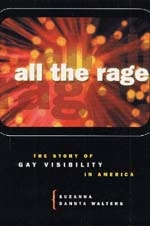
All the Rage
The Story of Gay Visibility in AmericaSuzanna Danuta Walters
University of Chicago Press, 2001
Many consider the new gay visibility a sign of social acceptance, while others charge that it is mere window dressing, obscuring the dogged persistence of discrimination. Walters moves beyond these positions and instead argues that these realities coexist: gays are simultaneously depicted as the sign of social decay and the chic flavor of the month. Taking on the common wisdom that visibility means progress, All the Rage maps the terrain on which gays are accepted as witty accessories in movies, gain access to political power, and yet still fall into constrictive stereotypes. Walters warns us with clarity and wit of the pitfalls of equating visibility with full integration into the fabric of American society. From the playful TV fantasies of lesbian weddings on Friends to the very real obstacles confronting gay marriage, from the award-winning comedy Will & Grace to Bible-thumping radio superhost Dr. Laura, All the Rage takes on naive celebrants and jaded naysayers alike. With a sophisticated mix of caution and optimism, it provides an illuminating guide through these exciting, controversial times.

Andy Warhol'S Blow Job
Roy Grundmann
Temple University Press, 2003
Grundmann draws on discourses of art history, film theory, queer studies, and cultural studies to situate Warhol's work at the nexus of Pop art, portrait painting, avant-garde film, and mainstream cinema. His close textual analysis of the film probes into its ambiguities and the ways in which viewers respond to what is and what is not on screen. Presenting rarely reproduced Warhol art and previously unpublished Ed Wallowitch photographs along with now iconic publicity shots of James Dean, Grundmann establishes Blow Job as a consummate example of Warhol's highly insightful engagement with a broad range of representational codes of gender and sexuality.
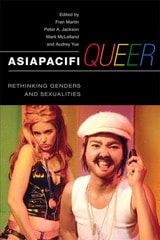
AsiaPacifiQueer
Rethinking Genders and SexualitiesEdited by Fran Martin, Peter A. Jackson, Mark McLelland, and Audrey Yue
University of Illinois Press, 2007
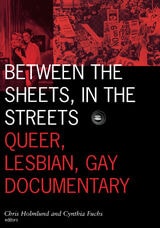
Between the Sheets, in the Streets
Queer, Lesbian, Gay DocumentaryChris Holmlund
University of Minnesota Press, 1997
The first book to focus on the connections between sexuality, activism, and documentary film.
From film festivals to university campuses, from private homes to first-run theaters, people everywhere are viewing and discussing gay, lesbian, queer, bisexual, and transgender films and videos. Between the Sheets, In the Streets considers these videos and films, testifying to the unavoidable connections between sexuality (the sheets) and activism (the streets) for all who identify as gay, lesbian, or queer in the 1990s.
This first collection of essays to focus exclusively on queer, lesbian, and gay documentary argues that documentary films and videos speak with a sense of political and social urgency, acting as testaments to the importance of reclaiming history and asserting the importance of these points of view. Among the topics discussed are representations of young queers on such shows as MTV’s The Real World; pre-Stonewall films; portrayals of lesbians and aging; video activism in Oregon and the South; and the works of Derek Jarman, Su Friedrich, Cheryl Dunye, and Sadie Benning. A range of films and videos is examined, including Strangers in Good Company, Paris Is Burning, Juggling Gender, Silverlake Life, and Without You I’m Nothing.Tracing an exhilarating range of perspectives and subject positions, Between the Sheets, In the Streets is an essential guide to current developments in queer, lesbian, and gay documentary. Contributors: Chris Cagle, Brown U; Linda Dittmar, U of Massachusetts, Boston; Lynda Goldstein, Pennsylvania State U, Wilkes-Barre Campus; Ronald Gregg, Drake U; Janet Jakobsen, U of Arizona; Lynda McAfee, New York Public Library; Kathleen McHugh, U of California, Riverside; Beverly Seckinger, U of Arizona; Marc Siegel, UCLA; Chris Straayer, Tisch School of the Arts; Erika Suderburg, U of California, Riverside; Thomas Waugh, Concordia U, Montreal; Justin Wyatt, U of North Texas.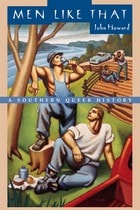
Men Like That
A Southern Queer HistoryJohn Howard
University of Chicago Press, 1999
Spanning four decades, Men Like That complicates traditional notions of a post-WWII conformist wave in America. Howard argues that the 1950s, for example, were a period of vibrant queer networking in Mississippi, while during the so-called "free love" 1960s homosexuals faced aggressive oppression. When queer sex was linked to racial agitation and when key civil rights leaders were implicated in homosexual acts, authorities cracked down and literally ran the accused out of town.
In addition to firsthand accounts, Men Like That finds representations of homosexuality in regional pulp fiction and artwork, as well as in the number one pop song about a suicidal youth who jumps off the Tallahatchie Bridge. And Howard offers frank, unprecedented assessments of outrageous public scandals: a conservative U.S. congressman caught in the act in Washington, and a white candidate for governor accused of patronizing black transgender sex workers.
The first book-length history of the queer South, Men Like That completely reorients our presuppositions about gay identity and about the dynamics of country life.
"Men Like That goes a long way towards redressing the urban bias in American lesbian and gay-history writing. . . . Howard's rigorous scholarship, which is based both on oral history and traditional historical documents . . . is enhanced by a disarmingly personal touch. . . . His insights into queerness and the mentality of the American South should be of great interest both to the professional gay historian and the general reader."—Madeleine Minson, Times Higher Education Supplement
"Howard creates a history remarkable in its complexity yet intimate in its portraiture. At long last an intimate and full vision of queer lives in America that did not unfold in San Francisco's discos."—Kirkus Reviews
"In this groundbreaking and engrossing analysis of gay male life in postwar Mississippi, Howard . . . boldly demonstrates that gay culture and sex not only existed but flourished in small towns."—Publishers Weekly, starred review

Our Vampires, Ourselves
Nina Auerbach
University of Chicago Press, 1995
"[Auerbach] has seen more Hammer movies than I (or the monsters) have had steaming hot diners, encountered more bloodsuckers than you could shake a stick at, even a pair of crossed sticks, such as might deter a very sophisticated ogre, a hick from the Moldavian boonies....Auerbach has dissected and deconstructed them with the tender ruthlessness of a hungry chef, with cogency and wit."—Eric Korn, Times Literary Supplement
"This seductive work offers profound insights into many of the urgent concerns of our time and forces us to confront the serious meanings that we invest, and seek, in even the shadiest manifestations of the eroticism of death."—Wendy Doniger, The Nation
"A vigorous, witty look at the undead as cultural icons."—Kirkus Review
"In case anyone should think this book is merely a boring lit-crit exposition...Auerbach sets matters straight in her very first paragraph. 'What vampires are in any given generation,' she writes, 'is a part of what I am and what my times have become. This book is a history of Anglo-American culture through its mutating vampires.'...Her book really takes off."—Maureen Duffy, New York Times Book Review
Queer Frontiers
Millennial Geographies, Genders, and GenerationsEdited by Joseph A. Boone, et.al.
University of Wisconsin Press, 2000
From the history of gay and lesbian studies to the emergence of video bars, from an interview with playwright Cherrie Moraga to a photo record of 1950s gay Los Angeles, these original essays tackle the past, present, and future of queer sexuality from all directions. Queer Frontiers brings together the most vital and energetic voices around; whether promising young scholar or veteran of gay activism, each contributor is helping to move the debate into uncharted territory.

Straight Korean Female Fans and Their Gay Fantasies
Jungmin Kwon
University of Iowa Press, 2019
The FANtasy subculture started forming around text-based media, such as yaoi, fan fiction, and U.S. gay-themed dramas (like Will & Grace), and has been influenced by diverse social, political, and economic conditions, such as the democratization of Korea, an open policy toward foreign media products, the diffusion of consumerism, government investment in the culture, the Hollywoodization of the film industry, and the popularity of Korean culture abroad. While much scholarly attention has been paid to female fandom for homoerotic cultural texts in many countries, this book seeks to explore a relatively neglected aspect of the subculture: its location in and influence on Korean society at large.
The Lesbian Menace
Ideology, Identity, and the Representation of Lesbian LifeSherrie A. Inness
University of Massachusetts Press, 1997
Electroshock. Hysterectomy. Lobotomy. These are only three of the many “cures” to which lesbians have been subjected in this century. How does a society develop such a profound aversion to a particular minority? In what ways do images in the popular media perpetuate cultural stereotypes about lesbians, and to what extent have lesbians been able to subvert and revise those images? This book addresses these and other questions by examining how lesbianism has been represented in American popular culture in the twentieth century and how conflicting ideologies have shaped lesbian experiences and identity.
In the first section, “Inventing the Lesbian,” Sherrie A. Inness explores depictions of lesbians in popular texts aimed primarily at heterosexual consumers. She moves from novels of the 1920s to books about life at women's colleges and boarding schools, to such contemporary women's magazines as Cosmopolitan, Glamour, and Vogue.
In the next section, “Forms of Resistance,” Inness probes the ways in which lesbians have refashioned texts intended for a heterosexual audience or created their own narratives. One chapter shows how lesbian readers have reinterpreted the Nancy Drew mysteries, looking at them from a distinctly “queer” perspective. Another chapter addresses the changing portrayal of lesbians in children's books over the past two decades.
The last section, “Writing in the Margins,” scrutinizes the extent to which lesbians, themselves a marginalized group, have created a society that relegates some of its own members to the outskirts. Topics include the geographic politics of lesbianism, the complex issue of "passing," and the meaning of butch identity in twentieth-century lesbian culture.