Results by title
6 books match the query 'Gays' writings'
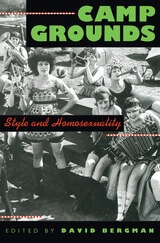
Camp Grounds
Style and HomosexualityEdited by David Bergman
University of Massachusetts Press, 1993
The concept of camp has never been easy to define. Derived from the French verb camper, “to pose,” it has been variously interpreted as a style that favors exaggeration, an ironic attitude toward the cultural mainstream, and a form of aestheticism that celebrates artifice over beauty. At the same time, camp has been long associated with homosexual culture, or at least with a self-conscious eroticism that questions traditional gender constructions.
The sixteen essays on camp included in this book explore further the relationship between style and homosexuality, showing how camp has made its way into every aspect of our cultural lives: theater, popular music, opera, film, and literature. Beginning with an overview of what camp is, where it came from, and how it operates, the chapter addresses topics ranging from the “high camp” of Whitman and Proust to the “low camp” of drag queen culture and gay fanzines. Together they carry forward a conversation that began more than twenty-five years ago, before Stonewall and AIDS, when Susan Sontag published her memorable “Notes on Camp.”
Novel Gazing
Queer Readings in FictionEve Kosofsky Sedgwick, ed.
Duke University Press, 1997
Through discussions of a diverse array of British, French, and American novels—including major canonical novels, best-sellers, children’s fiction, and science fiction—these essays explore queer worlds of taste, texture, joy, and ennui, focusing on such subjects as flogging, wizardry, exorcism, dance, Zionist desire, and Internet sexuality. Interpreting the works of authors as diverse as Benjamin Constant, Toni Morrison, T. H. White, and William Gibson, along with canonical queer modernists such as James, Proust, Woolf, and Cather, contributors reveal the wealth of ways in which selves and communities succeed in extracting sustenance from the objects of a culture whose avowed desire has often been not to sustain them. The dramatic reframing that these essays perform will make the significance of Novel Gazing extend beyond the scope of queer studies to literary criticism in general.
Contributors. Stephen Barber, Renu Bora, Anne Chandler, James Creech, Tyler Curtain, Jonathan Goldberg, Joseph Litvak, Michael Lucey, Jeff Nunokawa, Cindy Patton, Jacob Press, Robert F. Reid-Pharr, Eve Kosofsky Sedgwick, Melissa Solomon, Kathryn Bond Stockton, John Vincent, Maurice Wallace, Barry Weller
Queer Constellations
Subcultural Space In The Wake Of The CityDianne Chisholm
University of Minnesota Press, 2004
Discovers parallels between modern gay and lesbian views of urban life and Benjamin’s Paris, “the capital of the nineteenth century”
Queer Constellations investigates the dreams and catastrophes of recent urban history viewed through new queer narratives of inner-city life. The “gay village,” “gay mecca,” “gai Paris,” the “lesbian flaneur,” the “lesbian bohème”—these and other urban phantasmagoria feature paradoxically in this volume as figures of revolutionary utopia and commodity spectacle, as fossilized archetypes of social transformation and ruins of haunting cultural potential.
Dianne Chisholm introduces readers to new practices of walking, seeing, citing, and remembering the city in works by Neil Bartlett, Samuel R. Delany, Robert Glück, Alan Hollinghurst, Gary Indiana, Eileen Myles, Sarah Schulman, Gail Scott, Edmund White, and David Wojnarowicz. Reading these authors with reference to the history, sociology, geography, and philosophy of space, particularly to the everyday avant-garde production and practice of urban space, Chisholm reveals how—and how effectively—queer narrative documentary resembles and reassembles Walter Benjamin’s constellations of Paris, “capital of the nineteenth century.” Considering experimental queer writing in critical conjunction with Benjamin’s city writing, the book shows how a queer perspective on inner-city reality exposes contradictions otherwise obscured by mythic narratives of progress.If Benjamin regards the Paris arcade as a microcosm of high capitalism, wherein the (un)making of industrial society is perceived retrospectively, in contemporary queer narrative we see the sexually charged and commodity-entranced space of the gay bathhouse as a microcosm of late capitalism and as an exemplary site for excavating the contradictions of mass sex. In Chisholm’s book we discover how, looking back on the ruins of queer mecca, queer authors return to Benjamin to advance his “dialectics of seeing;” how they cruise the paradoxes of market capital, blasting a queer era out of the homogeneous course of history.
Queering Cold War Poetry
Ethics of Vulnerability in Cuba and the United StatesEric Keenaghan
The Ohio State University Press, 2009
Reading Sedgwick
Lauren Berlant, editor
Duke University Press, 2019
Contributors. Lauren Berlant, Kathryn Bond Stockton, Judith Butler, Lee Edelman, Jason Edwards, Ramzi Fawaz, Denis Flannery, Jane Gallop, Jonathan Goldberg, Meridith Kruse, Michael Moon, José Esteban Muñoz, Chris Nealon, Andrew Parker, H. A. Sedgwick, Karin Sellberg, Michael D. Snediker, Melissa Solomon, Robyn Wiegman
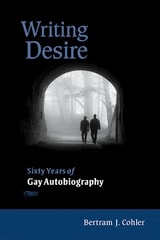
Writing Desire
Sixty Years of Gay AutobiographyBertram J. Cohler
University of Wisconsin Press, 2007
By contrasting the personal experience of these disparate writers, Cohler illustrates the social transformations that these men helped shape. Among Cohler's diverse subjects is Alan Helms, whose journey from Indiana to New York's gay society represents the passage of men who came of age in the 1950s and 1960s, when homosexuality was considered a hidden "disease." The liberating effects of Stonewall's aftermath are chronicled in the life of Arnie Kantrowitz, the prototypical activist for gay rights in the 1970s and the founder the Gay and Lesbian Alliance against Defamation. The artistic works of Tim Miller and Mark Doty evoke loss and shock during of the early stages of the AIDS epidemic in the 1980s. Cohler rounds out this collective group portrait by looking at the newest generation of writers in the Internet age via the blog of BrYaN, who did the previously unthinkable: he "outed" himself to millions of people.
A compelling mix of social history and personal biography, Writing Desire distills the experience of three generations of gay America.