Results by title

10 books match the query 'Gaze'
cover of An Utterly Dark Spot: Gaze and Body in Early Modern Philosophy

An Utterly Dark Spot

Gaze and Body in Early Modern Philosophy

Miran Bozovic

University of Michigan Press, 2000
Slovenian philosopher Miran Bozovic's An Utterly Dark Spot examines the elusive status of the body in early modern European philosophy by examining its various encounters with the gaze. Its range is impressive, moving from the Greek philosophers and theorists of the body (Aristotle, Plato, Hippocratic medical writers) to early modern thinkers (Spinoza, Leibniz, Malebranche, Descartes, Bentham) to modern figures including Jon Elster, Lacan, Althusser, Alfred Hitchcock, Stephen J. Gould, and others. Bozovic provides startling glimpses into various foreign mentalities haunted by problems of divinity, immortality, creation, nature, and desire, provoking insights that invert familiar assumptions about the relationship between mind and body.
The perspective is Lacanian, but Bozovic explores the idiosyncrasies of his material (e.g., the bodies of the Scythians, the transvestites transformed and disguised for the gaze of God; or Adam's body, which remained unseen as long as it was the only one in existence) with an attention to detail that is exceptional among Lacanian theorists. The approach makes for engaging reading, as Bozovic stages imagined encounters between leading thinkers, allowing them to converse about subjects that each explored, but in a different time and place. While its focus is on a particular problem in the history of philosophy, An Utterly Dark Spot will appeal to those interested in cultural studies, semiotics, theology, the history of religion, and political philosophy as well.
Miran Bozovic is Associate Professor of Philosophy at the University of Ljubljana, Slovenia. He is the author of Der grosse Andere: Gotteskonzepte in der Philosophie der Neuzeit (Vienna: Verlag Turia & Kant, 1993) and editor of The Panopticon Writings by Jeremy Bentham (London: Verso, 1995).
[more]
cover of Experimental Ethnography: The Work of Film in the Age of Video

Experimental Ethnography

The Work of Film in the Age of Video

Catherine Russell

Duke University Press, 1999

Experimental film and ethnographic film have long been considered separate, autonomous practices on the margins of mainstream cinema. By exploring the interplay between the two forms, Catherine Russell throws new light on both the avant-garde and visual anthropology.
Russell provides detailed analyses of more than thirty-five films and videos from the 1890s to the 1990s and discusses a wide range of film and videomakers, including Georges Méliès, Maya Deren, Peter Kubelka, Ray Birdwhistell, Jean Rouch, Su Friedrich, Bill Viola, Kidlat Tahimik, Margaret Mead, Tracey Moffatt, and Chantal Akerman. Arguing that video enables us to see film differently—not as a vanishing culture but as bodies inscripted in technology, Russell maps the slow fade from modernism to postmodern practices. Combining cultural critique with aesthetic analysis, she explores the dynamics of historical interruption, recovery, and reevaluation. As disciplinary boundaries dissolve, Russell contends, ethnography is a means of renewing the avant-gardism of “experimental” film, of mobilizing its play with language and form for historical ends. “Ethnography” likewise becomes an expansive term in which culture is represented from many different and fragmented perspectives.
Original in both its choice of subject and its theoretical and methodological
approaches, Experimental Ethnography will appeal to visual anthropologists, as well as film scholars interested in experimental and documentary practices.

[more]
cover of Gaze and Voice as Love Objects: SIC 1

Gaze and Voice as Love Objects

SIC 1

Renata Salecl and Slavoj Žižek, eds.

Duke University Press, 1996

The gaze entices, inspects, fascinates. The voice hypnotizes, seduces, disarms. Are gaze and voice part of the relationship we call love . . . or hate? If so, what part? How do they function? This provocative book examines love as the mediating entity in the essential antagonism between the sexes, and gaze and voice as love's medium. The contributors proceed from the Lacanian premise that "there is no sexual relationship," that the sexes are in no way complementary and that love—figured in the gaze and the voice —embodies the promise and impossibility of any relation between them.

The first detailed Lacanian elaboration of this topic, Gaze and Voice as Love Objects examines the status of gaze, voice, and love in philosophy from Plato to Kant, in ideology from early Christianity to contemporary cynicism, in music from Hildegard of Bingen to Richard Wagner, in literature from Edith Wharton's Age of Innocence to Kazuo Ishiguro's The Remains of the Day, and in cinema from Michael Powell's Peeping Tom to Kieslowski's A Short Film on Love. Throughout, the contributors seek to show that the conflict between the sexes is the site of a larger battle over the destiny of modernity. With insights into the underlying target of racist and sexist violence, this book offers surprising revelations into the nature of an ancient enigma—love.

Contributors. Elisabeth Bronfen, Mladen Dolar, Fredric Jameson, Renata Salecl, Slavoj Žižek, Alenka Zupancic
[more]
cover of Geography of the Gaze: Urban and Rural Vision in Early Modern Europe

Geography of the Gaze

Urban and Rural Vision in Early Modern Europe

Renzo Dubbini

University of Chicago Press, 2002

Geography of the Gaze offers a new history and theory of how the way we look at things influences what we see. Focusing on Western Europe from the seventeenth to nineteenth centuries, Renzo Dubbini shows how developments in science, art, mapping, and visual epistemology affected the ways natural and artificial landscapes were perceived and portrayed.

He begins with the idea of the "view," explaining its role in the invention of landscape painting and in the definition of landscape as a cultural space. Among other topics, Dubbini explores how the descriptive and pictorial techniques used in mariners' charts, view-oriented atlases, military cartography, and garden design were linked to the proliferation of highly realistic paintings of landscapes and city scenes; how the "picturesque" system for defining and composing landscapes affected not just art but also archaeology and engineering; and how the ever-changing modern cityscapes inspired new ways of seeing and representing the urban scene in Impressionist painting, photography, and stereoscopy. A marvelous history of viewing, Geography of the Gaze will interest everyone from scientists to artists.
[more]
cover of Returning the Gaze: A Genealogy of Black Film Criticism, 1909–1949

Returning the Gaze

A Genealogy of Black Film Criticism, 1909–1949

Anna Everett

Duke University Press, 2001

In Returning the Gaze Anna Everett revises American film history by recuperating the extensive and all-but-forgotten participation of black film critics during the early twentieth century. While much of the existing scholarship on blacks and the cinema focuses on image studies and stereotypical representations, this work excavates a wealth of early critical writing on the cinema by black cultural critics, academics, journalists, poets, writers, and film fans.
Culling black newspapers, magazines, scholarly and political journals, and monographs, Everett has produced an unparalleled investigation of black critical writing on the early cinema during the era of racial segregation in America. Correcting the notion that black critical interest in the cinema began and ended with the well-documented press campaign against D. W. Griffith’s Birth of a Nation, she discovers that as early as 1909 black newspapers produced celebratory discourses about the cinema as a much-needed corrective to the predominance of theatrical blackface minstrelsy. She shows how, even before the Birth of a Nation controversy, the black press succeeded in drawing attention to both the callous commercial exploitation of lynching footage and the varied work of black film entrepreneurs. The book also reveals a feast of film commentaries that were produced during the “roaring twenties” and the jazz age by such writers as W.E.B. DuBois, Langston Hughes, and Zora Neale Hurston, as well as additional pieces that were written throughout the Depression and the pre– and post–war periods. Situating this wide-ranging and ideologically complex material in its myriad social, political, economic, and cultural contexts, Everett aims to resuscitate a historical tradition for contemporary black film literature and criticism.
Returning the Gaze will appeal to scholars and students of film, black and ethnic studies, American studies, cultural studies, literature, and journalism.
[more]
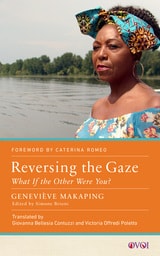
cover of Reversing the Gaze: What If the Other Were You?

Reversing the Gaze

What If the Other Were You?

Geneviève Makaping

Rutgers University Press, 2023

Tired of being scrutinized, criticized, and fetishized for her black skin, Cameroon-born scholar Geneviève Makaping turns the tables on Italy’s white majority, regarding them through the same unsparing gaze to which minorities have traditionally been subjected. As she candidly recounts her experiences—first across Africa and then as a migrant Black woman in Italy—Makaping describes acts of racist aggression that are wearying and degrading to encounter on a daily basis. She also offers her perspective on how various forms of inequality based on race, color, gender, and class feed off each other. Reversing the Gaze invites readers to confront the question of racism through the retelling of everyday occurrences that we might have experienced as victims, perpetrators, or witnesses. 
[more]
cover of Show & The Gaze Of Theatre: A European Perspective

Show & The Gaze Of Theatre

A European Perspective

Erika Fischer-Lichte

University of Iowa Press, 1997

Theatre, in some respects, resembles a market. Stories, rituals, ideas, perceptive modes, conversations, rules, techniques, behavior patterns, actions, language, and objects constantly circulate back and forth between theatre and the other cultural institutions that make up everyday life in the twentieth century. These exchanges, which challenge the established concept of theatre in a way that demands to be understood, form the core of Erika Fischer-Lichte's dynamic book.

Each eclectic essay investigates the boundaries that separate theatre from other cultural domains. Every encounter between theatre and other art forms and institutions renegotiates and redefines these boundaries as part of an ongoing process. Drawing on a wealth of fascinating examples, both historical and contemporary, Fischer-Lichte reveals new perspectives in theatre research from quite a number of different approaches. Energetically and excitingly, she theorizes history, theorizes and historicizes performance analysis, and historicizes theory.
[more]
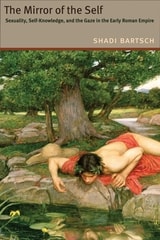
cover of The Mirror of the Self: Sexuality, Self-Knowledge, and the Gaze in the Early Roman Empire

The Mirror of the Self

Sexuality, Self-Knowledge, and the Gaze in the Early Roman Empire

Shadi Bartsch

University of Chicago Press, 2006

People in the ancient world thought of vision as both an ethical tool and a tactile sense, akin to touch. Gazing upon someone—or oneself—was treated as a path to philosophical self-knowledge, but the question of tactility introduced an erotic element as well.  In The Mirror of the Self, Shadi Bartsch asserts that these links among vision, sexuality, and self-knowledge are key to the classical understanding of the self. 

Weaving together literary theory, philosophy, and social history, Bartsch traces this complex notion of self from Plato’s Greece to Seneca’s Rome. She starts by showing how ancient authors envisioned the mirror as both a tool for ethical self-improvement and, paradoxically, a sign of erotic self-indulgence. Her reading of the Phaedrus, for example, demonstrates that the mirroring gaze in Plato, because of its sexual possibilities, could not be adopted by Roman philosophers and their students. Bartsch goes on to examine the Roman treatment of the ethical and sexual gaze, and she traces how self-knowledge, the philosopher’s body, and the performance of virtue all played a role in shaping the Roman understanding of the nature of selfhood. Culminating in a profoundly original reading of Medea, The Mirror of the Self illustrates how Seneca, in his Stoic quest for self-knowledge, embodies the Roman view, marking a new point in human thought about self-perception.

Bartsch leads readers on a journey that unveils divided selves, moral hypocrisy, and lustful Stoics—and offers fresh insights about seminal works. At once sexy and philosophical, The Mirror of the Self will be required reading for classicists, philosophers, and anthropologists alike.
[more]
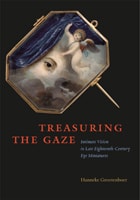
cover of Treasuring the Gaze: Intimate Vision in Late Eighteenth-Century Eye Miniatures

Treasuring the Gaze

Intimate Vision in Late Eighteenth-Century Eye Miniatures

Hanneke Grootenboer

University of Chicago Press, 2013

The end of the eighteenth century saw the start of a new craze in Europe: tiny portraits of single eyes that were exchanged by lovers or family members. Worn as brooches or pendants, these minuscule eyes served the same emotional need as more conventional mementoes, such as lockets containing a coil of a loved one’s hair. The fashion lasted only a few decades, and by the early 1800s eye miniatures had faded into oblivion. Unearthing these portraits in Treasuring the Gaze, Hanneke Grootenboer proposes that the rage for eye miniatures—and their abrupt disappearance—reveals a knot in the unfolding of the history of vision.
 
Drawing on Alois Riegl, Jean-Luc Nancy, Marcia Pointon, Melanie Klein, and others, Grootenboer unravels this knot, discovering previously unseen patterns of looking and strategies for showing. She shows that eye miniatures portray the subject’s gaze rather than his or her eye, making the recipient of the keepsake an exclusive beholder who is perpetually watched. These treasured portraits always return the looks they receive and, as such, they create a reciprocal mode of viewing that Grootenboer calls intimate vision. Recounting stories about eye miniatures—including the role one played in the scandalous affair of Mrs. Fitzherbert and the Prince of Wales, a portrait of the mesmerizing eye of Lord Byron, and the loss and longing incorporated in crying eye miniatures—Grootenboer shows that intimate vision brings the gaze of another deep into the heart of private experience.
 
With a host of fascinating imagery from this eccentric and mostly forgotten yet deeply private keepsake, Treasuring the Gaze provides new insights into the art of miniature painting and the genre of portraiture.
[more]
cover of WEB OF FANTASIES: Gaze, Image, & Gender in Ovid’s Metamorphoses

WEB OF FANTASIES

Gaze, Image, & Gender in Ovid’s Metamorphoses

Patricia B Salzman-Mitchell

The Ohio State University Press, 2005

Drawing on recent scholarship in art, film, literary theory, and gender studies, A Web of Fantasies examines the complexities, symbolism and interactions between gaze and image in Ovid’s Metamorphoses and forms a gender-sensitive perspective. It is a feminist study of Ovid’s epic, which includes many stories about change, in which discussions of viewers, viewing, and imagery strive to illuminate Ovid’s constructions of male and female. Patricia Salzman-Mitchell discusses the text from the perspective of three types of gazes: of characters looking, of the poet who narrates visually charged stories, and of the reader who “sees” the woven images in the text. Arguing against certain theorists who deny the possibility of any feminine vision in a male-authored poem, the author maintains that the female point of view can be released through the traditional feminine occupation of weaving, featuring the woven images of Arachne (involved in a weaving contest in which she tried to best the goddess Athena, who turned her into a spider) and Philomela (who had her tongue cut out, so had to weave a tapestry depicting her rape and mutilation).
     The book observes that while feminist models of the gaze can create productive readings of the poem, these models are too limited and reductive for such a protean and complex text as Metamorphoses. This work brings forth the pervasive importance of the act of looking in the poem which will affect future readings of Ovid’s epic.
[more]