Results by title
4 books match the query 'Geiger, Roger L.'
A New Deal for the Humanities
Liberal Arts and the Future of Public Higher EducationHutner, Gordon
Rutgers University Press, 2015
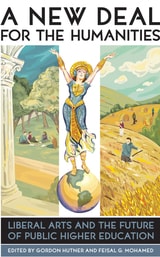
The contributors offer spirited and thought-provoking debates on a diverse range of topics. For instance, they deplore the push by administrations to narrow learning into quantifiable outcomes as well as the demands of state governments for more practical, usable training. Indeed, for those who suggest that a college education should be “practical”—that it should lean toward the sciences and engineering, where the high-paying jobs are—this book points out that while a few nations produce as many technicians as the United States does, America is still renowned worldwide for its innovation and creativity, skills taught most effectively in the humanities. Most importantly, the essays in this collection examine ways to make the humanities even more effective, such as offering a broader array of options than the traditional major/minor scheme, options that combine a student’s professional and intellectual interests, like the new medical humanities programs.
A democracy can only be as energetic as the minds of its citizens, and the questions fundamental to the humanities are also fundamental to a thoughtful life. A New Deal for the Humanities takes an intrepid step in making the humanities—and our citizens—even stronger in the future.
Private Sectors in Higher Education
Structure, Function, and Change in Eight CountriesRoger L. Geiger
University of Michigan Press, 1986
Science as Service
Establishing and Reformulating American Land-Grant Universities, 1865–1930Edited by Alan I Marcus
University of Alabama Press, 2015
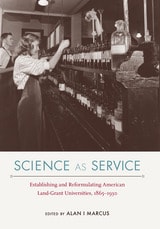
The Morrill Land-Grant College Act of 1862 created a series of institutions—at least one in every state and territory—with now familiar names: Michigan State University, Ohio State University, Purdue University, Rutgers University, the University of Arizona, and the University of California, to name a few. These schools opened educational opportunities and pathways to a significant segment of the American public and gave the United States a global edge in science, technical innovation, and agriculture.
Science as Service provides an essential body of literature for understanding the transformations of the land-grant colleges established by the Morrill Act in 1862 as well as the considerable impact they had on the history of the United States. Historians of science, technology, and agriculture, along with rural sociologists, public decision and policy makers, educators, and higher education administrators will find this an essential addition to their book collections.
The American College in the Nineteenth Century
Roger L. Geiger
Vanderbilt University Press, 2000
At the end of the eighteenth century, just eighteen colleges existed in the United States, with an average enrollment of fewer than seventy. One hundred years later, over 450 American colleges and universities boasted enrollments up more than one hundredfold. The role of educational institutions in the life of the nation had been utterly transformed.
As the bridge between the two eras, the nineteenth-century college has been among the most controversial subjects in the history of American higher education. While earlier historians portrayed the "old-time" college as an impediment to modernization, later scholars affirmed the broad role of the colleges in the education of the American people.
The American College in the Nineteenth Century combines the best recent scholarship with an interpretive introduction to provide a fresh view of the development of American colleges. The contributors consider these institutions within four new contexts: first, the dramatic transformation in the college students' experience from oppressive discipline to relative freedom; second, the regional variations among the developing American colleges (for example, a South dominated by state colleges, a Midwest by denominational schools); third, the revolution in the century's third quarter as colleges became multipurpose institutions; and fourth, universities that became dominant by the end of the century, incorporating rather than displacing the colleges.
Innovative in its examination of the nature and function of these uniquely American institutions, The American College in the Nineteenth Century is a vital addition to the scholarship of the period.
Contributors: David B. Potts, Leon Jackson, Julie Ann Bubolz, Michael Sugrue, James Findlay, Margaret A. Nash, Peter Dobkin Hall, James Turner, Paul Bernard, and Willard J. Pugh.