Results by title
3 books match the query 'Gems'
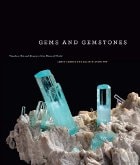
Gems and Gemstones
Timeless Natural Beauty of the Mineral WorldLance Grande and Allison Augustyn
University of Chicago Press, 2009
Gems are objects of wealth, icons of beauty, and emblems of the very best of everything. They are kept as signs of prestige or power. Given as tokens of love and affection, they also come in a kaleidoscopic array of hues and can be either mineral or organic. Gems can command a person’s gaze in the way they play with light and express rich color. And they can evoke feelings of passion, greed, mystery, and warmth.
For millennia, gems have played an important role in human culture: they have significant value, both financially and within folklore and mythology. But just what are gems, exactly? This lavishly illustrated volume—the most ambitious publication of its kind—provides a general introduction to gems and natural gemstones, conveying their timeless beauty and exploring similarities among different species and varieties. Gems and Gemstones features nearly 300 color images of the cut gems, precious and semiprecious stones, gem-quality mineral specimens, and fine jewelry to be unveiled in a new Grainger Hall of Gems at The Field Museum in Chicago this October. The book and exhibition’s overarching theme will be the relationship between finished gems and their natural origin: while beautiful as faceted and polished pieces of jewelry, gems are often just as lovely—or even more so—as gemstones in their natural state. For example, an aquamarine or emerald as originally found in a mine with its natural crystal faces can be as stunning as any cut and polished gem prepared for a ring, bracelet, or charm.
Thoughtful of both ancient and modern times, Gems and Gemstones also includes fun-filled facts and anecdotes that broaden the historical portrait of each specimen. When Harry Winston, for instance, donated the Hope Diamond to the Smithsonian in 1958, he sent it through the U.S. mail wrapped in plain brown paper. And for anyone who has ever marveled at the innovations of top jewelry designers, Gems and Gemstones features a dazzling array of polished stones, gold objects, and creations from around the world. Diamonds, sapphires, rubies, amethysts, pearls, topaz, amber—every major gem gets its due in what will be an invaluable source on the subject for years to come.
Gems and Gemstones is the basis for the iPad app, available in the Apple iTunes App Store, Gems and Jewels.
Gems and the New Science
Matter and Value in the Scientific RevolutionMichael Bycroft
University of Chicago Press, 2026
In Gems and the New Science, Michael Bycroft argues that gems were connected to major developments in the “new science” between the sixteenth and nineteenth centuries. As he explains, precious and semiprecious stones were at the center of dramatic shifts in natural knowledge in early modern Europe. They were used to investigate luminescence, electricity, combustion, chemical composition, and more. They were collected by naturalists; measured by mathematicians; and rubbed, burned, and dissolved by experimental philosophers. This led to the demise of the traditional way of classifying gems—which grouped them by transparency, color, and locality—and the turn to density, refraction, chemistry, and crystallography as more reliable guides for sorting these substances.
The science of gems shows that material evaluation was as important as material production in the history of science. It also shows the value of seeing science as the product of the interaction between different material worlds. The book begins by bringing these insights to bear on five themes of the Scientific Revolution. Each of the subsequent chapters deals with a major episode in early modern science, from the expansion of natural history in the sixteenth century to the emergence of applied science early in the nineteenth century. This important work is not only the first book-length history of the science of gems but also a fresh interpretation of the Scientific Revolution and an argument for using a new form of materialism to understand the evolution of science.
Gems of Art on Paper
Illustrated American Fiction and Poetry, 1785–1885Georgia Brady Barnhill
University of Massachusetts Press, 2021
In the immediate aftermath of the Revolutionary War, only the wealthiest Americans could afford to enjoy illustrated books and prints. But, by the end of the next century, it was commonplace for publishers to load their books with reproductions of fine art and beautiful new commissions from amateur and professional artists.
Georgia Brady Barnhill, an expert on the visual culture of this period, explains the costs and risks that publishers faced as they brought about the transition from a sparse visual culture to a rich one. Establishing new practices and investing in new technologies to enhance works of fiction and poetry, bookmakers worked closely with skilled draftsmen, engravers, and printers to reach an increasingly literate and discriminating American middle class. Barnhill argues that while scholars have largely overlooked the efforts of early American illustrators, the works of art that they produced impacted readers' understandings of the texts they encountered, and greatly enriched the nation's cultural life.