Results by title
6 books match the query 'Gender Equality'
Fetal Rights, Women's Rights
Gender Equality in the WorkplaceSuzanne U. Samuels
University of Wisconsin Press, 1995
In the late 1970s and throughout the 1980s, many private employers in the United States enacted fetal protection policies that barred fertile women—that is, women who had not been surgically sterilized—from working in jobs that might expose fetuses to toxins. In Fetal Rights, Women’s Rights, Suzanne Samuels analyzes these policies and the ambiguous responses to them by federal and state courts, legislatures, administrative agencies, litigants, and interest groups. She poses provocative questions about the implicit links between social welfare concerns and paternalism in the workplace, including: are women workers or wombs?
Placing the fetal protection controversy within the larger societal debate about gender roles, Samuels argues that governmental decision-makers confuse sex, which is based solely on biological characteristics, with gender, which is based on societal conceptions. She contends that the debate about fetal protection policies brought this ambiguity into stark relief, and that the response of policy-makers was rooted in assumptions about gender roles. Judges, legislators, and regulators used gender as a proxy, she argues, to sidestep the question of whether fetal protection policies could be justified by the biological differences between women and men.
The fetal protection controversy raises a number of concerns about women's role in the workplace. Samuels discusses the effect on governmental policies of the ongoing controversy over abortion rights and the debates between egalitarian and relational feminists about the treatment of women at work. A timely and engrossing study, Fetal Rights, Women's Rights details the pattern of gender politics in the United States and demonstrates the broader ramifications of gender bias in the workplace.

Multiple Meanings of Gender Equality
A critical frame analysis of gender policies in EuropeMieke Verloo
Central European University Press, 2007
The Paradox of Gender Equality
How American Women's Groups Gained and Lost Their Public VoiceKristin A. Goss
University of Michigan Press, 2013
Drawing on original research, Kristin A. Goss examines how women's civic place has changed over the span of more than 120 years, how public policy has driven these changes, and why these changes matter for women and American democracy. Suffrage, which granted women the right to vote and invited their democratic participation, provided a dual platform for the expansion of women's policy agendas. As measured by women's groups' appearances before the U.S. Congress, women's collective political engagement continued to grow between 1920 and 1960—when many conventional accounts claim it declined—and declined after 1980, when it might have been expected to grow. This waxing and waning was accompanied by major shifts in issue agendas, from broad public interests to narrow feminist interests.
Goss suggests that ascriptive differences are not necessarily barriers to disadvantaged groups' capacity to be heard; that enhanced political inclusion does not necessarily lead to greater collective engagement; and that rights movements do not necessarily constitute the best way to understand the political participation of marginalized groups. She asks what women have gained — and perhaps lost — through expanded incorporation as well as whether single-sex organizations continue to matter in 21st-century America.
The Paradox of Gender Equality
How American Women's Groups Gained and Lost Their Public VoiceKristin A. Goss
University of Michigan Press, 2020
Goss asks what women have gained, and perhaps lost, through expanded incorporation, as well as whether single-sex organizations continue to matter in 21st-century America.
Women and Workplace Discrimination
Overcoming Barriers to Gender EqualityGregory, Raymond F
Rutgers University Press, 2002
Attorney Raymond F. Gregory addresses the millions of women who think they might be facing sexual discrimination and explains federal measures enacted to assist workers in contesting unlawful employer conduct. He presents actual court cases to demonstrate the ways that women have challenged their employers. The cases illustrate legal principles in real-life experiences. Many of the cases relate compelling stories of workers caught up in a web of employer discriminatory conduct. Gregory has eliminated legal jargon, ensuring that all concepts are clear to his readers. Individuals will turn to this book again and again to obtain authoritative background on this important topic.
Topics covered include:
- The increasing incidence of sexual harassment in the workplace
- Common forms of sex discrimination
- Discrimination against older women
- Discrimination against women of color
- Discrimination against women in the professions
- Discrimination against pregnant women
- Discrimination against women with children
- Sex discrimination in hiring, promotion, termination
- Employer liability for workplace sexual harassment
- Employer retaliation against workers
- Proving sex discrimination in the courtroom
- Compensatory and punitive damages
- Back pay, front pay, and other remedies
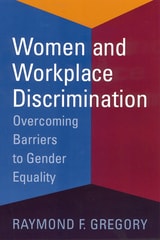
Women and Workplace Discrimination
Overcoming Barriers to Gender EqualityGregory, Raymond F
Rutgers University Press, 2002
Attorney Raymond F. Gregory addresses the millions of women who think they might be facing sexual discrimination and explains federal measures enacted to assist workers in contesting unlawful employer conduct. He presents actual court cases to demonstrate the ways that women have challenged their employers. The cases illustrate legal principles in real-life experiences. Many of the cases relate compelling stories of workers caught up in a web of employer discriminatory conduct. Gregory has eliminated legal jargon, ensuring that all concepts are clear to his readers. Individuals will turn to this book again and again to obtain authoritative background on this important topic.
Topics covered include:
- The increasing incidence of sexual harassment in the workplace
- Common forms of sex discrimination
- Discrimination against older women
- Discrimination against women of color
- Discrimination against women in the professions
- Discrimination against pregnant women
- Discrimination against women with children
- Sex discrimination in hiring, promotion, termination
- Employer liability for workplace sexual harassment
- Employer retaliation against workers
- Proving sex discrimination in the courtroom
- Compensatory and punitive damages
- Back pay, front pay, and other remedies