52 books match the query 'Gender identity in literature' and 4 start with a

cover of Act Like a Man: Challenging Masculinities in American Drama

Act Like a Man

Challenging Masculinities in American Drama

Robert Vorlicky

University of Michigan Press, 1995

In the first comprehensive study of plays written for male characters only, Robert Vorlicky offers a new theory that links cultural codes governing gender and the conventions determining dramatic form. Act Like a Manlooks at a range of plays, including those by O'Neill, Albee, Mamet, Baraka, and Rabe as well as new works by Philip Kan Gotanda, Alonzo Lamont, and Robin Swados, to examine how dialogue within these works reflects the social codes of male behavior and inhibits individualization among men.

Plays in which women are absent are often characterized by the location of a male "other"—a female presence who distances himself from the dominant, impersonal masculine ethos and thereby becomes a facilitator of personal communication. The potential authority of this figure is so powerful that its presence becomes the primary determinant of the quality of men's interaction and of the range of male subjectivities possible. This formulation becomes the basis of an alternative theory of American dramatic construction, one that challenges traditional dramaturgical notions of realism.

The book will appeal to scholars and students interested in drama, gender, race, sexuality, and American culture, as well as playwrights, teachers of playwrights, and artistic directors. It includes an extensive bibliography of more than four hundred male-cast plays and monodramas, the first such compilation and one that points to further research into a previously unexplored area.
[more]
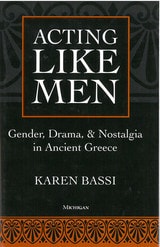
cover of Acting Like Men: Gender, Drama, and Nostalgia in Ancient Greece

Acting Like Men

Gender, Drama, and Nostalgia in Ancient Greece

Karen Bassi

University of Michigan Press, 1999

"Greek drama demands a story of origins," writes Karen Bassi in Acting Like Men. Abandoning the search for ritual and native origins of Greek drama, Bassi argues for a more secular and less formalist approach to the emergence of theater in ancient Greece. Bassi takes a broad view of Greek drama as a cultural phenomenon, and she discusses a wide variety of texts and artifacts that include epic poetry, historical narrative, philosophical treatises, visual media, and the dramatic texts themselves.
In her discussion of theaterlike practices and experiences, Bassi proposes new conceptual categories for understanding Greek drama as a cultural institution, viewing theatrical performance as part of what Foucault has called a discursive formation. Bassi also provides an important new analysis of gender in Greek culture at large and in Athenian civic ideology in particular, where spectatorship at the civic theater was a distinguishing feature of citizenship, and where citizenship was denied women.
Acting Like Men includes detailed discussions of message-sending as a form of scripted speech in the Iliad, of disguise and the theatrical body of Odysseus in the Odyssey, of tyranny as a theaterlike phenomenon in the narratives of Herodotus, and of Dionysus as the tyrannical and effeminate god of the theater in Euripides' Bacchae and Aristophanes' Frogs. Bassi concludes that the validity of an idealized masculine identity in Greek and Athenian culture is highly contested in the theater, where--in principle--citizens become passive spectators. Thereafter the author considers Athenian theater and Athenian democracy as mutually reinforcing mimetic regimes.
Acting Like Men will interest those interested in the history of the theater, performance theory, gender and cultural studies, and feminist approaches to ancient texts.
Karen Bassi is Associate Professor of Classics, University of California, Santa Cruz.
[more]
cover of Ancient Sex: New Essays

Ancient Sex

New Essays

Edited by Ruby Blondell and Kirk Ormand, epilogue by David M. Halperin

The Ohio State University Press, 2015

Ancient Sex: New Essays presents groundbreaking work in a post-Foucauldian mode on sexuality, sexual identities, and gender identities in ancient Greece and Rome. Since the production of Foucault’s History of Sexuality, the field of classics has been caught in a recursive loop of argument regarding the existence—or lack thereof—of "sexuality" (particularly "homosexuality") as a meaningful cultural concept for ancient Greece and Rome. Much of the argument concerning these issues, however, has failed to engage with the central argument of Foucault’s work, namely, the assertion that sexuality as we understand it is the correlative of a historically specific form of medical and legal discourse that emerged only in the late nineteenth century.

Rather than reopening old debates, Ancient Sex takes up Foucault’s call for discursive analysis and elucidates some of the ways that ancient Greek and Roman texts and visual arts articulate a culturally specific discourse about sexual matters. Each contributor presupposes that sexual and gendered identities are discursively produced, and teases out some of the ways that the Greeks and Romans spoke and thought about these issues. Comprising essays by emerging and established scholars, this volume emphasizes in particular: sexual discourses about women; the interaction between sexual identities and class status; gender as an unstable discursive category (even in antiquity); and the relationships between ancient and modern sexual categories.

[more]
cover of As If!: Queer Criticism Across Difference

As If!

Queer Criticism Across Difference

Chase Gregory

Duke University Press, 2025

In As If!, Chase Gregory explores the stylistically strategic, often campy, and productively fraught cross-identifications of early queer criticism. Gregory calls this form of aids-era criticism as if!—a mode of writing in which authors struggle to read, write, and identify with and across categories of race, sexuality, and gender. Analyzing the work of Robert Reid-Pharr, Deborah E. McDowell, Barbara Johnson, and Eve Kosofsky Sedgwick, Gregory shows how their writing productively challenges fixed ideas of identity and knowledge production. Using these four writers as case studies of a larger trend within early queer criticism, Gregory demonstrates that even when critical attempts at relation are met by impasse, as if! criticism breaks down social relation, especially within those fields influenced by queer theory, deconstructionist feminist theory, and Black feminist theory. By advocating a return to as if! criticism as a politically useful blueprint for contemporary cultural inquiry, Gregory draws attention to the obstacles to forging identification across difference and insists on the impossible project of solidarity across such difference.
[more]