Results by title

4 books match the query 'Gene'
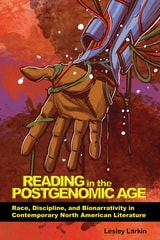
cover of Reading in the Postgenomic Age: Race, Discipline, and Bionarrativity in Contemporary North American Literature

Reading in the Postgenomic Age

Race, Discipline, and Bionarrativity in Contemporary North American Literature

Lesley Larkin

The Ohio State University Press, 2025

In Reading in the Postgenomic Age, Lesley Larkin analyzes how writers across literary genres have reckoned with the launch (in the early 1990s) and completion (in 2003) of the Human Genome Project and the ways it has fallen short of its promise to do away with spurious notions of race. Authors such as Margaret Atwood, Octavia Butler, Ruth Ozeki, Rebecca Skloot, Gerald Vizenor, and others demonstrate that genomics is a premier terrain upon which race is being reinscribed and reimagined in both scientific and mainstream contexts. Through construction of alternate genealogies, invention of hybrids, and citation of the textual metaphors replete within genomic discourse, these writers have illuminated the ethical, cultural, social, and political ramifications of genomic research, attuning readers to postgenomic discourses of race and power. At the same time, Larkin contends that literature’s engagement with genomics goes beyond its initial critique to comment self-reflexively on the practices and value of literary studies. Ultimately, she argues that contemporary writers outline a new ethical matrix for reading race in the postgenomic era—and rethinks literary criticism within this new paradigm.
[more]
cover of The Cinematic Life of the Gene

The Cinematic Life of the Gene

Jackie Stacey

Duke University Press, 2010

What might the cinema tell us about how and why the prospect of cloning disturbs our most profound ideas about gender, sexuality, difference, and the body? In The Cinematic Life of the Gene, the pioneering feminist film theorist Jackie Stacey argues that as a cultural technology of imitation, cinema is uniquely situated to help us theorize “the genetic imaginary,” the constellation of fantasies that genetic engineering provokes. Since the mid-1990s there has been remarkable innovation in genetic engineering and a proliferation of films structured by anxieties about the changing meanings of biological and cultural reproduction. Bringing analyses of several of these films into dialogue with contemporary cultural theory, Stacey demonstrates how the cinema animates the tropes and enacts the fears at the heart of our genetic imaginary. She engages with film theory; queer theories of desire, embodiment, and kinship; psychoanalytic theories of subject formation; and debates about the reproducibility of the image and the shift from analog to digital technologies.

Stacey examines the body-horror movies Alien: Resurrection and Species in light of Jean Baudrillard’s apocalyptic proclamations about cloning and “the hell of the same,” and she considers the art-house thrillers Gattaca and Code 46 in relation to ideas about imitation, including feminist theories of masquerade, postcolonial conceptualizations of mimicry, and queer notions of impersonation. Turning to Teknolust and Genetic Admiration, independent films by feminist directors, she extends Walter Benjamin’s theory of aura to draw an analogy between the replication of biological information and the reproducibility of the art object. Stacey suggests new ways to think about those who are not what they appear to be, the problem of determining identity in a world of artificiality, and the loss of singularity amid unchecked replication.

[more]
cover of The DNA Mystique: The Gene as a Cultural Icon

The DNA Mystique

The Gene as a Cultural Icon

Dorothy Nelkin and M. Susan Lindee

University of Michigan Press, 2004

The DNA Mystique suggests that the gene in popular culture draws on scientific ideas but is not constrained by the technical definition of the gene as a section of DNA that codes for a protein. In highlighting DNA as it appears in soap operas, comic books, advertising, and other expressions of mass culture, the authors propose that these domains provide critical insights into science itself.

With a new introduction and conclusion, this edition will continue to be an engaging, accessible, and provocative text for the sociology, anthropology, and bioethics classroom, as well as stimulating reading for those generally interested in science and culture.
[more]
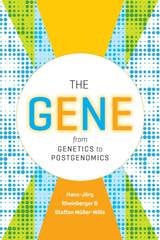
cover of The Gene: From Genetics to Postgenomics

The Gene

From Genetics to Postgenomics

Hans-Jörg Rheinberger and Staffan Müller-Wille

University of Chicago Press, 2018

Few concepts played a more important role in twentieth-century life sciences than that of the gene. Yet at this moment, the field of genetics is undergoing radical conceptual transformation, and some scientists are questioning the very usefulness of the concept of the gene, arguing instead for more systemic perspectives.
 
The time could not be better, therefore, for Hans-Jörg Rheinberger and Staffan Müller-Wille's magisterial history of the concept of the gene. Though the gene has long been the central organizing theme of biology, both conceptually and as an object of study, Rheinberger and Müller-Wille conclude that we have never even had a universally accepted, stable definition of it. Rather, the concept has been in continual flux—a state that, they contend, is typical of historically important and productive scientific concepts. It is that very openness to change and manipulation, the authors argue, that made it so useful: its very mutability enabled it to be useful while the technologies and approaches used to study and theorize about it changed dramatically.
 
[more]