Results by title
66 books match the query 'Genealogy' and 3 start with a
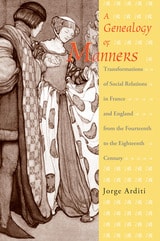
A Genealogy of Manners
Transformations of Social Relations in France and England from the Fourteenth to the Eighteenth CenturyJorge Arditi
University of Chicago Press, 1998
Remarkable for its scope and erudition, Jorge Arditi's new study offers a fascinating history of mores from the High Middle Ages to the Enlightenment. Drawing on the pioneering ideas of Norbert Elias, Michel Foucault, and Pierre Bourdieu, Arditi examines the relationship between power and social practices and traces how power changes over time.
Analyzing courtesy manuals and etiquette books from the thirteenth to the eighteenth century, Arditi shows how the dominant classes of a society were able to create a system of social relations and put it into operation. The result was an infrastructure in which these classes could successfully exert power. He explores how the ecclesiastical authorities of the Middle Ages, the monarchies from the fifteenth through the seventeenth century, and the aristocracies during the early stages of modernity all forged their own codes of manners within the confines of another, dominant order. Arditi goes on to describe how each of these different groups, through the sustained deployment of their own forms of relating with one another, gradually moved into a position of dominance.
Analyzing courtesy manuals and etiquette books from the thirteenth to the eighteenth century, Arditi shows how the dominant classes of a society were able to create a system of social relations and put it into operation. The result was an infrastructure in which these classes could successfully exert power. He explores how the ecclesiastical authorities of the Middle Ages, the monarchies from the fifteenth through the seventeenth century, and the aristocracies during the early stages of modernity all forged their own codes of manners within the confines of another, dominant order. Arditi goes on to describe how each of these different groups, through the sustained deployment of their own forms of relating with one another, gradually moved into a position of dominance.
[more]

A Genealogy of Terror in Eighteenth-Century France
Ronald Schechter
University of Chicago Press, 2018
In contemporary political discourse, it is common to denounce violent acts as “terroristic.” But this reflexive denunciation is a surprisingly recent development. In A Genealogy of Terror in Eighteenth-Century France, Ronald Schechter tells the story of the term’s evolution in Western thought, examining a neglected yet crucial chapter of our complicated romance with terror.
For centuries prior to the French Revolution, the word “terror” had largely positive connotations. Subjects flattered monarchs with the label “terror of his enemies.” Lawyers invoked the “terror of the laws.” Theater critics praised tragedies that imparted terror and pity. By August 1794, however, terror had lost its positive valence. As revolutionaries sought to rid France of its enemies, terror became associated with surveillance committees, tribunals, and the guillotine. By unearthing the tradition that associated terror with justice, magnificence, and health, Schechter helps us understand how the revolutionary call to make terror the order of the day could inspire such fervent loyalty in the first place—even as the gratuitous violence of the revolution eventually transformed it into the dreadful term we would recognize today. Most important, perhaps, Schechter proposes that terror is not an import to Western civilization—as contemporary discourse often suggests—but rather a domestic product with a long and consequential tradition.
For centuries prior to the French Revolution, the word “terror” had largely positive connotations. Subjects flattered monarchs with the label “terror of his enemies.” Lawyers invoked the “terror of the laws.” Theater critics praised tragedies that imparted terror and pity. By August 1794, however, terror had lost its positive valence. As revolutionaries sought to rid France of its enemies, terror became associated with surveillance committees, tribunals, and the guillotine. By unearthing the tradition that associated terror with justice, magnificence, and health, Schechter helps us understand how the revolutionary call to make terror the order of the day could inspire such fervent loyalty in the first place—even as the gratuitous violence of the revolution eventually transformed it into the dreadful term we would recognize today. Most important, perhaps, Schechter proposes that terror is not an import to Western civilization—as contemporary discourse often suggests—but rather a domestic product with a long and consequential tradition.
[more]
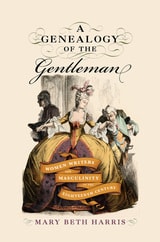
A Genealogy of the Gentleman
Women Writers and Masculinity in the Eighteenth CenturyMary Beth Harris
University of Delaware Press, 2024
A Genealogy of the Gentleman argues that eighteenth-century women writers made key interventions in modern ideals of masculinity and authorship through their narrative constructions of the gentleman. It challenges two latent critical assumptions: first, that the gentleman’s masculinity is normative, private, and therefore oppositional to concepts of performance; and second, that women writers, from their disadvantaged position within a patriarchal society, had no real means of influencing dominant structures of masculinity. By placing writers such as Mary Davys, Eliza Haywood, Charlotte Lennox, Elizabeth Inchbald, and Mary Robinson in dialogue with canonical representatives of the gentleman author—Joseph Addison and Richard Steele, David Hume, Samuel Johnson, and Samuel Richardson—Mary Beth Harris shows how these women carved out a space for their literary authority not by overtly opposing their male critics and society’s patriarchal structure, but by rewriting the persona of the gentleman as a figure whose very desirability and appeal were dependent on women’s influence. Ultimately, this project considers the import of these women writers’ legacy, both progressive and conservative, on hegemonic standards of masculinity that persist to this day.
[more]