Results by title
14 books match the query 'Genealogy & Heraldry'

A Family Practice
The Russell Doctors and the Evolving Business of Medicine, 1799-1989William D. Lindsey
University of Arkansas Press, 2020
The authors take a wide-ranging look at the meaning of intergenerational vocations and the role of family, the economy, and social issues on the evolution of medical education and practice in the United States.
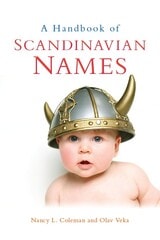
A Handbook of Scandinavian Names
Nancy L. Coleman
University of Wisconsin Press, 2010
Are you looking for
• A Scandinavian name for your baby?
• The names of Norse gods and heroes?
• The history and meaning of Scandinavian first names?
• Variations and alternate spellings for common Scandinavian names?
• Naming traditions and customs in Norway, Sweden, and Denmark?
A Handbook of Scandinavian Names includes a dictionary of more than fifteen hundred given names from Norway, Sweden, and Denmark, plus some from Iceland and Finland. Each entry provides a guide to pronunciation and the origin and meaning of the name. Many entries also include variations and usage in the Scandinavian countries and famous bearers of the name.
Adding engaging context to the dictionary section is an extensive comparative guide to naming practices. The authors discuss immigration to North America from Scandinavia and the ways given names and surnames were adapted in the New World. Also included in the book is a history of Scandinavian names, information on “Name Days,” and discussion of significant names from mythology and history, including naming traditions in royal families.
Common People
In Pursuit of My AncestorsAlison Light
University of Chicago Press, 2015
Most of us, however, give up a few generations back. We run into a gap, get embarrassed by a ne’er-do-well, or simply find our ancestors are less glamorous than we’d hoped. That didn’t stop Alison Light: in the last weeks of her father’s life, she embarked on an attempt to trace the history of her family as far back as she could reasonably go. The result is a clear-eyed, fascinating, frequently moving account of the lives of everyday people, of the tough decisions and hard work, the good luck and bad breaks, that chart the course of a life. Light’s forebears—servants, sailors, farm workers—were among the poorest, traveling the country looking for work; they left few lasting marks on the world. But through her painstaking work in archives, and her ability to make the people and struggles of the past come alive, Light reminds us that “every life, even glimpsed through the chinks of the census, has its surprises and secrets.”
What she did for the servants of Bloomsbury in her celebrated Mrs. Woolf and the Servants Light does here for her own ancestors, and, by extension, everyone’s: draws their experiences from the shadows of the past and helps us understand their lives, estranged from us by time yet inextricably interwoven with our own. Family history, in her hands, becomes a new kind of public history.
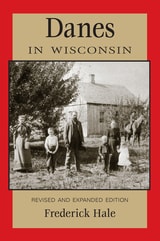
Danes in Wisconsin
Revised and Expanded EditionFrederick Hale
Wisconsin Historical Society Press, 2005
Wisconsin Territory's first Dane arrived in 1829, and by 1860 the state's Danish-born population had reached 1,150. Yet these newcomers remained only a small segment of Wisconsin's increasingly complex cultural mosaic, and the challenges of adapting to life in this new land shaped the Danish experience in the state. In this popular book, now revised and expanded with additional historical photos and documents, Frederick Hale offers a concise introduction to Wisconsin's Danish settlers, exploring their reasons for leaving their homeland, describing their difficult journeys, and examining their adjustments to life on Wisconsin soil.
New to this edition are the selected letters of Danish immigrant Andrew Frederickson. These compelling documents, written over a 40-year span, capture the personal observations of one Dane as he made a new life in Wisconsin.
Daughters of Stone and Tide
Loss and Resilience in a Fisherman's FamilyWritten by Maria "Mia" Millefoglie. Read by Maria Marquis.
University of Massachusetts Press, 2026
A powerful family memoir about inheritance, identity, and the pull of the sea
Surrendered as an infant in America, Maria “Mia” was taken in by Sicilian immigrants in Gloucester, Massachusetts—a gritty working-class town steeped in salt and tradition. She inherits a name that traces back to 19th-century Sicily, where her great-grandfather was abandoned as a newborn on la ruota dei proietti, the “wheel of the castoffs.” Christened Millefoglie, “a thousand leaves, a thousand pages,” he crossed the bold Atlantic to America’s shores, carrying with him a legacy of endurance and exile.
For generations, the Millefoglie men went to sea: dorymen who rose before dawn to cast their nets along jagged coastlines, captains of eastern-rig draggers navigating storms that could split a vessel in half, stowaways chasing the promise of a life they could scarcely imagine. They lived by tides, currents, and the unspoken rules of the ocean; their courage and skill tested daily by wind and water. The women, left on shore, learned a different kind of survival, keeping households, raising children, and enduring the constant absence of fathers, brothers, and husbands.
Into this world of fishermen and keepers of the shore, Mia was adopted, learning early that bloodlines dictate identity and tradition shapes fate. College is forbidden; marriages are arranged, and no one abandons the family. By nineteen, trapped in a fish-packing job and lost in a haze of drugs, Mia does the unthinkable: she leaves. Decades later, drawn back to Gloucester’s weathered harbor to care for her aging parents, Mia begins to unearth her family’s buried stories, tracing the lineage from a Sicilian orphanage to a New England fishing port and the invisible inheritance that shaped them all.
Both intimate and historical, Daughters of Stone and Tide is a meditation on identity, abandonment, and belonging—a fisherman’s daughter’s search to understand the forces that bind and break a family across generations and seas.
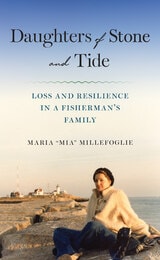
Daughters of Stone and Tide
Loss and Resilience in a Fisherman’s FamilyMaria "Mia" Millefoglie
University of Massachusetts Press, 2026
A powerful family memoir about inheritance, identity, and the pull of the sea
Surrendered as an infant in America, Maria “Mia” was taken in by Sicilian immigrants in Gloucester, Massachusetts—a gritty working-class town steeped in salt and tradition. She inherits a name that traces back to 19th-century Sicily, where her great-grandfather was abandoned as a newborn on la ruota dei proietti, the “wheel of the castoffs.” Christened Millefoglie, “a thousand leaves, a thousand pages,” he crossed the bold Atlantic to America’s shores, carrying with him a legacy of endurance and exile.
For generations, the Millefoglie men went to sea: dorymen who rose before dawn to cast their nets along jagged coastlines, captains of eastern-rig draggers navigating storms that could split a vessel in half, stowaways chasing the promise of a life they could scarcely imagine. They lived by tides, currents, and the unspoken rules of the ocean; their courage and skill tested daily by wind and water. The women, left on shore, learned a different kind of survival, keeping households, raising children, and enduring the constant absence of fathers, brothers, and husbands.
Into this world of fishermen and keepers of the shore, Mia was adopted, learning early that bloodlines dictate identity and tradition shapes fate. College is forbidden; marriages are arranged, and no one abandons the family. By nineteen, trapped in a fish-packing job and lost in a haze of drugs, Mia does the unthinkable: she leaves. Decades later, drawn back to Gloucester’s weathered harbor to care for her aging parents, Mia begins to unearth her family’s buried stories, tracing the lineage from a Sicilian orphanage to a New England fishing port and the invisible inheritance that shaped them all.
Both intimate and historical, Daughters of Stone and Tide is a meditation on identity, abandonment, and belonging—a fisherman’s daughter’s search to understand the forces that bind and break a family across generations and seas.
Family History Record Book
James Bell
University of Minnesota Press, 1980
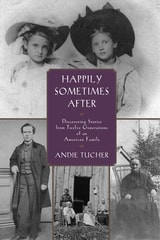
Happily Sometimes After
Discovering Stories from Twelve Generations of an American FamilyAndie Tucher
University of Massachusetts Press, 2014
A 2015 CHOICE Outstanding Academic Title
For more than four hundred years, members of the author's family have been telling stories about their American lives. They have told of impassioned elopements and heart-breaking kidnaps, of hairbreadth escapes and shocking murders, of bigamists, changelings, patriots, Indians, fires, floods, and how the great-grandmother of Chief Justice John Marshall married the pirate Blackbeard by mistake.
In this beautifully written work, Andie Tucher considers family stories as another way to look at history, neither from the top down nor the bottom up but from the inside out. She explores not just what happened—everywhere from Jamestown to Boonesborough, from the bloody field at Chickamauga to the metropolis of the Gilded Age—but also what the storytellers thought or wished or hoped or feared happened. She offers insights into what they valued, what they lost, how they judged their own lives and found meaning in them. The narrative touches on sorrow, recompense, love, pain, and the persistent tension between hope and disappointment in a nation that by making the pursuit of happiness thinkable also made unhappiness regrettable.
Based on extensive research in archives, local history societies, and family-history sources as well as conversations and correspondence, Happily Sometimes After offers an intimate and unusual perspective on how ordinary people used stories to imagine the world they wished for, and what those stories reveal about their relationships with the world they actually had.

In Search of Susanna
Suzanne L. Bunkers
University of Iowa Press, 1996
On a summer day in 1980 in Niederfeulen, Luxembourg, Suzanne Bunkers pored over parish records of her maternal ancestors, immigrants to the rural American Midwest in the mid 1800s. Suddenly, chance led her to the name Simmerl and to the missing piece in the genealogical puzzle that had brought her so far: Susanna Simmerl, Bunkers' paternal great-great-grandmother, who had given birth to an illegitimate daughter in 1856 before coming to America. Finding Susanna was the catalyst for Bunkers' intensely personal book, which blends history, memory, and imagination into a drama of two women's lives within their multigenerational family.
Legacies of Slavery
Shared History and Family Conversations with Myra Davis-Branic, Frye Gaillard, and Kern JacksonEdited by Frye Gaillard
University of Alabama Press, 2026
Documents conversations between two southern writers and friends whose families were intertwined in slavery
Legacies of Slavery commemorates a story of racial reconciliation in the South. Writers, educators, and friends Frye Gaillard and Myra Davis-Branic discovered a shared family history of slavery in Eutawville, South Carolina, where Davis-Branic’s family was enslaved by Gaillard’s family.
In 2024, the University of South Alabama’s Kern Jackson moderated three conversations with Davis-Branic and Gaillard in Mobile. These conversations are presented here in an edited format. Davis-Branic and Gaillard discussed their intertwined family history and what they each learned from research into their ancestors. They relay origin stories and the role of a key grandparent who greatly impacted their lives. They also talk about their own trajectories in a historical context, the issue of slavery in their families, and the legacy of slavery for their children and families.
The book concludes with short excerpts, one from Davis-Branic’s book Cornbread My Soul: The Davis Family of Eutawville, South Carolina, and one from Gaillard’s family history, Lessons from the Big House: One Family’s Passage Through the History of the South, a Memoir. Legacies of Slavery stands as a powerful and unique documentation for all who are interested in how two southern families, bound by slavery in the past and now by friendship and a degree of understanding, have found some measure of redemption.
Origins of New Mexico Families
A Genealogy of the Spanish Colonial PeriodFray Angélico Chávez
Museum of New Mexico Press, 1992
Scholars and Their Kin
Historical Explorations, Literary ExperimentsEdited by Stéphane Gerson
University of Chicago Press, 2025
Historians have often been discouraged from writing about their relatives, subjects who are deemed too close for objective analysis. But new work by scholars interested in their own families raises fascinating questions about subjectivity—and how historians might put it to use. It also invites historians to abandon traditional aspects of academic writing and draw, instead, on literary forms more equipped to highlight the relationships between scholar and material, feeling and reason.
Scholars and Their Kin embraces diverse approaches to such writing, bringing into the open the personal, professional, and historiographic complexities that ensue when scholars write intimate yet self-aware histories about their families. The first book devoted to this genre, which editor Stéphane Gerson terms “personal family history,” this anthology features ten essays and an afterword by scholars working in this vein. The contributors—varied in their disciplines, themes, and nationalities—reflect on their motivations and methodological choices, the politics of family history, and the institutional constraints they have sometimes faced. Making full use of the creative possibilities of voice and form, they expand the literary ambitions of personal family history, provide readers with narrative models, and address questions of shame, responsibility, love, gendered and racial violence, family archives, as well as the tall tales, myths, misrepresentations, memories, and omissions that suffuse family lives. Scholars and Their Kin will interest historians, scholars in other disciplines, and readers interested in family histories that open broader worlds.

The Elefánthy
The Hungarian Nobleman and His KindredErik Fügedi
Central European University Press, 1998
In an exploration of the life and customs of the Hungarian nobility, this book compares historical reality and legal literature on the example of one noble family--the Elefánthy kindred from northern Hungary (present-day Slovakia). The author begins by outlining the customary law regarding noble status, inheritance and marriage, as summarized in the famous code of Stephen Werbőczy (1514). He then compares these norms with the documentary evidence and establishes the fact that the legal literature differs in regard to social mobility and kindred solidarity.
With this frame of reference in mind, the fate of the Elefánthy family is traced through several generations, enabling the author to make some general statistical statements on inheritance, the rise and fall of various branches, marriage strategies, and the "survival skills" of the kindred. In his summary, the author outlines some of the major avenues for further research, including the peculiar Hungarian form of retainership (familiaritas), and the relationships between noble families and between the nobility and local communities.
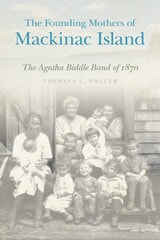
The Founding Mothers of Mackinac Island
The Agatha Biddle Band of 1870Theresa L. Weller
Michigan State University Press, 2021