Results by title
3 books match the query 'Genealogy in literature'

Anti-Apocalypse
Exercises in Genealogical CriticismLee Quinby
University of Minnesota Press, 1994
Anti-Apocalypse was first published in 1994. Minnesota Archive Editions uses digital technology to make long-unavailable books once again accessible, and are published unaltered from the original University of Minnesota Press editions.
As the year 2000 looms, heralding a new millennium, apocalyptic thought abounds-and not merely among religious radicals. In politics, science, philosophy, popular culture, and feminist discourse, apprehensions of the End appear in images of cultural decline and urban chaos, forecasts of the end of history and ecological devastation, and visions of a new age of triumphant technology or a gender-free utopia. There is, Lee Quinby contends, a threatening "regime of truth" prevailing in the United States-and this regime, with its enforcement of absolute truth and morality, imperils democracy. In Anti-Apocalypse, Quinby offers a powerful critique of the millenarian rhetoric that pervades American culture. In doing so, she develops strategies for resisting its tyrannies.
Drawing on feminist and Foucauldian theory, Quinby explores the complex relationship between power, truth, ethics, and apocalypse. She exposes the ramifications of this relationship in areas as diverse as jeanswear magazine advertising, the Human Genome project, contemporary feminism and philosophy, texts by Henry Adams and Zora Neale Hurston, and radical democratic activism. By bringing together such a wide range of topics, Quinby shows how apocalypse weaves its way through a vast network of seemingly unrelated discourses and practices. Tracing the deployment of power through systems of alliance, sexuality, and technology, Quinby reveals how these power relationships produce conflicting modes of subjectivity that create possibilities for resistance. She promotes a variety of critical stances—genealogical feminism, an ethics of the flesh, and "pissed criticism"—as challenges to apocalyptic claims for absolute truth and universal morality. Far-reaching in its implications for social and cultural theory as well as for political activism, Anti-Apocalypse will engage readers across the cultural spectrum and challenge them to confront one of the most subtle and insidious orthodoxies of our day.Lee Quinby is associate professor of English and American studies at Hobart and William Smith Colleges. She is the author of Freedom, Foucault, and the Subject of America (1991) and coeditor (with Irene Diamond) of Feminism and Foucault: Reflections on Resistance (1988).
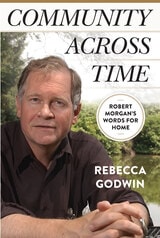
Community across Time
Robert Morgan’s Words for HomeRebecca Godwin
West Virginia University Press, 2023
One of the first book-length considerations of the Appalachian writer Robert Morgan.
One of the first book-length studies of Robert Morgan, Community across Time considers the Appalachian writer’s explorations of memory, family history, and landscape. It provides a study of all of Morgan’s fiction to date, as well as a chapter on his poetry and some reference, where appropriate, to his nonfiction. Rebecca Godwin examines the family history that informs much of this body of work, offering an extended biographical essay that ties characters and plot details to Morgan’s ancestors’ lives and to his own experiences growing up in the Blue Ridge Mountains.
Religious rifts, economic hardships, class conflicts, the place of women and Indigenous peoples, and the failure of humans to recognize the divinity of the natural world are among the motifs centering Morgan’s writing. Community across Time explores those themes as it looks to Morgan’s relationship to the Appalachian South.
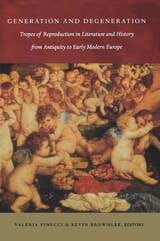
Generation and Degeneration
Tropes of Reproduction in Literature and History from Antiquity through Early Modern EuropeValeria Finucci and Kevin Brownlee, eds.
Duke University Press, 2001
The discourses on reproduction, biology, degeneration, legacy, and lineage that this book broaches not only bring to the forefront concepts of sexual identity and gender politics but also show how they were culturally constructed and reconstructed through the centuries by medicine, philosophy, the visual arts, law, religion, and literature. The contributors reflect on a wide range of topics—from what makes men “manly” to the identity of Christ’s father, from what kinds of erotic practices went on among women in sixteenth-century seraglios to how men’s hemorrhoids can be variously labeled. Essays scrutinize stories of menstruating males and early writings on the presumed inferiority of female bodily functions. Others investigate a psychomorphology of the clitoris that challenges Freud’s account of lesbianism as an infantile stage of sexual development and such topics as the geographical origins of medicine and the materialization of genealogy in the presence of Renaissance theatrical ghosts.
This collection will engage those in English, comparative, Italian, Spanish, and French studies, as well as in history, history of medicine, and ancient and early modern religious studies.
Contributors. Kevin Brownlee, Marina Scordilis Brownlee, Elizabeth Clark, Valeria Finucci, Dale Martin, Gianna Pomata, Maureen Quilligan, Nancy Siraisi, Peter Stallybrass,Valerie Traub