Results by title

7 books match the query 'General Agreement on Tariffs and Trade (Organization)'
cover of Antidumping: How It Works and Who Gets Hurt

Antidumping

How It Works and Who Gets Hurt

J. Michael Finger

University of Michigan Press, 1993
Antidumping is a threat to the liberal trading system that post-World War II Western leadership struggled courageously and effectively to create. It offers a GATT-legal means to destroy the GATT system, leading to restrictions on more U.S. imports than even the Multi-Fibre Arrangement. This book presents studies of five industries whose exports have been hard hit by antidumping actions. Each of these studies avoids the legalisms and the jargon of antidumping and answers a straightforward question: was the national economic interest of either the exporting or the importing country improved by the antidumping actions that were taken? The contributors not only ask questions and present viable answers, but also provide a proposal that offers both consistence with GATT and good economics.This book will be of interest to lawyers, political scientists, economists, and business people. It has intentionally avoided the specialized language of trade regulation so that it may be more readily accessible to anyone interested in international commercial policy.
[more]
cover of China's Participation in the IMF, the World Bank, and GATT: Toward a Global Economic Order

China's Participation in the IMF, the World Bank, and GATT

Toward a Global Economic Order

Harold K. Jacobson and Michel Oksenberg

University of Michigan Press, 1990
Harold K. Jacobson and Michel Oksenberg bring their considerable knowledge of, respectively, international agencies and China to this study of the evolving relationship between the People’s Republic of China and the keystone international economic organizations (KIEQs): the International Monetary Fund, the World Bank and its affiliated agencies, and the General Agreement on Tariffs and Trade (GATT).Until the early 1970s China was hostile toward the KIEOs, seeing them as instruments of capitalist exploitation. The change in that position, and the ensuing rapprochement between the two sides culminating in the negotiations and Chinese membership in the KEIOs, is an important subject. It is made immeasurably more significant by the extraordinary potential of China in the world economy. The different perspectives of the two authors permits this process to be analyzed from the point of view of both sides and to be informed by discussions and interviews with senior officers of the KIEOs and high Chinese officials.Among the questions addressed are: How and why did such a sharp change in the relationship between China and the KIEOs occur? What accounts for the Chinese decision to seek inclusion in the KIEOs? How did the KIEOs, and their most important members, the Western states, come to welcome China’s inclusion? What have the consequences of China’s involvement in the IMF and World Bank been for the two institutions and for China? What are the issues involved in China’s request for entrance in the KIEOs and full participation in the GATT? How will China’s involvement in the KIEOs affect the USSR’s involvement?Although the book deals with issues and events that predate the June, 1989, events in Tiananmen Square, the authors completed their manuscript after those events. They endeavor to interpret their observations in the light of the changed situation in China and the clear evidence that China has not yet settled into easy international participation with the Western states.
[more]
cover of Revisiting U.S. Trade Policy: Decisions in Perspective

Revisiting U.S. Trade Policy

Decisions in Perspective

Alfred E. Eckes Jr.

Ohio University Press, 2000

In trade policy, as in many other areas of public policy, decision makers often confront present and future problems with little understanding of how similar disputes were resolved in the past. Too often, busy public officials had no time to write or record negotiating histories. Revisiting U.S. Trade Policy, which is certain to become a classic in the literature of trade negotiations, is just such a record.

Built on the oral histories of thirty-five former U.S. trade policymakers—including Michael Blumenthal, Alonzo McDonald, William Roth, and Robert S. Strauss—this unique record, prepared for publication by Alfred E. Eckes, revisits some of the most important moments of America’s trade liberalization program in the years after World War II.

From GATT to the World Trade Organization, these major players look back in candid hindsight at their decisions concerning trade policy and the effects that those decisions had on shaping the new international economic order.
[more]
cover of Strengthening International Courts: The Hidden Costs of Legalization

Strengthening International Courts

The Hidden Costs of Legalization

Leslie Johns

University of Michigan Press, 2015

As all manner of commerce becomes increasingly global, states must establish laws to protect property rights, human rights, and national security. In many cases, states delegate authority to resolve disputes regarding these laws to an independent court, whose power depends upon its ability to enforce its rulings.

Examining detailed case studies of the International Court of Justice and the transition from the General Agreement on Tariffs and Trade to the World Trade Organization, Leslie Johns finds that a court’s design has nuanced and mixed effects on international cooperation. A strong court is ideal when laws are precise and the court is nested within a political structure like the European Union. Strong courts encourage litigation but make states more likely to comply with agreements when compliance is easy and withdraw from agreements when it is difficult. A weak court is optimal when law is imprecise and states can easily exit agreements with minimal political or economic repercussions. Johns concludes the book with recommendations for promoting cooperation by creating more precise international laws and increasing both delegation and obligation to international courts. 
[more]
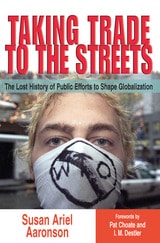
cover of Taking Trade to the Streets: The Lost History of Public Efforts to Shape Globalization

Taking Trade to the Streets

The Lost History of Public Efforts to Shape Globalization

Susan Ariel Aaronson

University of Michigan Press, 2002

In the wake of civil protest in Seattle during the 1999 World Trade Organization meeting, many issues raised by globalization and increasingly free trade have been in the forefront of the news. But these issues are not necessarily new. Taking Trade to the Streets describes how so many individuals and nongovernmental organizations came over time to see trade agreements as threatening national systems of social and environmental regulations. Using the United States as a case study, Susan Ariel Aaronson examines the history of trade agreement critics, focusing particular attention on NAFTA (the North American Free Trade Agreement between Canada, Mexico, and the United States) and the Tokyo and Uruguay Rounds of trade liberalization under the GATT. She also considers the question of whether such trade agreement critics are truly protectionist.
The book explores how trade agreement critics built a fluid global movement to redefine the terms of trade agreements (the international system of rules governing trade) and to redefine how citizens talk about trade. (The "terms of trade" is a relationship between the prices of exports and of imports.) That movement, which has been growing since the 1980s, transcends borders as well as longstanding views about the role of government in the economy. While many trade agreement critics on the left say they want government policies to make markets more equitable, they find themselves allied with activists on the right who want to reduce the role of government in the economy.
Aaronson highlights three hot-button social issues--food safety, the environment, and labor standards--to illustrate how conflicts arise between trade and other types of regulation. And finally she calls for a careful evaluation of the terms of trade from which an honest debate over regulating the global economy might emerge.
Ultimately, this book links the history of trade policy to the history of social regulation. It is a social, political, and economic history that will be of interest to policymakers and students of history, economics, political science, government, trade, sociology, and international affairs.
Susan Ariel Aaronson is Senior Fellow at the National Policy Institute and occasional commentator on National Public Radio's "Morning Edition."
[more]
cover of Trade Policy in a Changing World Economy

Trade Policy in a Changing World Economy

Robert E. Baldwin

University of Chicago Press, 1989

Trade policy issues are no longer solely the concern of a few government specialists and academics. Manufacturers, businesspeople, educators, and government officials must keep abreast of laws and regulations relating to trade, the economic consequences of various trade measures, and current trends in policy, but there have been few coherent sources for such information.

Trade Policy in a Changing World Economy provides a clear introduction to complex trade issues, covering theoretical issues of trade policy, the changing nature of American trade policy, the changing nature of American trade policy since World War II, multilateral trade negotiations, and trade strategies. The volume is particularly timely as the world's nations enter a new round of GATT negotiations for the reduction of trade barriers.
[more]
cover of Traders in a Brave New World: The Uruguay Round and the Future of the International Trading System

Traders in a Brave New World

The Uruguay Round and the Future of the International Trading System

Ernest H. Preeg

University of Chicago Press, 1995

The recently concluded Uruguay Round of the General Agreement on Tariffs and Trade (GATT) will undoubtedly lead to a fundamental transformation of the world trading system as an instrument of a global economy. In Traders in a Brave New World, Ernest H. Preeg, a distinguished former U.S. diplomat and trade negotiator, presents a blow-by-blow account of the Uruguay Round, an examination of the historical context in which it took place, and an insider's assessment of the agreement's future impact on the international trading system.

Preeg places the Uruguay Round in the broader context of global politics and economics, showing how changes in the world order—from the collapse of communism to dramatic economic reforms in developing countries—influenced both the topics of negotiations and their outcome. He then assesses the final GATT agreement as a case study in international negotiations and evaluates its probable effects on income and trade.

Finally, Preeg looks to the short- and long-term issues confronting future trade-policy negotiators. He shows that the international trade agenda will consist of three evolving types of agreement—further multilateral commitments, regional free-trade agreements, and selective bilateral accords. Going to the heart of current debates on the "new world order," an important final chapter evaluates the political and economic relationships that will result from the international trading system.
[more]