Results by title
7 books match the query 'Genes'

Genes And Human Self-Knowledge
Reflections On Modern GeneticsRobert F. Weir
University of Iowa Press, 1994
Contemporary developments in human genetics are profoundly meaningful, both for the rapidity of scientific discoveries and for their personal and social implications. The Human Genome Project, a worldwide effort to map the 50,000 to 100,000 genes making up the human blueprint, is creating new ways of understanding ourselves as individuals, as parents, as members of a family, an ethnic group, a species. Almost every day yet another medical detective finds a genetic clue to the long-running mystery of human identity.
In 1992, the University of Iowa Humanities Symposium provided a public forum to examine the issues—moral, conceptual, legal, and practical—in modern genetics that are crucial to all of us. This strong, challenging volume is a collection of the major essays presented by historians, philosophers, and other academic humanists to a multidisciplinary audience of molecular and clinical geneticists, genetic counselors, humanists, and members of the public. The essays explore the historical background, philosophical implications, and ethical issues related to the Human Genome Project as well as other developments in modern genetics.
The questions raised in these essays are dramatic and troubling. What kind of knowledge is being produced by molecular geneticists? Do individual human genomes differ significantly from each other? How much do females and males differ from each other at the molecular level? Is there any genetic basis for distinguishing among racial or ethical groups? Can current practices in genetics counseling be compared to the earlier eugenics movement? Will current research lead to updated views on genetic “normalcy” or even “superiority”?
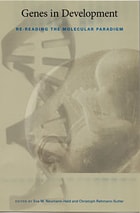
Genes in Development
Re-reading the Molecular ParadigmEva M. Neumann-Held and Christoph Rehmann-Sutter, eds.
Duke University Press, 2006
Contributors discuss alternatives to the programmatic view of dna, including the developmental systems approach, methodical culturalism, the molecular process concept of the gene, the hermeneutic theory of description, and process structuralist biology. None of the approaches cast doubt on the notion that dna is tremendously important to biological life on earth; rather, contributors examine different ideas of how dna should be represented, evaluated, and explained. Just as ideas about genetic codes have reached far beyond the realm of science, the reconceptualizations of genetic theory in this volume have broad implications for ethics, philosophy, and the social sciences.
Contributors. Thomas Bürglin, Brian C. Goodwin, James Griesemer, Paul Griffiths, Jesper Hoffmeyer, Evelyn Fox Keller, Gerd B. Müller, Eva M. Neumann-Held, Stuart A. Newman, Susan Oyama, Christoph Rehmann-Sutter, Sahotra Sarkar, Jackie Leach Scully, Gerry Webster, Ulrich Wolf
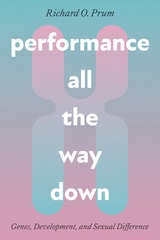
Performance All the Way Down
Genes, Development, and Sexual DifferenceRichard O. Prum
University of Chicago Press, 2023
The idea that gender is a performance—a tenet of queer feminist theory since the nineties—has spread from college classrooms to popular culture. This transformative concept has sparked reappraisals of social expectations as well as debate over not just gender, but sex: what it is, what it means, and how we know it. Most scientific and biomedical research over the past seventy years has assumed and reinforced a binary concept of biological sex, though some scientists point out that male and female are just two outcomes in a world rich in sexual diversity.
In Performance All the Way Down, MacArthur Fellow and Pulitzer Prize finalist Richard O. Prum brings feminist thought into conversation with biology, arguing that the sexual binary is not essential to human genes, chromosomes, or embryos. Our genomes are not blueprints, algorithms, or recipes for the physical representation of our individual sexual essences or fates. In accessible language, Prum shows that when we look closely at the science, we see that gene expression is a material action in the world, a performance through which the individual regulates and achieves its own becoming. A fertilized zygote matures into an organism with tissues and organs, neurological control, immune defenses, psychological mechanisms, and gender and sexual behavior through a performative continuum. This complex hierarchy of self-enactment reflects the evolved agency of individual genes, molecules, cells, and tissues.
Rejecting the notion of an intractable divide between the humanities and the sciences, Prum proves that the contributions of queer and feminist theorists can help scientists understand the human body in new ways, yielding key insights into genetics, developmental biology, physiology. Sure to inspire discussion, Performance All the Way Down is a book about biology for feminists, a book about feminist theory for biologists, and a book for anyone curious about how our sexual bodies grow.
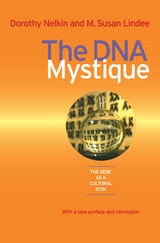
The DNA Mystique
The Gene as a Cultural IconDorothy Nelkin and M. Susan Lindee
University of Michigan Press, 2004
With a new introduction and conclusion, this edition will continue to be an engaging, accessible, and provocative text for the sociology, anthropology, and bioethics classroom, as well as stimulating reading for those generally interested in science and culture.
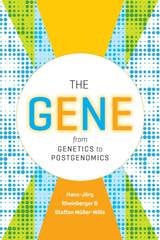
The Gene
From Genetics to PostgenomicsHans-Jörg Rheinberger and Staffan Müller-Wille
University of Chicago Press, 2018
The time could not be better, therefore, for Hans-Jörg Rheinberger and Staffan Müller-Wille's magisterial history of the concept of the gene. Though the gene has long been the central organizing theme of biology, both conceptually and as an object of study, Rheinberger and Müller-Wille conclude that we have never even had a universally accepted, stable definition of it. Rather, the concept has been in continual flux—a state that, they contend, is typical of historically important and productive scientific concepts. It is that very openness to change and manipulation, the authors argue, that made it so useful: its very mutability enabled it to be useful while the technologies and approaches used to study and theorize about it changed dramatically.
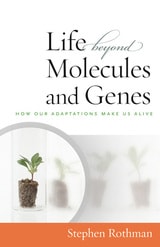
The Life Beyond Molecules and Genes
In Search of Harmony between Life and ScienceStephen Rothman
Templeton Press, 2009
What makes us alive? Is it our DNA? Our genetics? Is it our atomic composition that gives us life? Somehow, all of this feels radically dissonant from our everyday experience. In Life Beyond Molecules and Genes, experimental biologist Stephen Rothman makes the bold case that it is, in fact, our adaptive abilities, hewn by evolution, that make us alive. In making this point, he reveals a hidden harmony between science and life as we live it.
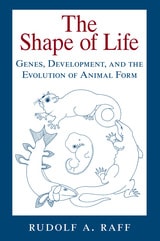
The Shape of Life
Genes, Development, and the Evolution of Animal FormRudolf A. Raff
University of Chicago Press, 1996
Raff uses the evolution of animal body plans to exemplify the interplay between developmental mechanisms and evolutionary patterns. Animal body plans emerged half a billion years ago. Evolution within these body plans during this span of time has resulted in the tremendous diversity of living animal forms.
Raff argues for an integrated approach to the study of the intertwined roles of development and evolution involving phylogenetic, comparative, and functional biology. This new synthesis will interest not only scientists working in these areas, but also paleontologists, zoologists, morphologists, molecular biologists, and geneticists.