Results by title
3 books match the query 'Geneticists'
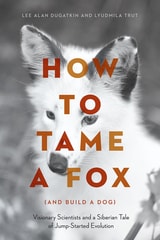
How to Tame a Fox (and Build a Dog)
Visionary Scientists and a Siberian Tale of Jump-Started EvolutionLee Alan Dugatkin and Lyudmila Trut
University of Chicago Press, 2017
Tucked away in Siberia, there are furry, four-legged creatures with wagging tails and floppy ears that are as docile and friendly as any lapdog. But, despite appearances, these are not dogs—they are foxes. They are the result of the most astonishing experiment in breeding ever undertaken—imagine speeding up thousands of years of evolution into a few decades. In 1959, biologists Dmitri Belyaev and Lyudmila Trut set out to do just that, by starting with a few dozen silver foxes from fox farms in the USSR and attempting to recreate the evolution of wolves into dogs in real time in order to witness the process of domestication. This is the extraordinary, untold story of this remarkable undertaking.
Most accounts of the natural evolution of wolves place it over a span of about 15,000 years, but within a decade, Belyaev and Trut’s fox breeding experiments had resulted in puppy-like foxes with floppy ears, piebald spots, and curly tails. Along with these physical changes came genetic and behavioral changes, as well. The foxes were bred using selection criteria for tameness, and with each generation, they became increasingly interested in human companionship. Trut has been there the whole time, and has been the lead scientist on this work since Belyaev’s death in 1985, and with Lee Dugatkin, biologist and science writer, she tells the story of the adventure, science, politics, and love behind it all. In How to Tame a Fox, Dugatkin and Trut take us inside this path-breaking experiment in the midst of the brutal winters of Siberia to reveal how scientific history is made and continues to be made today.
To date, fifty-six generations of foxes have been domesticated, and we continue to learn significant lessons from them about the genetic and behavioral evolution of domesticated animals. How to Tame a Fox offers an incredible tale of scientists at work, while also celebrating the deep attachments that have brought humans and animals together throughout time.
[more]
Misbehaving Science
Controversy and the Development of Behavior GeneticsAaron Panofsky
University of Chicago Press, 2014
Behavior genetics has always been a breeding ground for controversies. From the “criminal chromosome” to the “gay gene,” claims about the influence of genes like these have led to often vitriolic national debates about race, class, and inequality. Many behavior geneticists have encountered accusations of racism and have had their scientific authority and credibility questioned, ruining reputations, and threatening their access to coveted resources.
In Misbehaving Science, Aaron Panofsky traces the field of behavior genetics back to its origins in the 1950s, telling the story through close looks at five major controversies. In the process, Panofsky argues that persistent, ungovernable controversy in behavior genetics is due to the broken hierarchies within the field. All authority and scientific norms are questioned, while the absence of unanimously accepted methods and theories leaves a foundationless field, where disorder is ongoing. Critics charge behavior geneticists with political motivations; champions say they merely follow the data where they lead. But Panofsky shows how pragmatic coping with repeated controversies drives their scientific actions. Ironically, behavior geneticists’ struggles for scientific authority and efforts to deal with the threats to their legitimacy and autonomy have made controversy inevitable—and in some ways essential—to the study of behavior genetics.
In Misbehaving Science, Aaron Panofsky traces the field of behavior genetics back to its origins in the 1950s, telling the story through close looks at five major controversies. In the process, Panofsky argues that persistent, ungovernable controversy in behavior genetics is due to the broken hierarchies within the field. All authority and scientific norms are questioned, while the absence of unanimously accepted methods and theories leaves a foundationless field, where disorder is ongoing. Critics charge behavior geneticists with political motivations; champions say they merely follow the data where they lead. But Panofsky shows how pragmatic coping with repeated controversies drives their scientific actions. Ironically, behavior geneticists’ struggles for scientific authority and efforts to deal with the threats to their legitimacy and autonomy have made controversy inevitable—and in some ways essential—to the study of behavior genetics.
[more]

Sewall Wright and Evolutionary Biology
William B. Provine
University of Chicago Press, 1986
"Provine's thorough and thoroughly admirable examination of Wright's life and influence, which is accompanied by a very useful collection of Wright's papers on evolution, is the best we have for any recent figure in evolutionary biology."—Joe Felsenstein, Nature
"In Sewall Wright and Evolutionary Biology . . . Provine has produced an intellectual biography which serves to chart in considerable detail both the life and work of one man and the history of evolutionary theory in the middle half of this century. Provine is admirably suited to his task. . . . The resulting book is clearly a labour of love which will be of great interest to those who have a mature interest in the history of evolutionary theory."-John Durant, ;ITimes Higher Education Supplement;X
"In Sewall Wright and Evolutionary Biology . . . Provine has produced an intellectual biography which serves to chart in considerable detail both the life and work of one man and the history of evolutionary theory in the middle half of this century. Provine is admirably suited to his task. . . . The resulting book is clearly a labour of love which will be of great interest to those who have a mature interest in the history of evolutionary theory."-John Durant, ;ITimes Higher Education Supplement;X
[more]