Results by title
4 books match the query 'Genocide intervention'
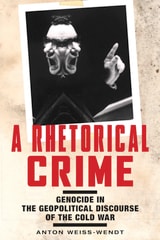
A Rhetorical Crime
Genocide in the Geopolitical Discourse of the Cold WarWeiss-Wendt, Anton
Rutgers University Press, 2018
The Genocide Convention was drafted by the United Nations in the late 1940s, as a response to the horrors of the Second World War. But was the Genocide Convention truly effective at achieving its humanitarian aims, or did it merely exacerbate the divisive rhetoric of Cold War geopolitics?
A Rhetorical Crime shows how genocide morphed from a legal concept into a political discourse used in propaganda battles between the United States and the Soviet Union. Over the course of the Cold War era, nearly eighty countries were accused of genocide, and yet there were few real-time interventions to stop the atrocities committed by genocidal regimes like the Cambodian Khmer Rouge.
Renowned genocide scholar Anton Weiss-Wendt employs a unique comparative approach, analyzing the statements of Soviet and American politicians, historians, and legal scholars in order to deduce why their moral posturing far exceeded their humanitarian action.
[more]
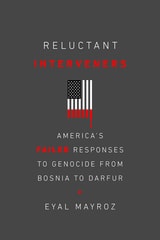
Reluctant Interveners
America's Failed Responses to Genocide from Bosnia to DarfurEyal Mayroz
Rutgers University Press, 2020
2020 Choice Outstanding Academic Title
Featured in the 2020 Association of University Presses Book, Jacket, and Journal Show
Why do we allow our governments to get away with “bystanding” to genocide? How can we, when alerted to the mass slaughter of innocents, still not take a stand? Reluctant Interveners provides the most comprehensive answers yet to these confronting questions, focusing on the complex relationships between the citizenry, the media, the political elites, and institutions in the most powerful nation in the world, the United States of America.
Eyal Mayroz offers a sobering account of the interactions between the governing and the governed, and the dynamics which transformed moral concerns for the lives of faraway “others” into cold political calculations. Exposed are the processes that turned the promise of “never again” to a recurring reality of ever again, the role of the office of the presidency in their advancement, and the resultant image of America as seen by the rest of the world. In a time of ubiquitous social media and populist revival, a greater role for the U.S. citizenry in decision-making on responses to genocide may be in the cards. The question is, in which directions will these trends take American foreign policy?
[more]
The Politics of Genocide
From the Genocide Convention to the Responsibility to ProtectJeffrey S. Bachman
Rutgers University Press, 2022
Beginning with the negotiations that concluded with the unanimous adoption of the United Nations Convention on the Prevention and Punishment of the Crime of Genocide on December 9, 1948, and extending to the present day, the United States, Soviet Union/Russia, China, United Kingdom, and France have put forth great effort to ensure that they will not be implicated in the crime of genocide. If this were to fail, they have also ensured that holding any of them accountable for genocide will be practically impossible. By situating genocide prevention in a system of territorial jurisdiction; by excluding protection for political groups and acts constituting cultural genocide from the Genocide Convention; by controlling when genocide is meaningfully named at the Security Council; and by pointing the responsibility to protect in directions away from any of the P-5, they have achieved what can only be described as practical impunity for genocide. The Politics of Genocide is the first book to explicitly demonstrate how the permanent member nations have exploited the Genocide Convention to isolate themselves from the reach of the law, marking them as "outlaw states."
[more]
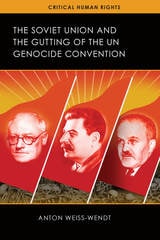
The Soviet Union and the Gutting of the UN Genocide Convention
Anton Weiss-Wendt
University of Wisconsin Press, 2017
After the staggering horrors of World War II and the Holocaust, the United Nations resolved to prevent and punish the crime of genocide throughout the world. The resulting UN Genocide Convention treaty, however, was drafted, contested, and weakened in the midst of Cold War tensions and ideological struggles between the Soviet Union and the West.
Based on extensive archival research, Anton Weiss-Wendt reveals in detail how the political aims of the superpowers rendered the convention a weak instrument for addressing abuses against human rights. The Kremlin viewed the genocide treaty as a political document and feared repercussions. What the Soviets wanted most was to keep the subjugation of Eastern Europe and the vast system of forced labor camps out of the genocide discourse. The American Bar Association and Senate Committee on Foreign Relations, in turn, worried that the Convention contained vague formulations that could be used against the United States, especially in relation to the plight of African Americans. Sidelined in the heated discussions, Weiss-Wendt shows, were humanitarian concerns for preventing future genocides.
Based on extensive archival research, Anton Weiss-Wendt reveals in detail how the political aims of the superpowers rendered the convention a weak instrument for addressing abuses against human rights. The Kremlin viewed the genocide treaty as a political document and feared repercussions. What the Soviets wanted most was to keep the subjugation of Eastern Europe and the vast system of forced labor camps out of the genocide discourse. The American Bar Association and Senate Committee on Foreign Relations, in turn, worried that the Convention contained vague formulations that could be used against the United States, especially in relation to the plight of African Americans. Sidelined in the heated discussions, Weiss-Wendt shows, were humanitarian concerns for preventing future genocides.
[more]