Results by title
4 books match the query 'Genome'
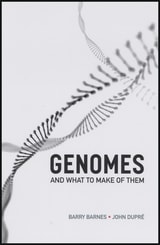
Genomes and What to Make of Them
Barry Barnes and John Dupré
University of Chicago Press, 2008
The announcement in 2003 that the Human Genome Project had completed its map of the entire human genome was heralded as a stunning scientific breakthrough: our first full picture of the basic building blocks of human life. Since then, boasts about the benefits—and warnings of the dangers—of genomics have remained front-page news, with everyone agreeing that genomics has the potential to radically alter life as we know it.
For the nonscientist, the claims and counterclaims are dizzying—what does it really mean to understand the genome? Barry Barnes and John Dupré offer an answer to that question and much more in Genomes and What to Make of Them, a clear and lively account of the genomic revolution and its promise. The book opens with a brief history of the science of genetics and genomics, from Mendel to Watson and Crick and all the way up to Craig Venter; from there the authors delve into the use of genomics in determining evolutionary paths—and what it can tell us, for example, about how far we really have come from our ape ancestors. Barnes and Dupré then consider both the power and risks of genetics, from the economic potential of plant genomes to overblown claims that certain human genes can be directly tied to such traits as intelligence or homosexuality. Ultimately, the authors argue, we are now living with a new knowledge as powerful in its way as nuclear physics, and the stark choices that face us—between biological warfare and gene therapy, a new eugenics or a new agricultural revolution—will demand the full engagement of both scientists and citizens.
Written in straightforward language but without denying the complexity of the issues, Genomes and What to Make of Them is both an up-to-date primer and a blueprint for the future.
[more]
Longevity, Senescence, and the Genome
Caleb E. Finch
University of Chicago Press, 1990
Featuring extensive references, updated for this paperback edition, Longevity, Senescence, and the Genome constitutes a landmark contribution to biomedicine and the evolutionary biology of aging.
To enhance gerontology's focus on human age-related dysfunctions, Caleb E. Finch provides a comparative review of all the phyla of organisms, broadening gerontology to intersect with behavioral, developmental, evolutionary, and molecular biology. By comparing species that have different developmental and life spans, Finch proposes an original typology of senescence from rapid to gradual to negligible, and he provides the first multiphyletic calculations of mortality rate constants.
To enhance gerontology's focus on human age-related dysfunctions, Caleb E. Finch provides a comparative review of all the phyla of organisms, broadening gerontology to intersect with behavioral, developmental, evolutionary, and molecular biology. By comparing species that have different developmental and life spans, Finch proposes an original typology of senescence from rapid to gradual to negligible, and he provides the first multiphyletic calculations of mortality rate constants.
[more]
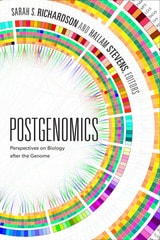
Postgenomics
Perspectives on Biology after the GenomeSarah S. Richardson and Hallam Stevens, editors
Duke University Press, 2015
Ten years after the Human Genome Project’s completion the life sciences stand in a moment of uncertainty, transition, and contestation. The postgenomic era has seen rapid shifts in research methodology, funding, scientific labor, and disciplinary structures. Postgenomics is transforming our understanding of disease and health, our environment, and the categories of race, class, and gender. At the same time, the gene retains its centrality and power in biological and popular discourse. The contributors to Postgenomics analyze these ruptures and continuities and place them in historical, social, and political context. Postgenomics, they argue, forces a rethinking of the genome itself, and opens new territory for conversations between the social sciences, humanities, and life sciences.
Contributors. Russ Altman, Rachel A. Ankeny, Catherine Bliss, John Dupré, Michael Fortun, Evelyn Fox Keller, Sabina Leonelli, Adrian Mackenzie, Margot Moinester, Aaron Panofsky, Sarah S. Richardson, Sara Shostak, Hallam Stevens
Contributors. Russ Altman, Rachel A. Ankeny, Catherine Bliss, John Dupré, Michael Fortun, Evelyn Fox Keller, Sabina Leonelli, Adrian Mackenzie, Margot Moinester, Aaron Panofsky, Sarah S. Richardson, Sara Shostak, Hallam Stevens
[more]
The Postgenomic Condition
Ethics, Justice, and Knowledge after the GenomeJenny Reardon
University of Chicago Press, 2017
Now that we have sequenced the human genome, what does it mean? In The Postgenomic Condition, Jenny Reardon critically examines the decade after the Human Genome Project, and the fundamental questions about meaning, value and justice this landmark achievement left in its wake.
Drawing on more than a decade of research—in molecular biology labs, commercial startups, governmental agencies, and civic spaces—Reardon demonstrates how the extensive efforts to transform genomics from high tech informatics practiced by a few to meaningful knowledge beneficial to all exposed the limits of long-cherished liberal modes of knowing and governing life. Those in the American South challenged the value of being included in genomics when no hospital served their community. Ethicists and lawyers charged with overseeing Scottish DNA and data questioned how to develop a system of ownership for these resources when their capacity to create things of value—new personalized treatments—remained largely unrealized. Molecular biologists who pioneered genomics asked whether their practices of thinking could survive the deluge of data produced by the growing power of sequencing machines. While the media is filled with grand visions of precision medicine, The Postgenomic Condition shares these actual challenges of the scientists, entrepreneurs, policy makers, bioethicists, lawyers, and patient advocates who sought to leverage liberal democratic practices to render genomic data a new source of meaning and value for interpreting and caring for life. It brings into rich empirical focus the resulting hard on-the-ground questions about how to know and live on a depleted but data-rich, interconnected yet fractured planet, where technoscience garners significant resources, but deeper questions of knowledge and justice urgently demand attention.
Drawing on more than a decade of research—in molecular biology labs, commercial startups, governmental agencies, and civic spaces—Reardon demonstrates how the extensive efforts to transform genomics from high tech informatics practiced by a few to meaningful knowledge beneficial to all exposed the limits of long-cherished liberal modes of knowing and governing life. Those in the American South challenged the value of being included in genomics when no hospital served their community. Ethicists and lawyers charged with overseeing Scottish DNA and data questioned how to develop a system of ownership for these resources when their capacity to create things of value—new personalized treatments—remained largely unrealized. Molecular biologists who pioneered genomics asked whether their practices of thinking could survive the deluge of data produced by the growing power of sequencing machines. While the media is filled with grand visions of precision medicine, The Postgenomic Condition shares these actual challenges of the scientists, entrepreneurs, policy makers, bioethicists, lawyers, and patient advocates who sought to leverage liberal democratic practices to render genomic data a new source of meaning and value for interpreting and caring for life. It brings into rich empirical focus the resulting hard on-the-ground questions about how to know and live on a depleted but data-rich, interconnected yet fractured planet, where technoscience garners significant resources, but deeper questions of knowledge and justice urgently demand attention.
[more]