Results by title
5 books match the query 'Geography, Medieval'
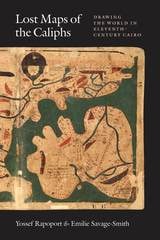
Lost Maps of the Caliphs
Drawing the World in Eleventh-Century CairoYossef Rapoport and Emilie Savage-Smith
University of Chicago Press, 2018
Lost Maps of the Caliphs provides the first general overview of The Book of Curiosities and the unique insight it offers into medieval Islamic thought. Opening with an account of the remarkable discovery of the manuscript and its purchase by the Bodleian Library, the authors use The Book of Curiosities to re-evaluate the development of astrology, geography, and cartography in the first four centuries of Islam. Their account assesses the transmission of Late Antique geography to the Islamic world, unearths the logic behind abstract maritime diagrams, and considers the palaces and walls that dominate medieval Islamic plans of towns and ports. Early astronomical maps and drawings demonstrate the medieval understanding of the structure of the cosmos and illustrate the pervasive assumption that almost any visible celestial event had an effect upon life on Earth. Lost Maps of the Caliphs also reconsiders the history of global communication networks at the turn of the previous millennium. It shows the Fatimid Empire, and its capital Cairo, as a global maritime power, with tentacles spanning from the eastern Mediterranean to the Indus Valley and the East African coast.
As Lost Maps of the Caliphs makes clear, not only is The Book of Curiosities one of the greatest achievements of medieval mapmaking, it is also a remarkable contribution to the story of Islamic civilization that opens an unexpected window to the medieval Islamic view of the world.
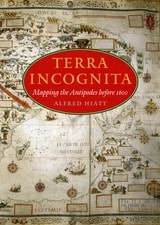
Terra Incognita
Mapping the Antipodes before 1600Alfred Hiatt
University of Chicago Press, 2008
In Terra Incognita, Alfred Hiatt draws on sources both literary and visual to understand the appeal of the antipodes. Examining maps and diagrams, as well as evidence contained in geographical and historical works, poetry, travel narratives, and legal documents, he challenges long-standing characterizations of medieval spatiality as exclusively symbolic and religious. Instead, Hiatt finds, the idea of people on the other side of the Earth provided a potent and malleable symbol for political theorists, satirists, scholars, and poets—as well as for map makers. Terra Incognita is, in the end, the history of a non-place, of lands conjured by the scientific imagination, which nevertheless drove exploration, and which continued to shape the world map, even as they slowly vanished from it.
The Birth of Territory
Stuart Elden
University of Chicago Press, 2013
The Earth Is Our Book
Geographical Knowledge in the Latin West ca. 400-1000Natalia Lozovsky
University of Michigan Press, 2000
Tackling an impressive array of primary and secondary sources--including a variety of late antique and early medieval texts--Lozovsky examines early medieval geography as it existed in other fields of learning: theology, history, and natural science. She expounds on the use of published resources by examining the nature of geographical knowledge in the Middle Ages. She draws on unpublished sources--such as school commentaries--for the rich information they provide about geographical education during that period. For many scholars of medieval studies, early medieval geographical texts have more philological than geographical value. Lozovsky's work provides an insightful, alternative interpretation.
Those interested in history, medieval studies, ethnography, science, education, religion, Latin studies, and, of course, geography, will find this book a most fascinating read.
Natalia Lozovsky is an instructor in the Department of History, University of Colorado, Boulder.
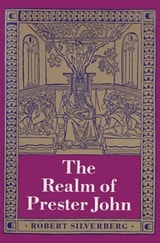
The Realm Of Prester John
Robert Silverberg
Ohio University Press, 1996
In this modern account of the genesis of a great medieval myth, celebrated science fiction author Robert Silverberg’s explores the mysterious origins of Prester John, the astonishing Christian potentate of the East.
Prester John was a legendary figure who cast a powerful spell over Latin Christendom for almost five centuries. Rumors of the warrior-king-prelate’s fabulous realms first reached Europe in the eleventh century and quickly assumed an exalted status alongside such fabled wonders as El Dorado, The Fountain of Youth, and the Holy Grail.
The defeat of a Moslem Turkish tribe by a Buddhist Chinese warlord seems to have been the unlikely historical nugget around which the Prester John myth grew, but contributions to this strange saga have also been traced all around the globe to the Apostle Thomas' apocryphal preaching in India, to the actual existence of small colonies of Nestorian schismatics in central Asia, and even to Genghis Khan.