Results by title

7 books match the query 'Geophysics'
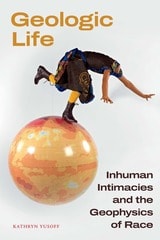
cover of Geologic Life: Inhuman Intimacies and the Geophysics of Race

Geologic Life

Inhuman Intimacies and the Geophysics of Race

Kathryn Yusoff

Duke University Press, 2024
In Geologic Life, Kathryn Yusoff theorizes the processes by which race and racialization emerged geologically. Examining both the history of geology as a discipline and ongoing mineral and resource extraction, Yusoff locates forms of imperial geology embedded in Western and Enlightenment thought and highlights how it creates anti-Black, anti-Indigenous, and anti-Brown environmental and racial injustices. Throughout, she outlines how the disciplines of geology and geography—and their conventions: surveying, identifying, classifying, valuing, and extracting—established and perpetuated colonial practices that ordered the world and people along a racial axis. Examining the conceptualization of the inhuman as political, geophysical, and paleontological, Yusoff unearths an apartheid of materiality as distinct geospatial forms. This colonial practice of geology organized and underpinned racialized accounts of space and time in ways that materially made Anthropocene Earth. At the same time, Yusoff turns to Caribbean, Indigenous, and Black thought to chart a parallel geologic epistemology of the "earth-bound" that challenges what and who the humanities have chosen to overlook in its stories of the earth. By reconsidering the material epistemologies of the earth as an on-going geotrauma in colonial afterlives, Yusoff demonstrates that race is as much a geological formation as a biological one.
[more]
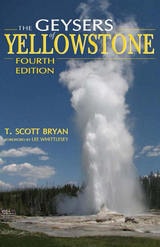
cover of Geysers of Yellowstone, Fourth Edition

Geysers of Yellowstone, Fourth Edition

T. Scott Bryan

University Press of Colorado, 2008
This revised popular field guide describes in detail each of the more than 500 geysers in Yellowstone National Park. With updated information and a new foreword by park archivist Lee Whittlesey, Geysers of Yellowstone is both a reference work and a fine introduction to the nature of geyser activity for the newcomer to geothermal phenomena. A glossary of key terms is provided, along with a comprehensive appendix that discusses other geyser areas of the world. Detailed maps accompany each geyser basin described, and tables are provided for easy reference.
[more]
cover of Probing the Sky with Radio Waves: From Wireless Technology to the Development of Atmospheric Science

Probing the Sky with Radio Waves

From Wireless Technology to the Development of Atmospheric Science

Chen-Pang Yeang

University of Chicago Press, 2013

By the late nineteenth century, engineers and experimental scientists generally knew how radio waves behaved, and by 1901 scientists were able to manipulate them to transmit messages across long distances. What no one could understand, however, was why radio waves followed the curvature of the Earth. Theorists puzzled over this for nearly twenty years before physicists confirmed the zig-zag theory, a solution that led to the discovery of a layer in the Earth’s upper atmosphere that bounces radio waves earthward—the ionosphere.
 
In Probing the Sky with Radio Waves, Chen-Pang Yeang documents this monumental discovery and the advances in radio ionospheric propagation research that occurred in its aftermath. Yeang illustrates how the discovery of the ionosphere transformed atmospheric science from what had been primarily an observational endeavor into an experimental science. It also gave researchers a host of new theories, experiments, and instruments with which to better understand the atmosphere’s constitution, the origin of atmospheric electricity, and how the sun and geomagnetism shape the Earth’s atmosphere.  
 
This book will be warmly welcomed by scholars of astronomy, atmospheric science, geoscience, military and institutional history, and the history and philosophy of science and technology, as well as by radio amateurs and electrical engineers interested in historical perspectives on their craft.

[more]
cover of The Potentials About a Point Electrode and Apparent Resistivity Curves for a Two-, Three-, and Four-Layer Earth

The Potentials About a Point Electrode and Apparent Resistivity Curves for a Two-, Three-, and Four-Layer Earth

Harold M. Mooney and W. W. Wetzel

University of Minnesota Press, 1956

The Potentials About a Point Electrode and Apparent Resistivity Curves for a Two-, Three-, and Four-Layer Earth was first published in 1956. Minnesota Archive Editions uses digital technology to make long-unavailable books once again accessible, and are published unaltered from the original University of Minnesota Press editions.

This publication will be useful to geophysicists, geologists, and others engaged in exploration for minerals by electrical methods, and may be used in theoretical studies of electrical prospecting. It makes available for the first time a comprehensive collection of 2268 master resistivity curves for a two-, three-, and four-layer earth. All previous collections of curves for Wenner electrode configuration are included, so the user will not need to refer elsewhere to complete his set of working curves. In addition, the basic potential data used in computing the curves is given in tables. Auxiliary tables are provided to reduce the graphic integration procedures to simple arithmetic. The integral in question occurs widely in solutions to Laplace's equation.
[more]
cover of The Sun in Time

The Sun in Time

Edited by C. P. Sonett, M. S. Giampapa, and M. S. Matthews

University of Arizona Press, 1991
An interdisciplinary approach to solar physics, as eighty-nine contributors trace the evolution of the Sun and provide a review of our current understanding of both its structure and its role in the origin and evolution of the solar system.
[more]
cover of Things Maps Don't Tell Us: An Adventure into Map Interpretation

Things Maps Don't Tell Us

An Adventure into Map Interpretation

Armin K. Lobeck

University of Chicago Press, 1993

An accessible, richly illustrated introduction to understanding and interpreting maps
 

A master cartographer and teacher, Armin Lobeck provides a clear, accessible guide to discerning the geological history of an area through an understanding of the lines of rivers, mountains, and coasts found on maps. He presents commonplace physical features that map users normally take for granted as a collection of cartographic detective stories. After pointing out patterns that call for solutions, Lobeck assembles clues and leads his readers through thoughtful, carefully crafted explanations, to show how to grasp the history of the earth through the art of map reading.
[more]
cover of Unearthing Fermi's Geophysics

Unearthing Fermi's Geophysics

Gino C. Segrè and John D. Stack

University of Chicago Press, 2022

Follow Nobel laureate and legendary teacher Enrico Fermi’s lost course on geophysics.

Nobel Prize–winning physicist Enrico Fermi (1901–54) is known for his work on experimental particle and nuclear physics, quantum theory, and statistical mechanics, and for his particular ability to condense complicated problems into approximations for understanding and testing theory in a variety of scientific disciplines. Six of his graduate students went on to win their own Nobel Prizes.

Unearthing Fermi’s Geophysics opens a window onto two underrepresented facets of this extraordinary thinker: Fermi’s teaching and his contribution to the field of geophysics. Drawing on Fermi’s handwritten calculations and notes, many of which are reproduced here in photographic facsimile, physicists Gino Segrè and John Stack have reconstructed a coursebook of Fermi’s insights into the physics of a range of geological and atmospheric phenomena. From gravity on Earth to thermodynamics in the atmosphere, the physics of raindrops, the Coriolis effect in hurricanes, tidal physics, earthquakes and seismic waves, Earth’s magnetism, atmospheric electricity, and much more, Unearthing Fermi’s Geophysics reveals the hidden workings of the world above, around, and below us—and of the mind of a great scientist who was able to bring those physical workings to light.
[more]