Results by title
9 books match the query 'German Idealism'
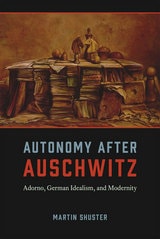
Autonomy After Auschwitz
Adorno, German Idealism, and ModernityMartin Shuster
University of Chicago Press, 2014
Shuster uncovers dangers in the notion of autonomy as it was originally conceived by Kant. Putting Adorno into dialogue with a range of European philosophers, notably Kant, Hegel, Horkheimer, and Habermas—as well as with a variety of contemporary Anglo-American thinkers such as Richard Rorty, Stanley Cavell, John McDowell, and Robert Pippin—he illuminates Adorno’s important revisions to this fraught concept and how his different understanding of autonomous agency, fully articulated, might open up new and positive social and political possibilities. Altogether, Autonomy after Auschwitz is a meditation on modern evil and human agency, one that demonstrates the tremendous ethical stakes at the heart of philosophy.
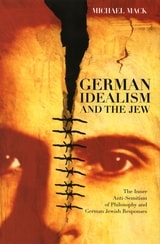
German Idealism and the Jew
The Inner Anti-Semitism of Philosophy and German Jewish ResponsesMichael Mack
University of Chicago Press, 2003
Offering the first analytical account of the connection between anti-Semitism and philosophy, Mack begins his exploration by showing how the fundamental thinkers in the German idealist tradition—Kant, Hegel, and, through them, Feuerbach and Wagner—argued that the human world should perform and enact the promises held out by a conception of an otherworldly heaven. But their respective philosophies all ran aground on the belief that the worldly proved incapable of transforming itself into this otherworldly ideal. To reconcile this incommensurability, Mack argues, philosophers created a construction of Jews as symbolic of the "worldliness" that hindered the development of a body politic and that served as a foil to Kantian autonomy and rationality.
In the second part, Mack examines how Moses Mendelssohn, Heinrich Heine, Franz Rosenzweig, and Freud, among others, grappled with being both German and Jewish. Each thinker accepted the philosophies of Kant and Hegel, in varying degrees, while simultaneously critiquing anti-Semitism in order to develop the modern Jewish notion of what it meant to be enlightened—a concept that differed substantially from that of Kant, Hegel, Feuerbach, and Wagner. By speaking the unspoken in German philosophy, this book profoundly reshapes our understanding of it.
German Idealism as Constructivism
Tom Rockmore
University of Chicago Press, 2016
Since ancient Greece philosophers have tried to know the world in itself, an effort that Kant believed had failed. His alternative strategy—which came to be known as the Copernican revolution—was that the world as we experience and know it depends on the mind. Rockmore shows that this project was central to Kant’s critical philosophy and the later German idealists who would follow him. He traces the different ways philosophers like Fichte, Schelling, and Hegel formulated their own versions of constructivism. Offering a sweeping but deeply attuned analysis of a crucial part of the legacy of German idealism, Rockmore reinvigorates this school of philosophy and opens up promising new avenues for its study.
German Idealism
An Anthology and GuideEdited by Brian O'Connor and Georg Mohr
University of Chicago Press, 2007
Beginning with the publication of Kant’s Critique of Pure Reason and extending through to Hegel’s death, the period known as German Idealism signaled the end of an epoch of rationalism, empiricism, and enlightenment—and the beginning of a new “critical” period of philosophy. The most comprehensive anthology of this vital tradition to date, German Idealism brings together an expansive selection of readings from the tradition’s major figures like Kant, Hegel, Fichte, and Schelling.
Arranged thematically into sections on topics such as the relationships between self and knowledge, freedom and morality, law and state, and nature and science, to name a few, German Idealism discloses many of the contrasts that helped to differentiate each of the tradition’s key thinkers. Each expertly translated text comes with an editorial introduction to guide readers through many of the problems the texts specifically deal with, as well as their historical context.
The most accessible and expansive introduction to German Idealism ever, this anthology will be hailed by instructors and scholars as the most dependable guide to the tradition for years to come.
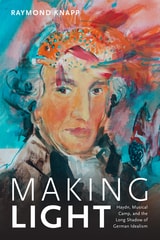
Making Light
Haydn, Musical Camp, and the Long Shadow of German IdealismRaymond Knapp
Duke University Press, 2018

Ontological Catastrophe
Zizek and the Paradoxical Metaphysics of German IdealismJoseph Carew
Michigan Publishing Services, 2014
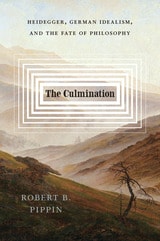
The Culmination
Heidegger, German Idealism, and the Fate of PhilosophyRobert B. Pippin
University of Chicago Press, 2024
Heidegger claimed that Western philosophy ended—failed, even—in the German Idealist tradition. In The Culmination, Robert B. Pippin explores the ramifications of this charge through a masterful survey of Western philosophy, especially Heidegger’s critiques of Hegel and Kant. Pippin argues that Heidegger’s basic concern was to determine sources of meaning for human life, particularly those that had been obscured by Western philosophy’s attention to reason. The Culmination offers a new interpretation of Heidegger, German Idealism, and the fate of Western rationalism.
The Emergence of German Idealism
Michael Baur
Catholic University of America Press, 2018
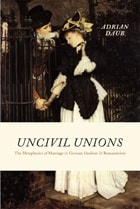
Uncivil Unions
The Metaphysics of Marriage in German Idealism and RomanticismAdrian Daub
University of Chicago Press, 2012
“What a strange invention marriage is!” wrote Kierkegaard. “Is it the expression of that inexplicable erotic sentiment, that concordant elective affinity of souls, or is it a duty or a partnership . . . or is it a little of all that?”
Like Kierkegaard a few decades later, many of Germany’s most influential thinkers at the turn of the eighteenth century wondered about the nature of marriage but rejected the easy answers provided by biology and theology. In Uncivil Unions, Adrian Daub presents a truly interdisciplinary look at the story of a generation of philosophers, poets, and intellectuals who turned away from theology, reason, common sense, and empirical observation to provide a purely metaphysical justification of marriage.
Through close readings of philosophers like Fichte and Schlegel, and novelists like Sophie Mereau and Jean Paul, Daub charts the development of this new concept of marriage with an insightful blend of philosophy, cultural studies, and theory. The author delves deeply into the lives and work of the romantic and idealist poets and thinkers whose beliefs about marriage continue to shape ideas about gender, marriage, and sex to the present day.