Results by title
11 books match the query 'German language'
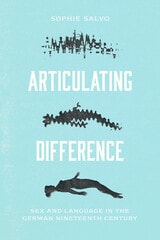
Articulating Difference
Sex and Language in the German Nineteenth CenturySophie Salvo
University of Chicago Press, 2024
Drawing on a wide range of texts, from understudied ethnographic and scientific works to canonical literature and philosophy, Sophie Salvo uncovers the prehistory of the inextricability of gender and language. Taking German discourses on language as her focus, she argues that we are not the inventors but, rather, the inheritors and adapters of the notion that gender and language are interrelated. Particularly during the long nineteenth century, ideas about sexual differences shaped how language was understood, classified, and analyzed. As Salvo explains, philosophers asserted the patriarchal origins of language, linguists investigated “women’s languages” and grammatical gender, and literary Modernists imagined “feminine” sign systems, and in doing so they not only deemed sex-based divisions to be necessary categories of language but also produced a plethora of gendered tropes and fictions, which they used both to support their claims and delimit their disciplines.
Articulating Difference charts new territory, revealing how gendered conceptions of language make possible the misogynistic logic of exclusion that underlies arguments claiming, for example, that women cannot be great orators or writers. While Salvo focuses on how male scholars aligned language study with masculinity, she also uncovers how women responded, highlighting the contributions of understudied nineteenth-century works on language that women wrote even as they were excluded from academic opportunities.
Constraint-Based Approaches to Germanic Syntax
Edited by W. Detmar Meurers and Tibor Kiss
CSLI, 2001
This volume begins with an introduction to the recent research performed on Germanic syntax using constraint-based frameworks. It then goes on to investigate the linguistic phenomena found in the grammar of the German and Danish languages. Using such approaches as Lexical-Functional Grammar and Head-Driven Phrase Structure Grammar, contributors shed a different light on theoretical issues addressed by past studies, including semi-free word order, partial front phenomena, and complex predicate formation. While alternative approaches have assumed that meaning (semantics) is dependent on form (syntax), various analyses presented in this volume explore the idea that both form and meaning are equally constitutive for grammatical descriptions.
Discontinuous NPs in German
A Case Study of the Interaction of Syntax, Semantics, and PragmaticsKordula De Kuthy
CSLI, 2002
Elements of German
Phonology and MorphologyElmer H. Antonsen
University of Alabama Press, 2007
Elements of German fills a gap in advanced undergraduate and beginning graduate levels of German language study by presenting more advanced concepts of the language in a light intended for practical use rather than theoretical discourse. This text provides a means to improve knowledge and command of grammatically correct German as it is spoken and written. It also introduces methods and tools of linguistic analysis in the areas of phonology and morphology. Unlike books that treat phonology in a cursory way, this text delves into the problems of word formation and the intricacies of inflection and derivation. Exercises are included throughout to help better absorb the rules for real-world language use. This volume provides an in-depth look at the German language from the ground up. Its detailed approach makes this book an excellent complement to the work of less specific grammar textbooks and reviews.
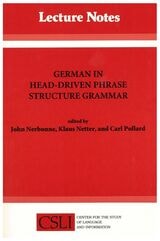
German in Head-Driven Phrase Structure Grammar
Edited by John Nerbonne, Carl Pollard, and Klaus Netter
CSLI, 1993
The theoretical background for these essays can be found in Information-Based Syntax and Semantics and Head-Driven Phrase Structure Grammar, both by Pollard and Sag and both available from the University of Chicago Press.
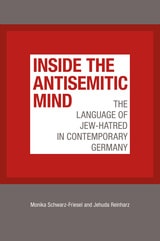
Inside the Antisemitic Mind
The Language of Jew-Hatred in Contemporary GermanyMonika Schwarz-Friesel and Jehuda Reinharz
Brandeis University Press, 2017
Jargon of Authenticity
Theodor W. Adorno
Northwestern University Press, 1973
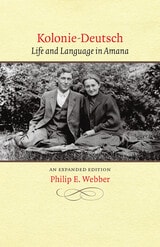
Kolonie-Deutsch
Life and Language in Amana, An Expanded EditionPhilip E. Webber
University of Iowa Press, 1993
Founded as a communal society in 1855 by German Pietists, the seven villages of Iowa’s Amana Colonies make up a community whose crafts, architecture, and institutions reflect—and to an extent perpetuate—the German heritage of earlier residents. In this intriguing blend of sociolinguistic research and stories from Colonists both past and present, Philip Webber examines the rich cultural and linguistic traditions of the Amanas.
Although the Colonies are open to the outside world, particularly after the Great Change of 1932, many distinctive vestiges of earlier lifeways survive, including the local variety of German known by its speakers as Kolonie-Deutsch. Drawing upon interviews with more than fifty Amana-German speakers in 1989 and 1990, Webber explores the nuances of this home-grown German, signaling the development of local microdialects, the changing pattern in the use of German in the Colonies, and the reciprocal influence of English and German on residents’ speech. By letting his sources tell their own stories of earlier days, in which the common message seems to be wir haben fun gehabt or “we had fun working together,” he illuminates the history and unique qualities of each Colony through the prism of language study.
Webber’s introduction to this paperback edition provides an up-to-date itinerary for visitors to the Colonies, information about recent publications on Amana history and culture, and an overview of expanded research opportunities for language study and historical inquiry. The result is an informative and engaging study that will be appreciated by linguists, anthropologists, and historians as well as by general readers interested in these historic villages.
On Particle Verbs and Similar Constructions in German
Anke Lüdeling
CSLI, 2001
Particle verbs have previously been analyzed as morphological objects or as phrasal constructions, but neither approach fits cleanly within its chosen framework. The resolution presented here is that particle verbs should be seen as lexicalized phrasal constructions. Emphasizing morphological and syntactic testability, over a hundred colloquial examples are shown to break the rules of previous approaches while remaining consistent with this book's proposition. To distinguish particle verbs from similar constructions, and to demonstrate how structural and morphological factors have been misidentified in the past, preverb verb constructions (PVCs) are introduced and diagrammed. This reveals the roles of listedness and non-transparency in word formation and clarifies the conclusion that particle verbs do not form a definable class of words.

The Theory of German Word Order from the Renaissance to the Present
Aldo Scaglione
University of Minnesota Press, 1981
The Theory of German Word Order from the Renaissance to the Present was first published in 1981. Minnesota Archive Editions uses digital technology to make long unavailable books once again accessible, and are published unaltered from the original University of Minnesota Press editions.
The uniquely systematic character of German word order and sentence structure has long been recognized as an important feature of the language and of its literary uses. This book is the first comprehensive survey of the way theorists and stylists have interpreted these features through the centuries. Aldo Scaglione contends that the story of this theoretical awareness is part of the emerging cultural and literary consciousness of the German nation, as well as a testing ground for contemporary linguistic typology.
German speculation on the nature of a national language is, to Scaglione, best understood as a dialogue with the prevailing models of Latin, Italian, French, and English. His account of the debates over German word order is thus grounded in the complex historical circumstances from which they emerge: Renaissance grammarians took stock of German divergencies from the Latin cultural model, and those in the seventeenth century faced the challenges of French rationalism, nineteenth-century Romanticism and the many linguistic movements of the twentieth century have all cast new light upon the peculiarities of German sentence structure. Readers interested in historical syntax, rhetorical traditions, and the history of the German language will value both Scaglione's wide-ranging knowledge and his lively style.
Word Order and Constituent Structure in German
Hans Uszkoreit
CSLI, 1987