Results by title
4 books match the query 'Germino, Dante'
Machiavelli to Marx
Modern Western Political ThoughtDante Germino
University of Chicago Press, 1979
Order and History, Volume 3 (CW16)
Plato and AristotleEric Voegelin. Edited & Intro by Dante Germino
University of Missouri Press, 2000
This third volume of Order and History completes Voegelin's study of Greek culture from its earliest pre- Hellenic origins to its full maturity with the dominance of Athens. As the title suggests, Plato and Aristotle is principally devoted to the work of the two great thinkers who represent the high point of philosophic inquiry among the Greeks.
Through an absorbing analysis of the Platonic and Aristotelian vision of soul, polis, and cosmos, Voegelin demonstrates how the symbolic framework of the older myth was superseded by the more precisely differentiated symbols of philosophy. Although this outmoding and rejection of past symbols of truth might seem to lead to a chaotic and despairing relativism, Voegelin makes it the basis of a profound conception of the historical process: "the attempts to find the symbolic forms that will adequately express the meaning [of a society], while imperfect, do not form a senseless series of failures. For the great societies have created a sequence of orders, intelligibly connected with one another as advances toward, or recessions from, an adequate symbolization of the truth concerning the order of being of which the order of society is a part."
In this view, history has no obvious "meaning," yet each society makes a similar venture after truth. Although every society works out its destiny under different conditions, each nonetheless creates symbols"in its deeds and institutions"which bear the meaning of its own existence. History, then, acquires a unity in the common endeavor toward meaning and order. The rationality and nobility of this view of history has much to say to the present age.
Dante Germino's powerful introduction to this edition of Plato and Aristotle eloquently directs the reader into Voegelin's search through the thought of Plato foremost and Aristotle secondarily and toward a full understanding of their relevance to the "modern" world. This masterpiece, Germino argues, provides a welcome antidote to the spirit of an era Voegelin once called the Gnostic age.
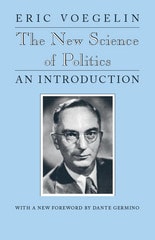
The New Science of Politics
An IntroductionEric Voegelin
University of Chicago Press, 1987
What Eric Voegelin attempts in The New Science of Politics is nothing less ambitious than a complete theory of humanity, society, and history. To build his theory, Voegelin draws on a breathtaking range of subjects from throughout history, including the Mongol Orders of Submission, the Behistun Inscription, and a controversy over an alter to the goddess Victoria in the Roman Forum. Addressing the access to truth afforded by myth, revelation, and philosophy, Voegelin then carefully contrasts each with gnosticism. The resulting book is a heady exploration of the development of European politics through the Western tradition and the ongoing importance of the inner quest for transcendent reality. =
The New Science of Politics
An IntroductionEric Voegelin
University of Chicago Press, 1987
"Thirty-five years ago few could have predicted that The New Science of Politics would be a best-seller by political theory standards. Compressed within the Draconian economy of the six Walgreen lectures is a complete theory of man, society, and history, presented at the most profound and intellectual level. . . . Voegelin's [work] stands out in bold relief from much of what has passed under the name of political science in recent decades. . . . The New Science is aptly titled, for Voegelin makes clear at the outset that a 'return to the specific content' of premodern political theory is out of the question. . . . The subtitle of the book, An Introduction, clearly indicates that The New Science of Politics is an invitation to join the search for the recovery of our full humanity."—From the new Foreword by Dante Germino
"This book must be considered one of the most enlightening essays on the character of European politics that has appeared in half a century. . . . This is a book powerful and vivid enough to make agreement or disagreement with even its main thesis relatively unimportant."—Times Literary Supplement
"Voegelin . . . is one of the most distinguished interpreters to Americans of the non-liberal streams of European thought. . . . He brings a remarkable breadth of knowledge, and a historical imagination that ranges frequently into brilliant insights and generalizations."—Francis G. Wilson, American Political Science Review
"This book is beautifully constructed . . . his erudition constantly brings a startling illumination."—Martin Wright, International Affairs
"A ledestar to thinking men who seek a restoration of political science on the classic and Christian basis . . . a significant accomplishment in the retheorization of our age."—Anthony Harrigan, Christian Century