Results by title
5 books match the query 'Gertrude Stein'
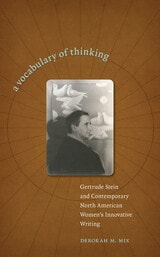
A Vocabulary of Thinking
Gertrude Stein and Contemporary North American Women's Innnovative WritingDeborah M. Mix
University of Iowa Press, 2007
Arguing that these authors have received relatively little attention because of the difficulty in categorizing them, Mix brings the writing of women of color, lesbians, and collaborative writers into the discussion of experimental writing. Thus, rather than exploring conventional lines of influence, she departs from earlier scholarship by using Stein and her work as a lens through which to read the ways these authors have renegotiated tradition, authority, and innovation.
Building on the tradition of experimental or avant-garde writing in the United States, Mix questions the politics of the canon and literary influence, offers close readings of previously neglected contemporary writers whose work doesn't fit within conventional categories, and by linking genres not typically associated with experimentalism-lyric, epic, and autobiography-challenges ongoing reevaluations of innovative writing.
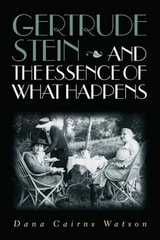
Gertrude Stein and the Essence of What Happens
Dana Cairns Watson
Vanderbilt University Press, 2005
Seeking to sustain Stein's lively, pleasant, populist spirit, Watson shows how the writer's playful entanglement of sight and sound--of silent reading and social speaking--reveals the crucial ambiguity by which reading and conversation build communities of meaning, and thus form not only personal relationships but also our very selves and the larger political structures we inhabit. Stein reminds us that the residual properties of words and the implications behind the give-and-take of ordinary conversation offer alternatives to linear structures of social order, alternatives especially precious in times of political oppression. For example, her novels Mrs. Reynolds and Brewsie and Willie, both written in embattled Vichy France, contemplate the speech patterns of totalitarian leaders and the ways in which everyday discourse might capitulate to--or resist--such verbal tyranny.
Like recent theorists, Stein recognized the repressiveness of conventional order--carried in language and thus in thought and social organization--but as Watson persuasively shows, she also insisted that the free will of individuals can persist in language and enable change. In the play of literary aesthetics, Stein saw a liberating force.
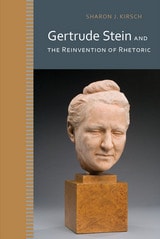
Gertrude Stein and the Reinvention of Rhetoric
Sharon J. Kirsch
University of Alabama Press, 2014
For humanities scholars as well as popular audiences, the relationship between rhetoric and literature remains vexed, in part due to rhetoric’s contemporary affiliation with composition, which makes it separate from, if not subordinate to, the study of literature. Gertrude Stein recognized no such separation, and this disciplinary policing of the study of English has diminished our understanding of her work, Kirsch argues. Stein’s career unfolded at the crossroads of literary composition and rhetorical theory, a site where she alternately challenged, satirized, and reinvented the five classical canons of rhetoric—invention, arrangement, style, memory, and delivery—even as she invented new trajectories of literary experimentation.
Kirsch follows Stein from her days studying composition and philosophy at Harvard through her expatriate years in France, fame in the 1930s, and experience of the Second World War. She frames Stein’s explorations of language as an inventive poetics that reconceived practices and theories of rhetorical invention during a period that saw the rise of literary studies and the decline of rhetorical studies. Through careful readings of canonical and lesser-known works, Kirsch offers a convincing critical portrait of Stein as a Sophistic provocateur who reinvented the canons by making a productive mess of canonical rhetoric and modernist categories of thought.
Readers will find much of interest in Gertrude Stein and the Reinvention of Rhetoric. Kirsch offers myriad insights to scholars of Stein, to those interested in the interdisciplinary intersections of literature, rhetoric, and philosophy, as well as to scholars and students in the field of rhetoric and communication studies. Positioning Stein as a major twentieth-century rhetorical theorist is particularly timely given increasing interest in historical and theoretical resonances between rhetoric and poetics and given the continued lack of recognition for women theorists in rhetorical studies.
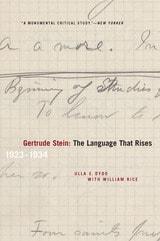
Gertrude Stein
The Language That Rises: 1923-1934Ulla E. Dydo
Northwestern University Press, 2008
The first extensive examination of Stein's notebooks, manuscripts and letters, prepared over a period of twenty years, Gertrude Stein: The Language That Rises asks new questions and explores new ways of reading Stein. This definitive study give us a finely detailed, deeply felt understanding of Stein, the great modernist, throughout one of her most productive periods. From "An Elucidation" in 1923 to Lectures In America in 1934, Ulla E. Dydo examines the process of the making and remaking of Stein's texts as they move from notepad to notebook to manuscript, from an idea to the ultimate refinement of the author's intentions. The result is an unprecedented view of the development of Stein's work, word by word, text by text, and over time.
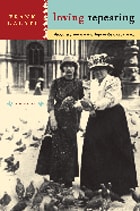
Loving Repeating
A Musical Adapted from the Writings of Gertrude SteinFrank Galati
Northwestern University Press, 2009